


Kratom contains over 40 alkaloids, but two dominate the pharmacological conversation: mitragynine (MG) and 7-hydroxymitragynine (7-HMG). Understanding their distinct mechanisms, potency differential, and the metabolic relationship between them is the most important piece of kratom science a serious user — or prescribing clinician — can know. This guide covers the peer-reviewed research on both compounds in depth.[1]
What are kratom’s most important alkaloids?
Kratom (Mitragyna speciosa) leaf contains over 40 naturally occurring alkaloids — nitrogen-containing organic compounds concentrated in the leaf tissue.[1] Most occur in trace amounts with limited pharmacological activity. The five most significant compounds, and their typical abundance ranges from published HPLC analyses, are:
- Mitragynine (MG) — the dominant alkaloid, comprising 12–66% of total alkaloid content depending on strain and origin
- 7-Hydroxymitragynine (7-HMG) — present at <2% naturally, but dramatically more potent at mu-opioid receptors[3]
- Paynantheine — the second or third most abundant alkaloid in most strains (4.8–23.6%); smooth muscle relaxant
- Speciociliatine — a diastereomer of MG with weak opioid receptor activity (2.3–16.6%)
- Speciogynine — moderate concentrations across all varieties (3.9–13.4%); smooth muscle relaxant
The ratios between these compounds vary significantly by strain, geography, and leaf maturity — which explains why different kratom varieties produce distinct effect profiles. For a broader overview of all 40+ alkaloids including minor compounds, see: Kratom Alkaloids: Full Spectrum Overview
How does mitragynine work pharmacologically?
Mitragynine (C₂₃H₃₀N₂O₄, molecular weight 398.5 g/mol) is a corynantheidine-type indole alkaloid — first isolated in 1921, with its complete structure confirmed in 1964. It is the most abundant and most extensively studied kratom alkaloid.
Mitragynine acts as a partial agonist at mu-opioid receptors (MOR) — the same receptor class targeted by morphine and codeine, though with important mechanistic differences.[1] Unlike full agonists, partial agonists produce a ceiling effect: their intrinsic activity plateaus at higher doses rather than continuing to increase. This ceiling is one of the reasons kratom’s dose-response curve differs from classical opioids.
Beyond opioid receptors, mitragynine interacts with multiple receptor systems:[2]
- Alpha-2 adrenergic receptors — primary driver of mitragynine’s stimulant effects at low doses
- Delta-opioid receptors — additional analgesic contribution
- Serotonergic receptors (5-HT₂A) — influencing mood and contributing to reported mood-lifting effects
This multi-receptor profile is what makes mitragynine pharmacologically distinct from conventional opioids — it is described by researchers as an “atypical opioid” because its full activity profile cannot be reduced to opioid receptor agonism alone.[1] Obeng et al. (2024) directly characterized mitragynine’s activity at the alpha-2 adrenergic receptor in both cell-based assays and rodent behavioral models, confirming that adrenergic signaling is not an incidental side-effect of mitragynine exposure but an active, measurable component of its low-dose stimulant profile.[7]
Pharmacokinetics of mitragynine
In human pharmacokinetic studies, mitragynine has a plasma half-life of approximately 9–24 hours depending on the model used and individual metabolic variability.[6] Peak plasma levels (Tmax) occur at approximately 1–1.5 hours after oral ingestion. Mitragynine is primarily metabolized by CYP3A4 with contributions from CYP2D6 and CYP2C9 — and this hepatic metabolism is critical because it generates 7-HMG in vivo.[5]
How does 7-hydroxymitragynine differ from mitragynine?
7-Hydroxymitragynine (7-HMG) is an oxygenated derivative of mitragynine present in natural kratom leaf at under 2% of total alkaloids. Despite this low natural abundance, it exerts a disproportionate pharmacological impact because of its dramatically higher potency at mu-opioid receptors.[3]
Unlike mitragynine, which primarily drives stimulant effects via adrenergic receptor activity at low doses, 7-HMG is predominantly opioid receptor-focused. It crosses the blood-brain barrier more efficiently than mitragynine, explaining the delayed shift from stimulant to sedative effects as doses increase — the lag reflects the time required for hepatic MG-to-7-HMG conversion.[3]
Key distinguishing characteristics of 7-HMG:
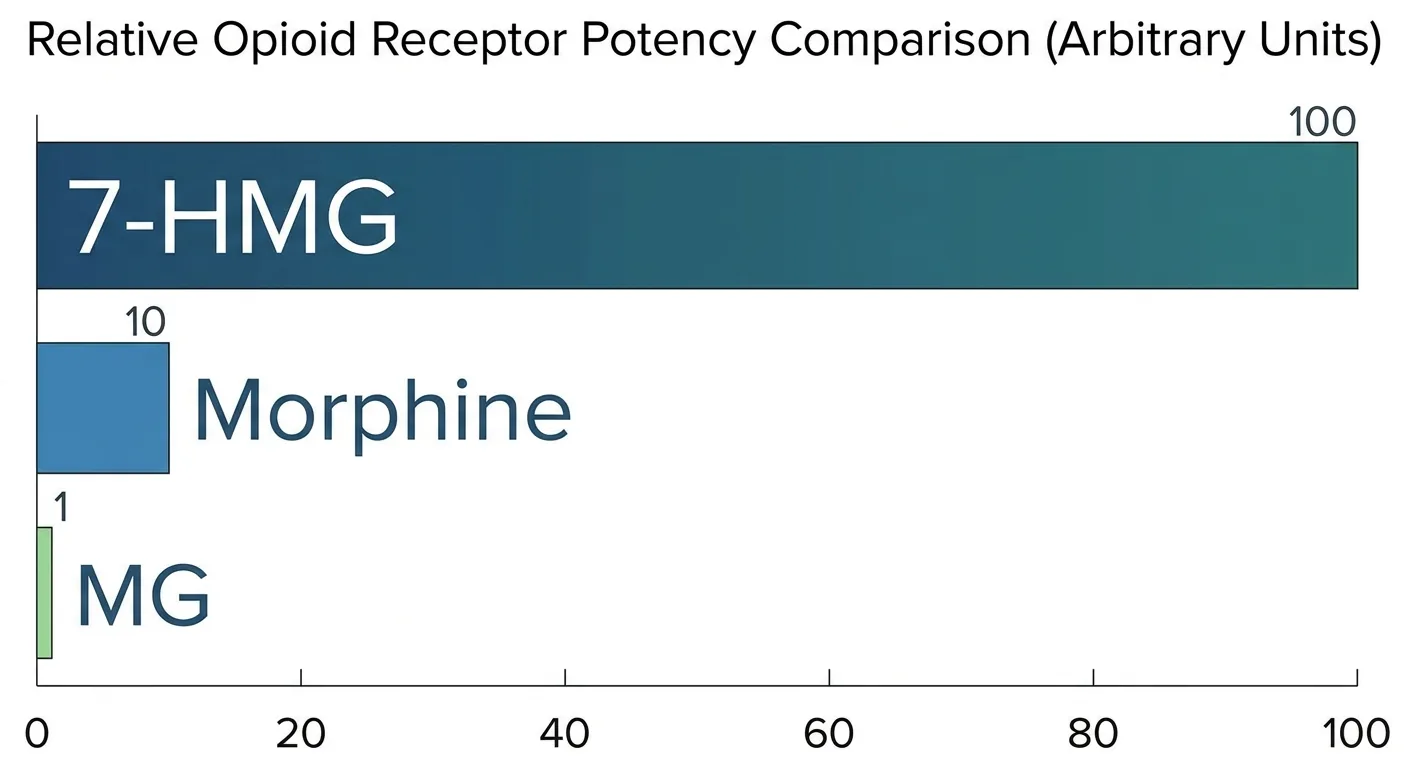
- Approximately 46× more potent than mitragynine at mu-opioid receptors[4]
- Approximately 13× more potent than morphine in antinociceptive (pain) assays in animal models[4]
- Higher blood-brain barrier permeability than MG[3]
- Readily self-administered by animals trained to self-administer morphine (unlike MG, which is not)[4]
- Primary mediator of kratom’s analgesic and sedative effects at higher doses
How does the body convert mitragynine to 7-HMG?
One of the most important discoveries in kratom pharmacology: your liver converts mitragynine into 7-hydroxymitragynine during first-pass metabolism. CYP3A4 — the most important drug-metabolizing enzyme in the liver — catalyzes the oxidation of MG to 7-HMG.[3]
Kruegel et al. (2019) confirmed this metabolic conversion in both mouse and human liver microsomes, establishing that the 7-HMG you experience from kratom comes primarily from in vivo conversion of mitragynine rather than the small amount naturally present in the leaf.[3]
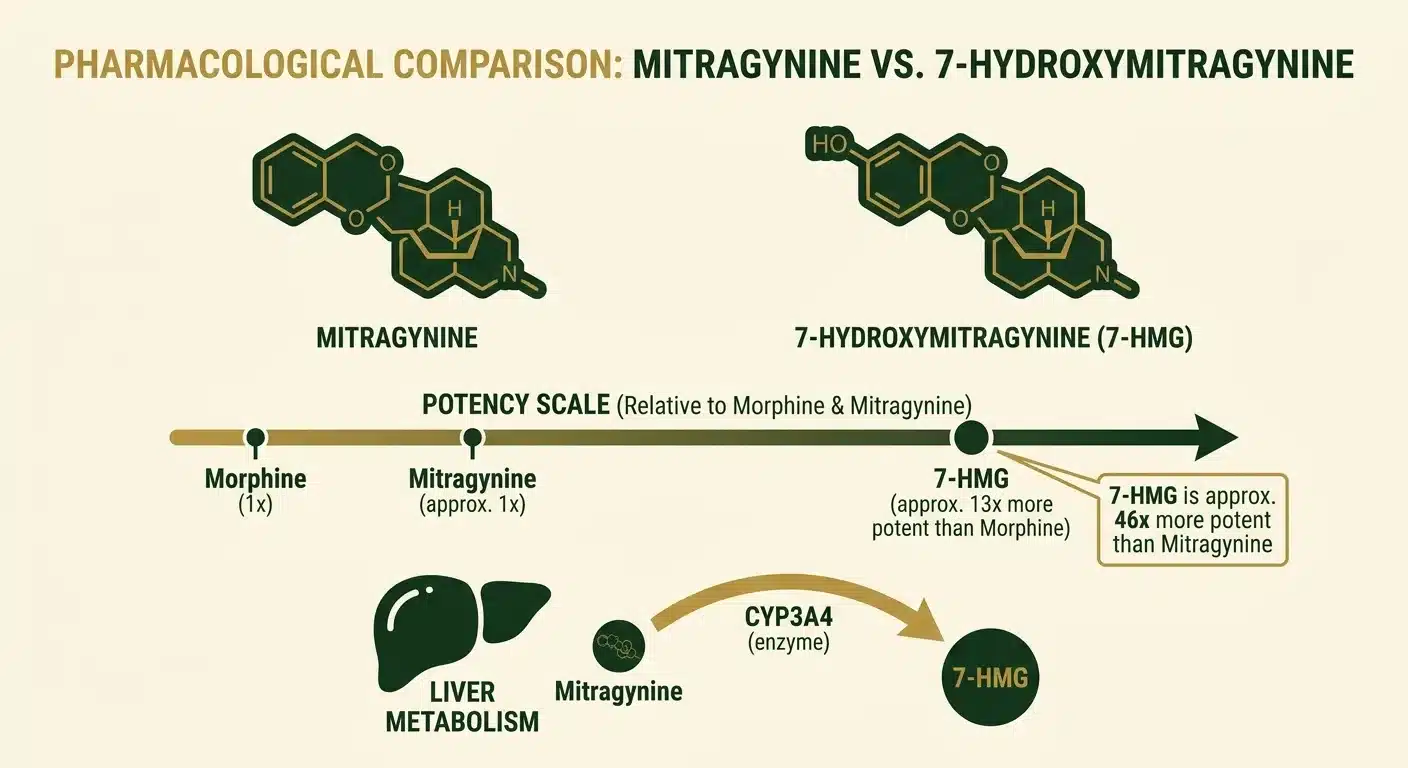
This prodrug relationship has several practical implications:
- Individual variability is partly CYP3A4-dependent. Rapid CYP3A4 metabolizers generate more 7-HMG from the same dose of kratom than poor metabolizers, contributing to the significant person-to-person variability in kratom’s effects.
- Drug interactions can alter the ratio. Medications that inhibit CYP3A4 (e.g., ketoconazole, grapefruit furanocoumarins, fluoxetine) may increase 7-HMG generation, intensifying kratom’s opioid-receptor-mediated effects. CYP3A4 inducers (e.g., rifampin, carbamazepine) may reduce it.[5]
- The delayed onset of sedative effects makes pharmacological sense. Low-dose effects are primarily MG-driven (adrenergic, fast onset). The shift toward sedation and analgesia at higher doses or later time points reflects the lag of hepatic conversion and 7-HMG accumulation.
- Dose isn’t linear in effect. As MG dose increases, more substrate is available for conversion — potentially generating disproportionately more 7-HMG at higher doses than a simple linear model would predict.
Potency comparison: MG vs. 7-HMG vs. morphine
Pharmacological Comparison: Mitragynine vs. 7-HMG vs. Morphine
| Property | Mitragynine | 7-Hydroxymitragynine | Morphine |
|---|---|---|---|
| MOR agonist type | Partial (G-protein biased) | Partial (G-protein biased) | Full agonist |
| Relative analgesic potency | 1× (reference) | ~46× vs. MG | ~1/13× vs. 7-HMG |
| β-arrestin-2 recruitment | Minimal | Minimal | High |
| Natural leaf content | 12–66% | <2% | N/A (synthetic) |
| Self-admin in opioid-trained rats | Not self-administered | Readily self-administered | Readily self-administered |
| Effect on morphine intake | Prior exposure decreased morphine intake | Prior exposure increased morphine intake | N/A |
| Respiratory depression risk | Low (partial agonist ceiling) | Low–moderate (partial agonist) | High (full agonist) |
Sources: Matsumoto et al. 2006[4]; Hemby et al. 2018[4]; Kruegel & Grundmann 2018[1]; Kruegel et al. 2019[3].
What does the abuse liability research say?
A landmark 2018 study by Hemby and colleagues (published in Addiction Biology) provided the first direct head-to-head comparison of abuse potential between MG and 7-HMG using the gold-standard self-administration paradigm in rats trained on morphine.[4] The findings were striking:
- 7-HMG readily substituted for morphine in dose-dependent self-administration — animals trained to self-administer morphine would also self-administer 7-HMG
- Mitragynine did NOT substitute for morphine at any tested dose — no self-administration behavior was observed
- Prior 7-HMG exposure increased subsequent morphine intake
- Prior mitragynine exposure decreased subsequent morphine intake — a pattern consistent with anti-addictive properties
This finding is among the most pharmacologically significant in kratom research. It suggests that in natural whole-leaf kratom — where mitragynine (60–70%) overwhelmingly dominates 7-HMG (<2%) — the dominant compound may actually modulate and reduce opioid-seeking behavior, while isolated or concentrated 7-HMG carries genuine abuse potential.[4]
The practical implication: products containing artificially concentrated or synthetic 7-HMG carry a fundamentally different risk profile than natural full-spectrum kratom, even if both are labeled “kratom.” This distinction matters enormously for both individual users and regulatory evaluation.
How do alkaloid profiles vary across strains?
Published HPLC analyses have documented significant alkaloid profile variation across kratom strain categories. The most comprehensive published dataset comes from Boffa et al. (2018, Natural Product Communications), which analyzed five commercial strains via HPLC-DAD and HPLC-MS/MS.
Alkaloid Profile by Kratom Strain (Boffa et al., 2018)
| Strain | MG (%) | Paynantheine (%) | Speciociliatine (%) | Speciogynine (%) | Total Alk (mg/g leaf) | Unique compounds |
|---|---|---|---|---|---|---|
| Green Malay | 59.7 | 9.7 | 12.0 | 8.38 | 9.86 | 11 |
| White Borneo | 48.2 | 8.2 | 16.0 | 6.54 | 12.2 | 11 |
| Red Thai | 44.0 | 10.2 | 16.6 | 7.07 | 8.76 | 11 |
| Red Bali | 37.7 | 4.80 | 11.0 | 3.85 | 9.84 | 24 |
| Red Malay | 4.0 | 23.6 | 2.33 | 13.4 | 5.81 | 11 |
Data: Boffa et al. 2018, Natural Product Communications. HPLC-DAD and HPLC-MS/MS analysis. Percentages reflect proportion of total measured alkaloids in extract.
Key findings from this dataset:
- Green Malay had the highest mitragynine concentration (59.7%) and greatest overall alkaloid purity (94.9% total alkaloids in extract) — making it one of the most MG-dominant products available
- White Borneo delivered the most total alkaloids per gram of leaf (12.2 mg/g) — more raw alkaloid material than any other tested variety
- Red Malay was an outlier: paynantheine (23.6%) dominated over mitragynine (4.0%), creating a fundamentally different alkaloid profile than any other strain — potentially explaining its distinct subjective character
- Red Bali contained 24 distinct detectable alkaloids versus 11 in other varieties — suggesting greater chemical complexity and a more pronounced entourage effect[1]
This data explains one of the most common user observations: two products marketed with identical strain names can produce notably different effects across vendors, because alkaloid profiles reflect growing conditions, processing, and blend composition — not just the name on the label.
What is the entourage effect in kratom?
Kratom’s 40+ alkaloids don’t act in isolation. The concept of an “entourage effect” — where multiple compounds interact to produce effects distinct from any single alkaloid — is supported by the presence of alkaloids with opposing pharmacological activities in the same leaf.
Secondary Kratom Alkaloids and Known Activities
| Alkaloid | Typical Content (%) | Known / Proposed Activity |
|---|---|---|
| Paynantheine | 4.8–23.6% | Smooth muscle relaxant; adrenergic modulation |
| Speciociliatine | 2.3–16.6% | Weak MOR activity; peripheral GI opioid receptors; MG diastereomer |
| Speciogynine | 3.9–13.4% | Smooth muscle relaxant; peripheral effects |
| Corynantheidine | 0.1–2.2% | Opioid receptor antagonist in some models; may temper MG/7-HMG agonism |
| Ajmalicine | Trace | Vasodilator; used clinically for circulatory disorders in other contexts |
The presence of corynantheidine — an opioid receptor antagonist — alongside the agonists MG and 7-HMG creates a natural self-limiting system. This built-in chemical balance helps explain why whole-leaf kratom behaves differently from isolated 7-HMG, and supports the Hemby (2018) finding that whole-plant kratom carries a different abuse liability profile than its most potent isolated compound.[4]
What is G-protein-biased agonism and why does it matter?
When an opioid drug activates a mu-opioid receptor, it can trigger two distinct downstream signaling cascades:
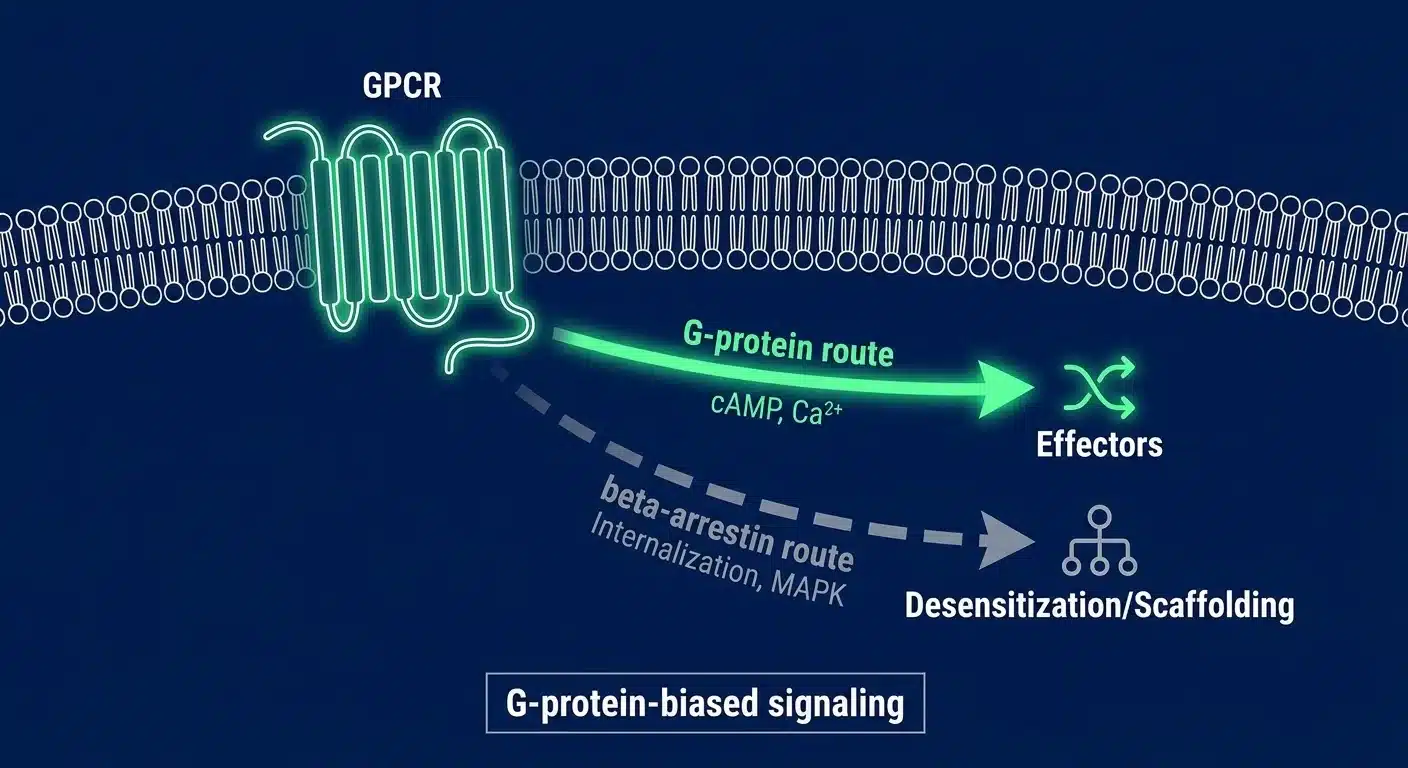
- G-protein pathway → produces analgesia, mood elevation, and pain relief
- β-arrestin-2 pathway → associated with respiratory depression, constipation, tolerance development, and opioid-induced hyperalgesia
Classical opioids like morphine activate both pathways robustly. Mitragynine and 7-HMG preferentially activate the G-protein pathway while showing minimal β-arrestin-2 recruitment — a pharmacological property called “biased agonism” or “functional selectivity.”[1]
This distinction has several implications:[1]
- Lower respiratory depression ceiling. Both MG and 7-HMG act as partial agonists with respect to respiratory effects, producing a ceiling effect that full opioid agonists do not have
- Potentially reduced tolerance development. β-arrestin-2 is implicated in MOR desensitization and receptor downregulation — the mechanism underlying opioid tolerance
- Different side effect profile. Reduced β-arrestin-2 activation may explain why kratom produces less constipation and acute sedation than equi-analgesic doses of conventional opioids
This G-protein biased signaling profile has made kratom alkaloids a subject of significant pharmaceutical interest. Researchers are studying mitragynine scaffolds as potential templates for next-generation analgesics that could offer pain relief with a reduced side effect burden compared to current opioids.[1] Grundmann et al. (2026) in Pharmaceuticals situate mitragynine and 7-HMG within the broader class of indole alkaloids acting as biased opioid-receptor modulators, with bias factors and receptor-subtype profiles catalogued against reference opioids — the review is the clearest recent framing of what “biased” means quantitatively for this class rather than as a talking point.[8] Hemby et al. (2026) in Frontiers in Pharmacology push the mechanistic case further by assaying binding affinity, functional selectivity, and allosteric activity of kratom alkaloids across human opioid-receptor subtypes, and the data reinforce the core distinction in this page: mitragynine and 7-HMG are not interchangeable, and the ratio at which a product delivers them shifts the downstream pharmacology.[9]
It’s important to note: biased agonism reduces — it does not eliminate — opioid receptor risks. Daily kratom use can still produce physical dependence via MOR downregulation, and 7-HMG still carries meaningful self-administration potential in animal models.[4]
What are the drug interaction risks?
Mitragynine is both a substrate and inhibitor of cytochrome P450 enzymes, particularly CYP3A4, CYP2D6, and CYP2C9.[5] This dual role creates two categories of interaction risk:
- Kratom’s effects may be altered by drugs that inhibit or induce CYP3A4. CYP3A4 inhibitors (ketoconazole, fluoxetine, grapefruit juice) can increase MG plasma levels and increase 7-HMG generation. CYP3A4 inducers (rifampin, carbamazepine, St. John’s Wort) reduce MG levels and 7-HMG production.
- Kratom may alter the metabolism of co-administered drugs metabolized by the same pathways — including benzodiazepines, many SSRIs, opioid analgesics (codeine, tramadol), statins, and macrolide antibiotics.
The combination of kratom with other CNS depressants — particularly opioids or benzodiazepines — presents the most significant safety concern. Most kratom-associated fatalities in published case reports involve concurrent use of other CNS depressants, not kratom alone.[1]
Anyone taking prescription medications should disclose kratom use to their prescribing physician. See: Kratom Side Effects and Drug Interactions Guide
What is the synthetic 7-HMG adulteration problem?
The kratom market increasingly includes products containing artificially concentrated or synthetic 7-hydroxymitragynine. These products bypass the natural alkaloid balance present in whole-leaf kratom and introduce meaningfully different risks.
Based on the self-administration research (Hemby 2018), isolated 7-HMG — not mitragynine — carries the opioid-class abuse potential.[4] Products enriched with 7-HMG remove the natural buffering provided by the dominant mitragynine and the antagonist alkaloids like corynantheidine.
How to identify potential adulteration:
- A batch COA showing 7-HMG above ~0.1% in a plain-leaf powder product is a red flag — natural dried leaf 7-HMG rarely exceeds 0.02%
- Liquid shots and “enhanced” products disproportionately represent the concentrated 7-HMG category
- Products marketed by very high potency claims (e.g., “50× extract”) without COA documentation warrant specific scrutiny of the 7-HMG percentage
At Amazing Botanicals, all products are full-spectrum natural kratom with batch-specific COAs. No synthetic 7-HMG, no artificially enriched products. See: How to Read a Kratom COA
Frequently asked questions about MG and 7-HMG
Why is 7-HMG so much more potent than mitragynine if it’s present in such small amounts?
7-HMG’s much higher mu-opioid receptor binding affinity (~46× MG) means even trace amounts produce significant opioid receptor activation. Additionally, most of the 7-HMG you experience from kratom is generated in your liver via CYP3A4 conversion of the abundant mitragynine — not just from the 7-HMG naturally present in the leaf. This prodrug mechanism makes 7-HMG’s pharmacological contribution much larger than its leaf concentration would suggest.[3]
Does mitragynine have opioid abuse potential?
Based on the best available preclinical evidence, mitragynine itself does not substitute for morphine in self-administration paradigms and may actually reduce subsequent opioid-seeking behavior.[4] This is in sharp contrast to 7-HMG, which readily substitutes for morphine. However, daily kratom use — which involves continuous MG-to-7-HMG conversion — does produce physical dependence via MOR downregulation, so the absence of direct self-administration potential does not mean kratom is without dependence risk.
What does biased agonism mean in plain English?
Classical opioids like morphine turn on two separate alarm systems in the MOR receptor: one that provides pain relief (G-protein pathway) and one that causes dangerous side effects like respiratory depression and severe constipation (β-arrestin-2 pathway). Mitragynine and 7-HMG preferentially activate the first alarm while barely triggering the second. That’s biased agonism — not “cleaner” opioids, but opioids with a different ratio of wanted to unwanted receptor effects.[1]
Why do some people respond much more strongly to kratom than others?
Individual CYP3A4 enzyme activity is one major factor. People who are “rapid metabolizers” of CYP3A4 substrates generate more 7-HMG from the same dose of mitragynine, producing stronger opioid receptor effects. CYP2D6 polymorphisms may also contribute. Body weight, food intake, and co-administered substances further affect plasma mitragynine levels and the MG-to-7-HMG conversion rate.[5]
Is Red Bali really different from other strains at the alkaloid level?
Published HPLC analysis suggests yes — Red Bali was unique in containing 24 distinct detectable alkaloids versus 11 in other tested varieties, and showed different minor alkaloid proportions than the other red-vein strains studied. Whether this chemical complexity translates to meaningfully different subjective effects depends on individual pharmacogenomics and dose, but the analytical data supports the anecdotal claim that Bali produces a distinct character.[1]
Does Green Malay really have more mitragynine than other strains?
In the Boffa et al. (2018) HPLC analysis, Green Malay showed the highest mitragynine percentage (59.7% of total alkaloids) and the highest alkaloid purity (94.9%). This may explain why Green Malay is frequently cited by users as producing particularly clean, stimulant-dominant effects at low doses relative to other green strains. That said, significant batch-to-batch variability exists — always check the batch-specific COA for actual mitragynine percentage.
Are extracts with concentrated 7-HMG more dangerous than plain leaf?
Based on the pharmacological evidence, products with significantly elevated 7-HMG — whether from artificial enrichment or synthesis — carry a higher abuse liability profile than plain-leaf products where mitragynine remains the dominant compound. The natural antagonist alkaloids (like corynantheidine) that buffer 7-HMG’s effects in whole-leaf kratom may not be present or proportionate in concentrated extract products. This is a meaningful risk distinction, not a marketing claim.[4]
Can kratom alkaloids cause a positive opioid drug test?
Mitragynine and 7-HMG are structurally distinct from classical opioids (morphine, codeine, heroin, oxycodone) and do not typically cause false positives on standard 5-panel or 10-panel immunoassay drug tests. Specialized kratom-specific tests that screen for mitragynine do exist. For a complete breakdown of which tests detect kratom, see: Does Kratom Show Up on Drug Tests?
References
- Kruegel AC, Grundmann O. The medicinal chemistry and neuropharmacology of kratom. Neuropharmacology. 2018.
- Suhaimi FW, et al. Neurobiology of kratom and its main alkaloid mitragynine. Brain Res Bull. 2016.
- Kruegel AC, et al. 7-Hydroxymitragynine is an active metabolite of mitragynine and a key mediator of its analgesic effects. ACS Cent Sci. 2019.
- Hemby SE, McIntosh S, Leon F, et al. (2019). Abuse liability and therapeutic potential of the Mitragyna speciosa (kratom) alkaloids mitragynine and 7-hydroxymitragynine. Addiction biology, 24(5), 874-885. [PubMed]
- Hanapi NA, et al. Kratom alkaloids: interactions with enzymes, receptors, and cellular barriers. Front Pharmacol. 2021.
- Trakulsrichai S, et al. Pharmacokinetics of mitragynine in man. Drug Des Devel Ther. 2015.
- Obeng S, et al. The Mitragyna speciosa (kratom) alkaloid mitragynine: analysis of adrenergic α(2) receptor activity in vitro and in vivo. Eur J Pharmacol. 2024.
- Grundmann O, et al. Indole alkaloids as biased opioid receptor modulators. Pharmaceuticals (Basel). 2026.
- Hemby SE, et al. Multifaceted modulation of human opioid receptors by kratom alkaloids: binding affinity, functional selectivity, and allosteric activity. Front Pharmacol. 2026.

Shop Lab-Tested Kratom
Browse our full selection of AKA GMP-qualified kratom — powder, capsules, extracts, and more. Free shipping on orders $99+.
Shop All Kratom