


Kratom powder degrades over time when exposed to light, oxygen, heat, and moisture — all of which accelerate oxidation of the alkaloids that make it effective. How long your kratom stays potent depends almost entirely on how you store it. This guide covers the science behind kratom degradation, the best containers and conditions, and what to look for when you suspect quality has dropped.
What Makes Kratom Degrade Over Time?
Kratom’s active compounds are primarily terpene indole alkaloids — a class of nitrogen-containing organic molecules that are inherently susceptible to environmental degradation. The principal alkaloid, mitragynine, has physicochemical properties that inform exactly which storage conditions accelerate its breakdown.
Ramanathan et al. (2015) characterized the physicochemical profile of mitragynine and found it has a moderate LogP (octanol-water partition coefficient) of approximately 2.7, indicating lipophilic character — meaning it partitions into fatty environments rather than water.[1] Brown et al. (2017) confirmed this alkaloid-rich and environmentally sensitive phytochemical profile across the genus Mitragyna.[6] Together, these properties make mitragynine sensitive to the following degradation pathways:
- Oxidation — the primary degradation pathway. Indole alkaloids react with molecular oxygen, particularly under UV irradiation, leading to structural changes that alter receptor binding activity. This is the same chemical process that turns a cut apple brown.
- UV photodegradation — light energy (especially UV) accelerates oxidation and can directly cleave chemical bonds in the indole ring structure. Even indirect sunlight through a window transmits enough UV to degrade kratom over time.
- Hydrolysis from moisture — while mitragynine itself is not highly water-soluble, excess humidity provides a medium for both chemical hydrolysis reactions and biological degradation (mold, bacteria). A relative humidity above 65% significantly increases microbial risk.
- Thermal degradation — heat accelerates all chemical reaction rates. Storage above 40°C (104°F) meaningfully increases degradation speed. Temperatures above this threshold — common in cars, garages, and kitchens near stoves — can reduce alkaloid content noticeably over weeks rather than months.
The practical implication: kratom stored correctly degrades slowly and predictably. Kratom stored carelessly — left in a clear bag on a sunny counter, or in a hot car for weeks — can lose significant alkaloid potency in a fraction of its theoretical shelf life. At Amazing Botanicals, every batch is COA-tested at the time we receive it, giving you a documented alkaloid baseline. What happens after that point is entirely a function of storage.

How Long Does Kratom Last?
There are no published randomized controlled studies on kratom powder shelf life — the research literature focuses on pharmacology, not food science. What we have instead is a combination of alkaloid chemistry principles, industry experience, and user-reported observations across large populations of regular kratom users.[5]
Based on the physicochemical stability of mitragynine and practical sourcing experience across hundreds of batches, the following shelf life estimates apply under proper storage conditions:
| Timeframe | Storage Method | Expected Quality Retention | Notes |
|---|---|---|---|
| Up to 3 months | Original packaging, kept sealed, cool and dark | 90–100% — essentially no detectable loss | No special steps needed beyond keeping it sealed |
| 3–12 months | Airtight glass or HDPE container, dark location, room temperature | 80–95% — gradual decline, still fully effective | Transfer out of original bag; use desiccant |
| 1–2 years | Vacuum-sealed mylar bag with oxygen absorber, dark and cool | 70–85% — noticeable potency shift at the higher end | Ideal for bulk purchasing; check for off-odor before use |
| 2+ years | Freezer-stored, vacuum-sealed, fully dry | 60–75% — significant potency loss, microbial risk increases | Not recommended; restock rather than extend this far |
These estimates assume proper storage. Kratom stored in suboptimal conditions — exposed to light, humidity, or heat — degrades significantly faster and the above timelines compress accordingly. In over a decade of receiving, storing, and shipping kratom, I have found that the first meaningful loss in perceived potency typically occurs around the 12–18 month mark even under good conditions, and earlier when storage is careless.
What Are the Best Containers for Kratom Storage?
Container selection is the single highest-leverage storage decision — it determines both air exposure (the primary degradation driver) and light exposure. The table below rates common options:
| Container | Airtight | Light-Blocking | Moisture Resistance | Best For |
|---|---|---|---|---|
| Vacuum-sealed mylar bag + O₂ absorber | Excellent | Excellent | Excellent | Long-term bulk storage (6mo+) |
| Dark glass jar with rubber-sealed lid | Good | Excellent (amber/cobalt) | Good | Daily-use supply (up to 1 year) |
| Clear glass mason jar (in cabinet) | Good | Poor (if exposed to light) | Good | Acceptable if kept in dark cabinet |
| HDPE plastic container (food-grade) | Good | Good (opaque) | Good | Practical everyday option |
| Resealable plastic zip bag | Poor | Poor | Poor | Short-term only (under 4 weeks) |
| Original vendor packaging (sealed) | Good (if heat-sealed) | Good (opaque mylar) | Good | Up to 3 months if unopened |
The practical recommendation for most users: transfer your daily-use supply into a dark glass jar with a tight rubber-sealed lid (a standard canning jar or amber pharmacy jar works well), and keep larger quantities vacuum-sealed in mylar bags until needed. Add a food-grade desiccant silica gel packet to any container that will be opened regularly — each time you open a container, you exchange air and introduce humidity.
Glass is preferable to plastic for long-term storage because glass is chemically inert and does not leach compounds that could interact with the alkaloids over time. HDPE food-grade plastic is an acceptable alternative if glass is not practical. Never store kratom in containers that previously held strongly aromatic substances — kratom powder absorbs odors readily due to its porous, fine texture.
Where Should You Store Kratom?
The optimal storage environment controls all four degradation factors simultaneously: light, temperature, humidity, and air contact. A sealed container addresses air and light; the storage location addresses temperature and ambient humidity.
| Factor | Optimal Range | Effect of Excess | Practical Control |
|---|---|---|---|
| Light (UV) | Zero — dark storage | Accelerates oxidation; can cleave indole ring bonds directly | Opaque container + dark cabinet or drawer |
| Temperature | Below 25°C (77°F) — room temperature or cooler | Faster degradation reaction rates; risk of moisture condensation if cycling | Interior cabinet, away from stove, radiator, or direct sun |
| Humidity (RH) | Below 55% RH | Mold growth (above 65% RH); clumping; accelerated hydrolysis | Desiccant packets inside container; avoid bathroom, garage in humid climates |
| Oxygen exposure | Minimal — airtight seal | Primary oxidation driver; each container opening introduces fresh O₂ | Minimize opening frequency; use O₂ absorbers for long-term |
Best locations in a typical home: a dark pantry shelf, an interior kitchen cabinet away from the stovetop, a bedroom closet shelf, or a dedicated supplement drawer. All of these provide consistent temperature, darkness, and low humidity.
Worst locations: countertop near a window, car glove compartment (extreme temperature swings), bathroom medicine cabinet (high humidity from showers), garage (temperature extremes and humidity), or anywhere with direct sun exposure for any portion of the day.
How Should You Store Large Quantities of Kratom?
Bulk purchasing — whether a kilogram or more — is common among regular users who want consistent access to a batch they trust. The adulteration risk documented by Lydecker et al. (2016) makes it especially valuable to source a tested batch and store it carefully rather than repeatedly buying from unknown quality lots.[2] The goal is to preserve the alkaloid content verified by the COA from the time of purchase.
For quantities over 250 grams intended to last more than three months, the following approach provides optimal preservation:
- Divide into use-sized portions — split bulk quantities into 100–250 gram portions before sealing. This allows you to open one portion at a time, keeping the rest undisturbed and fully sealed.
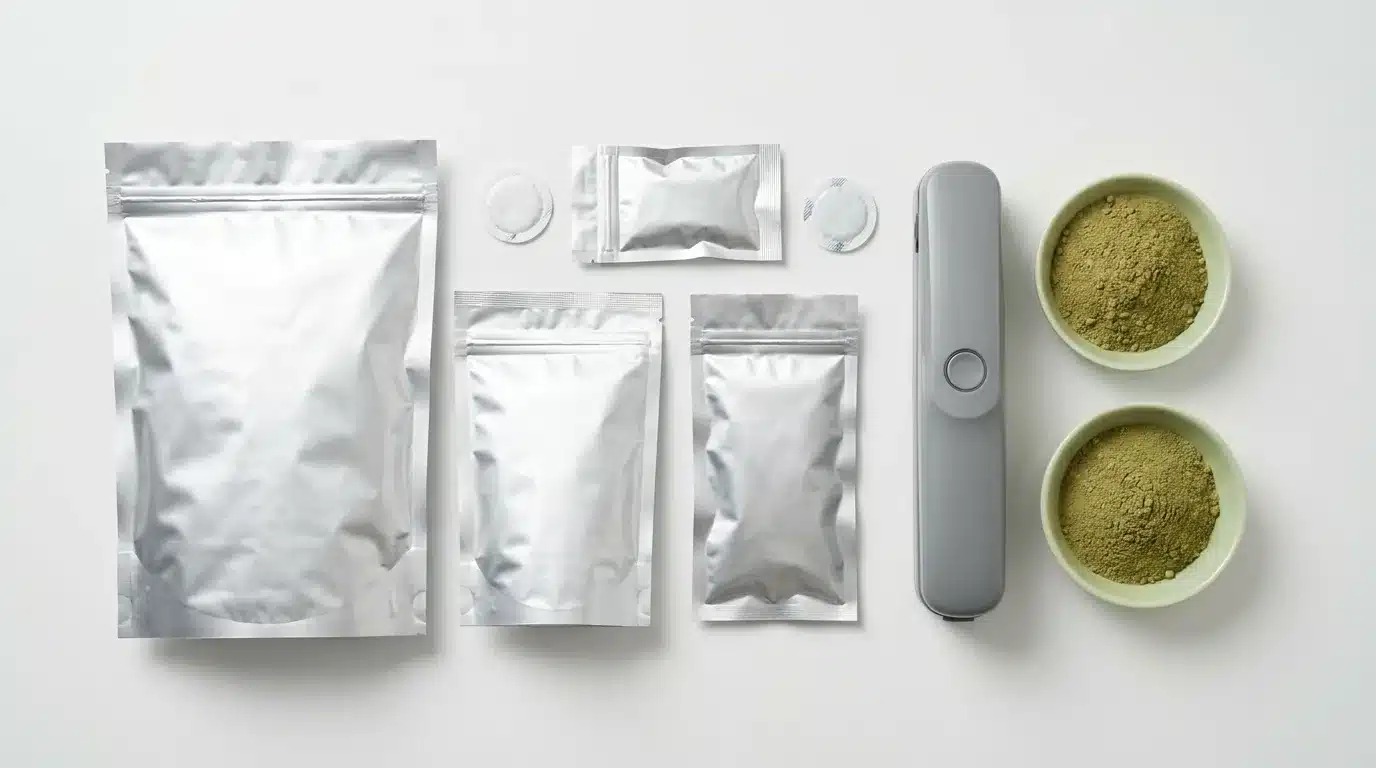
- Vacuum-seal each portion in mylar bags — food-grade mylar (4-7 mil thickness) provides excellent oxygen and moisture barriers. Use a vacuum sealer to remove as much air as possible before sealing.
- Add an oxygen absorber to each bag — 100cc oxygen absorbers (standard food storage grade) further reduce residual O₂ inside the sealed bag. Available at any food storage supply retailer.
- Label each bag with the strain, batch date, and COA alkaloid percentage so you can track quality across storage time.
- Store sealed bags in a cool, dark location — an interior cabinet, a dedicated storage box, or a chest freezer if you are storing for more than 12 months.
- Open bags in low-humidity conditions — if you live in a humid climate, open sealed bags quickly and reseal or transfer to a container immediately to minimize moisture exposure time.
How Do You Know If Kratom Has Gone Bad?
Kratom does not “expire” in the way that dairy products do — it does not become acutely dangerous after a specific date under normal degradation conditions. What happens instead is a gradual decline in alkaloid potency, and in cases of poor storage, potential microbial contamination. Here is what to look for:
Signs of alkaloid degradation (reduced potency, not safety risk):
- Noticeably reduced effects at your established dose — you need more to achieve the same result
- Color shift from vivid green to a duller, more brown-green or khaki tone — oxidation darkens alkaloids
- Flat, muted aroma — fresh kratom has a distinct earthy, slightly bitter green scent; degraded kratom smells flat or papery
- Loss of the characteristic mild bitterness on the tongue — alkaloids are bitter; reduced bitterness can indicate reduced alkaloid content
Signs of microbial contamination (do not use):
- Visible mold — any fuzzy growth, white patches, or unusual discoloration indicates mold and the batch should be discarded entirely
- Off or sour odor — a musty, sour, or fermented smell that doesn’t smell like plant material suggests bacterial or mold activity
- Clumping with moisture — if the powder has absorbed enough moisture to clump and doesn’t dry out after exposure to air, microbial growth risk is high
- Visible insects or webbing — rare but possible in compromised storage
At Amazing Botanicals, our batches are third-party tested for microbial contamination, heavy metals, and alkaloid content before they reach you — you can review current batch COA data on the lab testing page. Testing verifies quality at the point of purchase; proper storage is your responsibility after that point.

Does Refrigerating or Freezing Kratom Help?
Refrigeration and freezing slow chemical reaction rates and can extend shelf life — but introduce a significant practical risk: condensation. When cold kratom powder is removed from a refrigerator or freezer and exposed to room-temperature air, moisture condenses on the powder surface. This condensation can rapidly introduce the humidity levels that promote mold growth and alkaloid hydrolysis — exactly the opposite of what you’re trying to achieve.
If you choose to refrigerate or freeze kratom, these rules are non-negotiable:
- The container or bag must be completely airtight — vacuum-sealed mylar preferred, with a desiccant packet inside
- When removing from cold storage, allow the sealed container to come to room temperature fully before opening — typically 2–4 hours for a sealed bag, longer for a large container
- Never return partially used portions to frozen storage after they’ve been opened at room temperature
- Use a dedicated food-grade freezer container or zip-lock freezer bag inside a mylar bag — avoid storing near strongly aromatic freezer foods as kratom absorbs odors
The honest assessment: for most home users who are going through kratom within 6–12 months, refrigeration and freezing add complexity without proportionate benefit. A dark pantry cabinet with a quality airtight container and desiccant packets achieves 90%+ of the storage quality that freezing provides, with none of the condensation risk. Reserve cold storage for quantities that you genuinely cannot use within a year. Avery et al. (2018) confirmed that extract preparation method and integrity significantly affect bioavailability in animal studies — the same principle applies to degraded powder versus fresh powder.[3]
How Does Storage Affect Kratom Potency Over Time?
The relationship between storage time and potency is not linear — it follows a curve that is initially flat (little change in the first few months) and gradually steepens as the alkaloid mass decreases. This is consistent with how oxidation reactions generally work: the rate of degradation depends on the concentration of the reacting species, so as alkaloids degrade, the rate of further degradation slows.
Tanna et al. (2022) established that mitragynine bioavailability in humans varies significantly based on the form and preparation of kratom consumed.[4] Storage-related degradation effectively changes what you’re consuming — a batch that was 1.5% mitragynine at the time of purchase may read 1.1–1.3% after a year of suboptimal storage. This 15–25% reduction in alkaloid content requires a proportional dose adjustment to maintain the same effect, which can be disorienting if you don’t know it’s happening.
The practical implication: if kratom that previously worked at a specific dose seems weaker without any change in your routine, poor storage is the first variable to examine — before increasing your dose. At Amazing Botanicals, every batch we ship has a batch-specific COA available on our lab testing page with the verified alkaloid percentages at time of testing. If you have concerns about a batch, that COA is your baseline reference point. The storage conditions since receipt determine how much of that baseline you have preserved.
Grundmann’s (2017) survey of US kratom users found that the majority of users consume kratom daily or near-daily, suggesting most users cycle through their supply relatively quickly.[5] Singh et al. (2017) similarly documented high-frequency traditional daily use in Southeast Asia — populations that have used fresh or recently dried kratom for centuries, reinforcing the advantage of fresh supply over extended storage.[7] For users in this pattern, long-term storage degradation is rarely the limiting factor — purchasing smaller, fresher quantities more frequently is a better strategy than bulk-buying and hoping for storage to carry you through. Trakulsrichai et al. (2015) found mitragynine half-life in humans to be approximately 9 hours — an alkaloid that exits the body relatively quickly, underscoring that freshness at ingestion matters more than long-term stockpiling.[8]
Frequently Asked Questions
How long does kratom powder last if stored properly?
Under optimal storage conditions — airtight opaque container, dark location, below 25°C, below 55% relative humidity — kratom powder retains meaningful alkaloid potency for 1–2 years. The most significant decline occurs between 12–24 months. Kratom stored carelessly (exposed to light, heat, or humidity) can degrade noticeably in 3–6 months. There is no hard expiration date — quality declines gradually rather than dropping off a cliff at a specific point. The best indicator is your own consistent dose response: if you need significantly more for the same effect without any change in your routine, storage-related potency loss is the likely explanation.
Can kratom go moldy?
Yes. Kratom powder is a plant material with a fine, porous texture that absorbs environmental moisture readily. Any sustained exposure to humidity above 65% relative humidity creates conditions suitable for mold and bacterial growth. This is most common when kratom is stored in bathrooms, garages in humid climates, or when powder is exposed to condensation from temperature cycling. Visible mold (fuzzy growth, white patches, unusual discoloration) or an off, musty odor are clear indicators — discard the batch entirely, as mold produces mycotoxins that cannot be rendered safe by drying. Never try to salvage moldy kratom by removing the affected portion.
What is the best container for kratom?
For everyday use (quantities you will consume within 3–6 months): a dark glass jar with a rubber-sealed lid — amber pharmacy jars or cobalt glass mason jars work well. Add a food-grade silica gel desiccant packet inside. For long-term bulk storage (6+ months): vacuum-sealed mylar bags (4–7 mil) with a 100cc oxygen absorber inside each bag. Mylar provides the most comprehensive protection against oxygen, light, and moisture simultaneously. Avoid clear containers, zip-lock bags for anything beyond a few weeks, and containers previously used for strongly aromatic foods.
Should I keep kratom in the refrigerator?
Generally no — the condensation risk when removing cold kratom from the refrigerator outweighs the benefits for most users. Kratom stored at normal room temperature in an airtight, dark container retains quality for 1–2 years without refrigeration. If you have a very large quantity (500g+) that you won’t use for 12+ months and can commit to a strict open-at-room-temperature protocol, refrigeration can extend shelf life modestly. For most users, the simpler and safer approach is a quality airtight container in a cool, dark cabinet.
Can you freeze kratom?
Yes, but with important precautions. Kratom must be vacuum-sealed in a completely airtight container before freezing, and the sealed container must be allowed to come fully to room temperature (2–4 hours minimum) before opening, to prevent condensation from forming inside the container. Opening cold kratom directly exposes warm air to cold powder, causing immediate moisture condensation. If these steps are followed correctly, freezing can extend shelf life to 2+ years. If they are not, freezing creates a false sense of security while actually accelerating moisture-related degradation.
Does kratom expire?
Kratom does not have a hard expiration date in the pharmaceutical sense. It degrades gradually — losing alkaloid potency over time without becoming acutely dangerous under normal storage conditions. “Expired” kratom that has not developed mold is less potent, not toxic. The practical threshold is a function of your quality standards: if the potency has declined enough that your established dose no longer produces the expected effects, the batch has effectively expired for your purposes even if it’s not dangerous. Microbially contaminated kratom (mold, bacterial overgrowth from poor storage) is a different matter — this should not be used.
Why does my kratom smell different?
Freshly sourced, well-processed kratom has a characteristic earthy, slightly bitter green aroma — analogous to fresh tea leaves. A flat, papery, or musty smell that has replaced this characteristic scent indicates one of two things: oxidative degradation (alkaloids have broken down, reducing the volatile aromatic compounds), or moisture exposure leading to early microbial activity. A flat-but-not-offensive smell typically means aging and potency loss. A distinctly musty, sour, or off smell means moisture contamination and possible mold — inspect the powder closely and discard if any visual changes are present.
Does the strain type affect how long kratom stays fresh?
Strain type has minimal direct effect on shelf life — the degradation is driven by alkaloid chemistry and storage conditions, not by which specific vein color or region the kratom came from. However, alkaloid concentration at the time of purchase does matter indirectly: a batch with a higher starting mitragynine percentage (say, 1.7%) will remain effective at your standard dose longer than a lower-potency batch (say, 1.2%), even if both lose the same absolute percentage of alkaloids over the same storage period. This reinforces the value of COA data — knowing your starting concentration lets you better predict when potency decline will become noticeable.
Can I store kratom with other supplements?
Yes, as long as the containers are separate and sealed. Kratom should not share a container with other supplements — particularly aromatic ones like fish oil, turmeric, or strongly flavored vitamins — as kratom powder absorbs odors. Sealed containers stored on the same shelf pose no issue. The main concern is cross-contamination of aromas, not chemical interaction. If you use desiccant packets in your supplement storage area, ensure each container has its own dedicated packet — a single desiccant in a shared space is far less effective than individual packets in each sealed container.
How do I know if my kratom has lost potency from poor storage?
The clearest signal is a dose-response change: if a dose that previously produced consistent effects is noticeably less effective without any other variable changing (tolerance, diet, timing), storage-related potency loss is the most likely explanation. Visual and olfactory cues support this: color shift toward duller brown-green tones, and a flat or reduced aroma compared to when the batch was fresh. If you started with a COA showing the mitragynine percentage, you have a baseline to work from — the current potency will be somewhere below that number depending on storage conditions and elapsed time. Our lab testing page shows batch-specific COAs so you always know your starting point.
References
- Ramanathan S, Parthasarathy S, Murugaiyah V et al. (2015). Understanding the physicochemical properties of mitragynine, a principal alkaloid of Mitragyna speciosa, for preclinical evaluation. Molecules. [PubMed]
- Lydecker AG, Sharma A, McCurdy CR et al. (2016). Suspected adulteration of commercial kratom products with 7-hydroxymitragynine. Journal of Medical Toxicology. [PubMed]
- Avery BA, Boddu SP, Sharma A et al. (2018). Comparative pharmacokinetics of mitragynine after oral administration of Mitragyna speciosa (kratom) leaf extracts in rats. Planta Medica. [PubMed]
- Tanna RS, Nguyen JT, Hadi DL et al. (2022). Clinical pharmacokinetic assessment of kratom (Mitragyna speciosa), a botanical product with opioid-like effects, in healthy adult participants. Clinical Pharmacology & Therapeutics. [PubMed]
- Grundmann O. (2017). Patterns of kratom use and health impact in the US — results from an online survey. Drug and Alcohol Dependence. [PubMed]
- Brown PN, Lund JA, Murch SJ. (2017). A botanical, phytochemical and ethnomedicinal review of the genus Mitragyna korth: Implications for products sold as kratom. Journal of Ethnopharmacology. [PubMed]
- Singh D., Narayanan S., Vicknasingam B. (2017). Changing trends in the use of kratom (Mitragyna speciosa) in Southeast Asia. Human Psychopharmacology. [PubMed]
- Trakulsrichai S et al. (2015). Pharmacokinetics of mitragynine in man. Drug Design, Development and Therapy. [PubMed]
Disclaimer: This article is for educational purposes only and is not wellness advice. Kratom is not FDA-approved to diagnose, manage, resolve, or prevent any condition. Consult a qualified healthcare provider before starting, changing, or stopping any supplement regimen.
Ready to restock? Browse our fresh, resealable kratom powder.

Shop Lab-Tested Kratom
Browse our full selection of AKA GMP-qualified kratom — powder, capsules, extracts, and more. Free shipping on orders $99+.
Shop All Kratom