


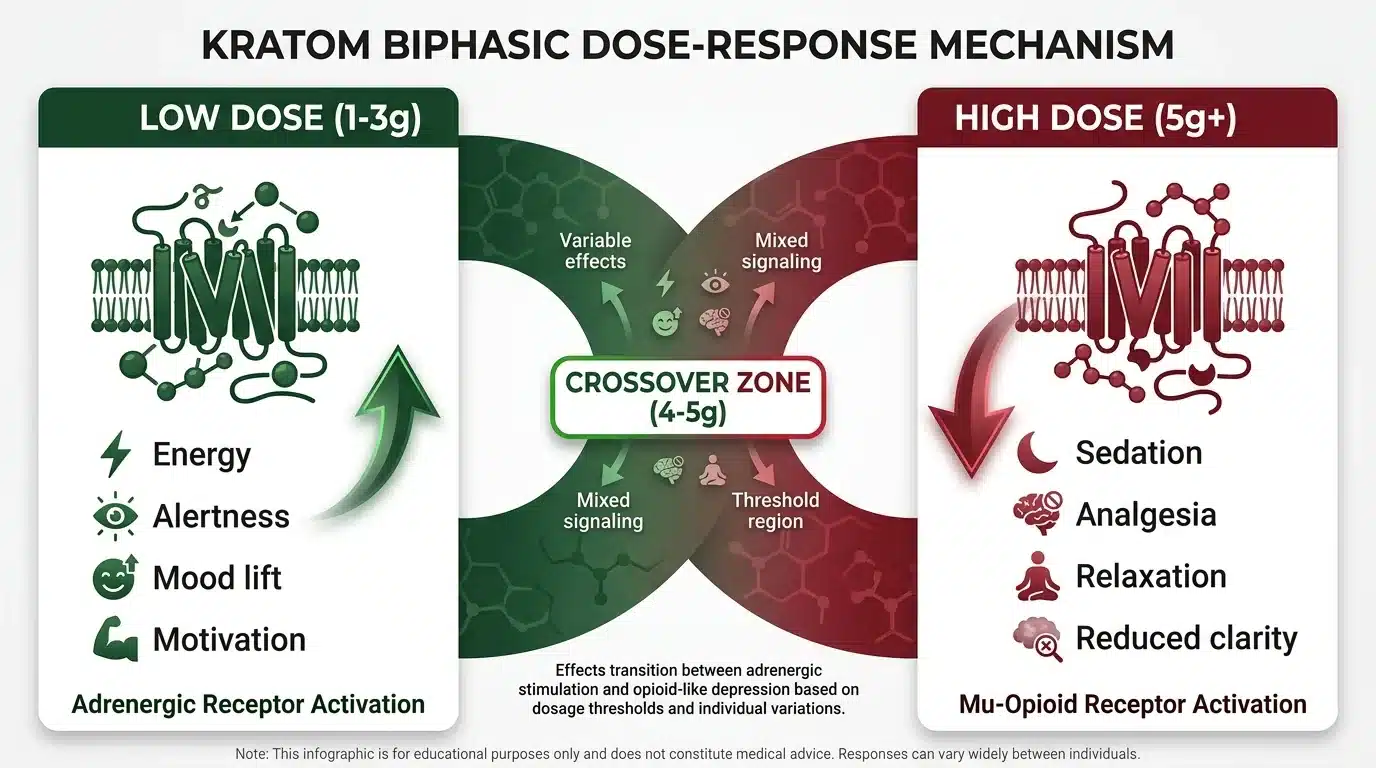
Kratom produces a dose-dependent biphasic effect profile: stimulant and adrenergic effects at low doses, sedating and opioid-receptor-mediated effects at higher doses. The same plant, taken in different amounts, can feel like two completely different substances. Understanding this mechanism — not just the list of reported effects — is what makes kratom legible rather than unpredictable.
What Is the Mechanism Behind Kratom’s Effects?
Kratom’s effects are not random — they follow directly from its alkaloid pharmacology. Prozialeck et al. (2012) reviewed kratom’s receptor activity and documented the biphasic mechanism: at low doses, mitragynine primarily stimulates adrenergic (adrenaline-related) receptors, producing stimulant effects similar in character to low-dose caffeine but through a different pathway. At higher doses, mitragynine and its active metabolite 7-hydroxymitragynine activate mu-opioid receptors, producing effects similar to opioid-class compounds — sedation, analgesia, and reduced mental clarity.[1]
Kruegel et al. (2018) characterized mitragynine as a partial agonist at mu-opioid receptors — meaning it activates the receptor but with a ceiling effect on some opioid pathways (like respiratory depression) while still producing analgesic and euphoric effects. This partial agonism is why kratom is often described as an atypical or biased opioid receptor ligand rather than a classical opioid.[2]
The alkaloid profile is also not a single compound. Kratom leaf contains 40+ alkaloids, but mitragynine (60–66% of total alkaloids in most preparations) and 7-hydroxymitragynine (a minor but potent metabolite) are the primary drivers of effects. Different vein colors and processing methods produce different ratios of these alkaloids, which is why the same dose of two different products can feel meaningfully different.
How Do Kratom’s Effects Change With Dose?
Smith et al. (2022) analyzed self-reported dose-effect relationships in a sample of regular US kratom users and documented clear dose-dependent patterns — with different effect categories predominating at different dose levels.[3] The transition from stimulant to sedative/analgesic effects is not a sharp line but a gradual shift across a dose range.
| Dose Range | Dominant Mechanism | Commonly Reported Effects | Side Effect Risk |
|---|---|---|---|
| 1–2 g | Adrenergic (stimulant) | Mild alertness, slight mood lift, increased talkativeness | Very low |
| 3–5 g | Mixed adrenergic + opioid | Full energy/focus profile (white/green) or moderate relaxation (red); mood elevation | Low–moderate; nausea possible above 4g on empty stomach |
| 5–8 g | Opioid receptor dominant | Strong sedation, analgesia, reduced motivation; stimulant effects minimal | Moderate–high; nausea, dizziness, constipation common |
| 8 g+ | Strong opioid activation | Heavy sedation, significant analgesia; cognitive impairment, brain fog | High; adverse effects frequently outweigh desired effects |
The practical implication of this dose-response relationship is that more is not necessarily better. Users seeking energy and mood benefits from kratom typically find the 2–4g range most productive. Users who escalate to 6–8g in pursuit of stronger effects typically find that the character shifts away from what they were seeking and toward heavy sedation. See our Kratom Dosage Guide for how to find your minimum effective dose.
What Are the Main Categories of Reported Effects?
Grundmann (2017) surveyed 8,049 kratom users and documented the most commonly reported reasons for use and effects experienced.[4] Swogger et al. (2015) conducted qualitative interviews with kratom users to document first-person accounts of what effects they experience and how they use kratom to manage various aspects of daily life.[5] These user-reported categories are consistent across multiple research populations.
Energy and alertness — At low-moderate doses, kratom’s adrenergic activity produces increased physical energy and mental alertness. Users commonly describe this as clean, functional energy — different from caffeine jitteriness. White vein kratom is most associated with this profile. This is the most commonly cited reason for kratom use among working-age adults in US survey populations.
Mood elevation and well-being — Opioid receptor activity at moderate doses produces a sense of well-being or mild euphoria. This is described as mood-brightening rather than intoxication at standard doses. Kratom’s mu-opioid partial agonism means mood effects are present without the level of euphoric intensity associated with full opioid agonists.
Relaxation and anxiolytic effects — Green and red vein kratom at moderate doses are most associated with relaxation. Anxiolytic effects (reduction in anxiety or social tension) are commonly reported, thought to involve both opioid receptor and serotonin pathway activity. These effects are the basis of kratom’s overlap with CBD marketing despite the fundamentally different mechanism.
Discomfort relief and analgesia — At higher doses, mu-opioid receptor activation produces meaningful analgesia (pain relief). Survey data consistently shows a significant proportion of kratom users reporting use for chronic pain or discomfort management. This is the most pharmacologically plausible use case given the mu-opioid receptor mechanism — though kratom is not FDA-approved for any pain indication.
Focus and motivation — At low-moderate doses with white or green vein kratom, many users report improved ability to sustain focus on tasks. This overlaps with the adrenergic stimulant mechanism and may also involve adrenergic modulation of dopamine pathways in the prefrontal cortex.
Social ease — At mild doses, reduced social anxiety and increased verbal fluency are frequently reported. This is likely a secondary effect of the combined mood elevation and mild anxiolytic action rather than a primary pharmacological target.
How Do Vein Color and Strain Affect Effects?
Vein color is the most practically relevant way to predict the character of kratom’s effects. The differences arise from measurably different alkaloid ratios between vein colors, documented in HPLC profiling studies — different mitragynine concentrations and secondary alkaloid compositions produce different balances between adrenergic and opioid receptor activity.
| Vein Color | Dominant Profile | Primary Use Cases | Best Time of Day |
|---|---|---|---|
| White vein | Stimulant-dominant; sharp onset, clean taper | Energy, focus, productivity, morning use | Morning / early afternoon |
| Green vein | Balanced: moderate stimulation with relaxation during taper | All-day use, social situations, mood balance, beginners | Anytime; most versatile |
| Red vein | Sedative/analgesic dominant; gradual taper, long duration | Relaxation, discomfort relief, evening wind-down | Afternoon / evening |
| Yellow / Gold | Typically green-to-red range; processing-dependent | Mood, relaxation, moderate energy; variety in rotation | Varies by product |
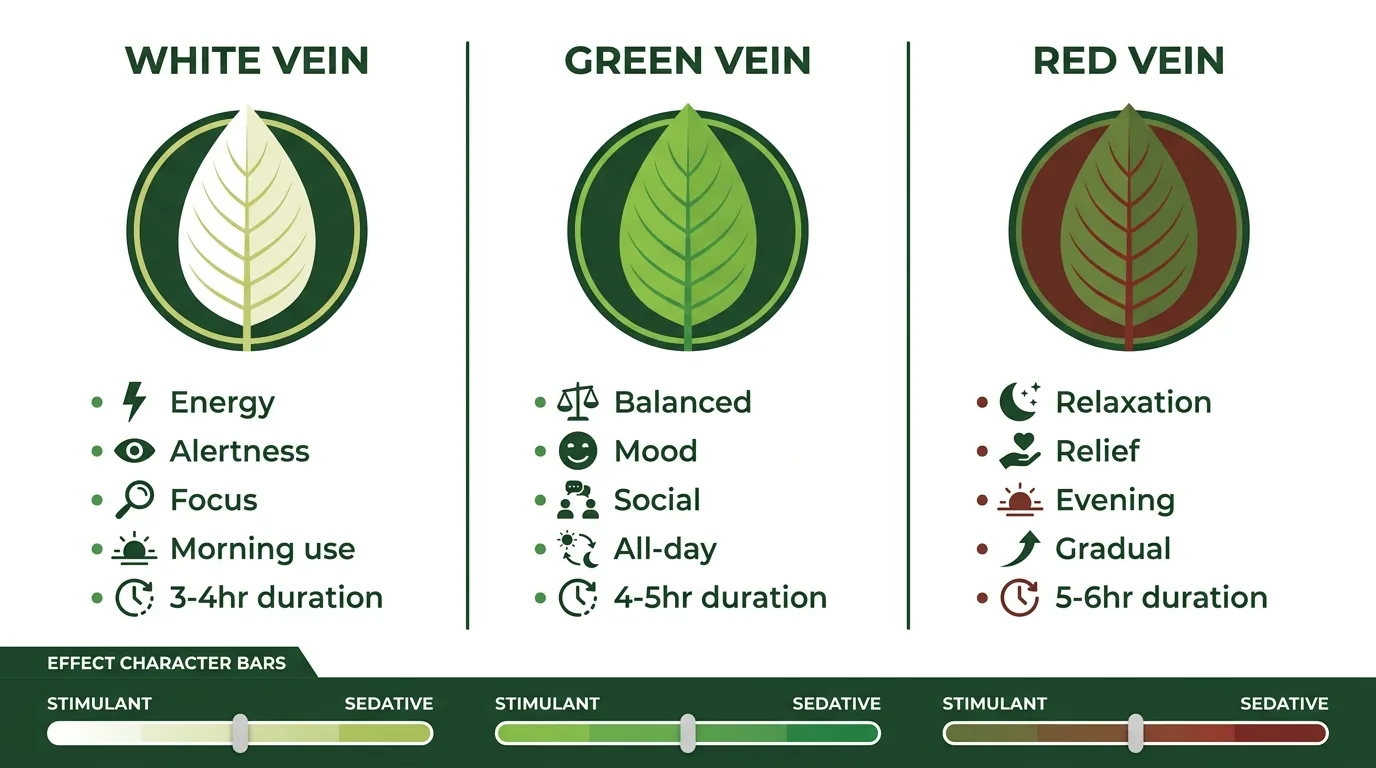
Regional strain names (Maeng Da, Borneo, Bali, Malay) are less predictive of effects than vein color in practice, because the “strain” nomenclature in the commercial kratom market is not standardized and does not reliably correspond to unique genetic varieties. Vein color is the more actionable differentiator. For a deeper dive into the alkaloid science behind strain variation, see our Kratom Strains Guide.
What Variables Affect How Kratom Feels?
Two people taking the same dose of the same product can have meaningfully different experiences. The key variables:
- Dose — The most critical variable. Small changes in dose (1–2g) can shift the dominant mechanism from stimulant to sedative. This is why starting low and adjusting is essential, especially with a new product or for a new user.
- Tolerance level — Daily kratom use downregulates opioid receptors over time, reducing both intensity and duration of effects. An experienced daily user may feel little from a dose that would strongly affect a new user. See our Kratom Tolerance Guide.
- Stomach contents — An empty stomach speeds absorption and intensifies effects at the same dose. A large meal significantly slows absorption, reduces peak concentration, and can make effects feel mild or flat.
- Mitragynine percentage (product quality) — A 5g dose of 1.2% mitragynine powder delivers 60mg; the same 5g of 1.7% delivers 85mg — a 42% difference. Smith et al. documented that dose variability from product-to-product is a major confounding factor in kratom’s dose-effect relationship.[3] Without COA-disclosed alkaloid percentages, you cannot know the actual effective dose you are taking.
- Individual CYP enzyme metabolism — Mitragynine is metabolized primarily by CYP3A4 and CYP2D6. Individuals who are fast metabolizers at these enzymes may experience shorter, milder effects; slow metabolizers may have more intense and prolonged responses at the same dose.
- Body weight and composition — Higher body weight generally requires slightly higher doses to achieve equivalent effects, consistent with standard pharmacokinetic principles.
- Mental state and setting — As with many pharmacologically active substances, subjective context influences how effects are perceived. Stress, fatigue, and expectations can modulate the experience independently of pharmacology.
How Does Tolerance Change Effects Over Time?
Tolerance is one of the most practically important aspects of kratom effects for regular users. With daily use, mu-opioid receptor downregulation reduces the number and sensitivity of active receptors — producing a state where the same dose produces weaker and shorter effects than it once did.[4]
The practical signs of developing tolerance:
- Effects feel milder than they once did at the same dose
- Duration shrinks — what used to last 5 hours now lasts 2–3
- Effects feel “flat” or “not there” even though you can feel something physical
- Increasing the dose temporarily restores effects but accelerates tolerance further
Tolerance reverses through receptor upregulation when kratom is withheld. The timeline depends on the degree of tolerance: a 2–3 day break may restore sensitivity for occasional users; long-term daily users may need 2–4 weeks for meaningful receptor reset. For the full mechanism and break protocol, see our Kratom Tolerance Break Guide.
Strain rotation — alternating vein colors rather than using the same product daily — is also commonly used to reduce tolerance buildup by engaging different alkaloid ratios across sessions rather than repeating the identical receptor stimulus.
Effects vs. Detection: What Is the Difference?
Kratom’s noticeable effects — the changes in energy, mood, or sensation — end when plasma mitragynine levels fall below the threshold for receptor activation. This typically occurs 3–6 hours after a moderate dose. The clinical pharmacokinetics data from Tanna et al. (2022) established that peak plasma concentration occurs around 1.5 hours, with the effects timeline tracking closely with this pharmacokinetic curve.[6]
Effects ending is not the same as kratom leaving the body. Mitragynine and its metabolites continue to clear for days after effects have resolved — they remain detectable in urine for 1–9 days depending on use frequency. These are two separate timelines that are often confused:
- Effects timeline: how long you feel changes — typically 3–6 hours
- Clearance timeline: how long compounds remain detectable — days
For detection windows and what tests actually screen for, see our Does Kratom Show Up on Drug Tests? guide. For full pharmacokinetic clearance data, see How Long Does Kratom Stay in Your System?
Frequently Asked Questions
Why does kratom feel so different at different doses?
Because different doses activate different receptor systems. At 1–3g, adrenergic (adrenaline-related) receptor stimulation dominates — producing stimulant effects. At 5g+, mu-opioid receptor activation becomes dominant — producing sedation and analgesia. This is the fundamental biphasic dose-response of mitragynine, not a variation in product quality or user perception. The crossover point is roughly 4–5g for most users at standard mitragynine concentrations, but it varies with individual CYP enzyme metabolism and tolerance.
Is kratom a stimulant or a sedative?
Both, depending on dose — which is what makes it unusual among botanicals. At low doses it behaves like a mild stimulant. At high doses it behaves like a mild opioid-class sedative. This dose-dependence is the most important fact to understand about kratom’s effects, and the source of most user confusion when they read conflicting accounts of what kratom “does.”
Why do different vendors’ kratom feel different at the same dose?
Almost entirely due to mitragynine content variation. A 5g dose can deliver anywhere from 40mg to 100mg of mitragynine depending on the batch’s alkaloid percentage. Without a COA disclosing the mitragynine percentage, you are guessing at your actual effective dose. Verified lab testing is the only way to compare products on a consistent basis. Every batch at Amazing Botanicals is COA-tested — see our lab testing page.
Can kratom cause anxiety?
Yes, in specific contexts: at high doses for some users; during tolerance-related inter-dose anxiety in daily users; and in users who are already anxiety-prone where the stimulant effects of low-dose kratom can exacerbate anxiety rather than relieve it. Kratom’s net effect on anxiety is strongly dose- and individual-dependent. The anxiolytic effects at moderate doses are well-documented in both animal studies and user surveys, but they are not universal. For anxious users, starting with green vein at a low dose (1–2g) is generally safer than starting with white vein at higher doses.
Does kratom produce euphoria?
At moderate-to-high doses, kratom’s mu-opioid receptor partial agonism produces mood elevation that some users describe as euphoric. It is less intense than classical opioid euphoria due to the partial agonism (ceiling effect), but it is present and is part of why kratom carries dependence potential with chronic use. At low doses, the mood lift is typically described as subtle well-being rather than euphoria.
Why do first-time users sometimes feel nothing?
Common reasons: dose too low for body weight and sensitivity; product with lower-than-expected mitragynine content; taken after a large meal significantly slowing absorption; or individual variation in CYP3A4 enzyme metabolism that clears mitragynine faster than average. If nothing was felt at 2–3g, the appropriate response is to try 3.5–4g in the next session — not to immediately jump to 6–8g.
Are kratom’s effects safe long-term?
Long-term safety data is limited. What is established: daily use carries meaningful dependence and tolerance risk via the opioid receptor mechanism; CYP enzyme inhibition creates drug interaction concerns; and some case reports link high-dose chronic use to liver stress in susceptible individuals. None of this means kratom cannot be used responsibly — but responsible long-term use means minimizing daily frequency, using the lowest effective dose, and monitoring for tolerance development. Kratom is not FDA-approved and long-term clinical safety trials do not exist.
References
- Prozialeck WC, Jivan JK, Andurkar SV. (2012). Pharmacology of kratom: an emerging botanical agent with stimulant, analgesic and opioid-like effects. Journal of the American Osteopathic Association. [PubMed]
- Kruegel AC, Uprety R, Grinnell SG et al. (2018). 7-Hydroxymitragynine Is an Active Metabolite of Mitragynine and a Key Mediator of Its Analgesic Effects. ACS Central Science. [PubMed]
- Smith KE, Feldman AZ, Rogers JM et al. (2022). Searching for a signal: self-reported kratom dose-effect relationships among a sample of US adults with regular kratom use histories. Drug and Alcohol Dependence. [PubMed]
- Grundmann O. (2017). Patterns of kratom use and health impact in the US — results from an online survey. Drug and Alcohol Dependence. [PubMed]
- Swogger MT, Hart E, Erowid F et al. (2015). Experiences of kratom users: a qualitative analysis. Journal of Psychoactive Drugs. [PubMed]
- Tanna RS, Nguyen JT, Hadi DL et al. (2022). Clinical pharmacokinetic assessment of kratom (Mitragyna speciosa), a botanical product with opioid-like effects, in healthy adult participants. Clinical Pharmacology & Therapeutics. [PubMed]
Disclaimer: This article is for educational purposes only and is not medical advice. Kratom is not FDA-approved to diagnose, treat, cure, or prevent any condition. Individual experiences vary. Consult a qualified healthcare provider with questions about health conditions or medications.
Browse the full kratom collection by vein and format.

Shop Lab-Tested Kratom
Browse our full selection of AKA GMP-qualified kratom — powder, capsules, extracts, and more. Free shipping on orders $99+.
Shop All Kratom