


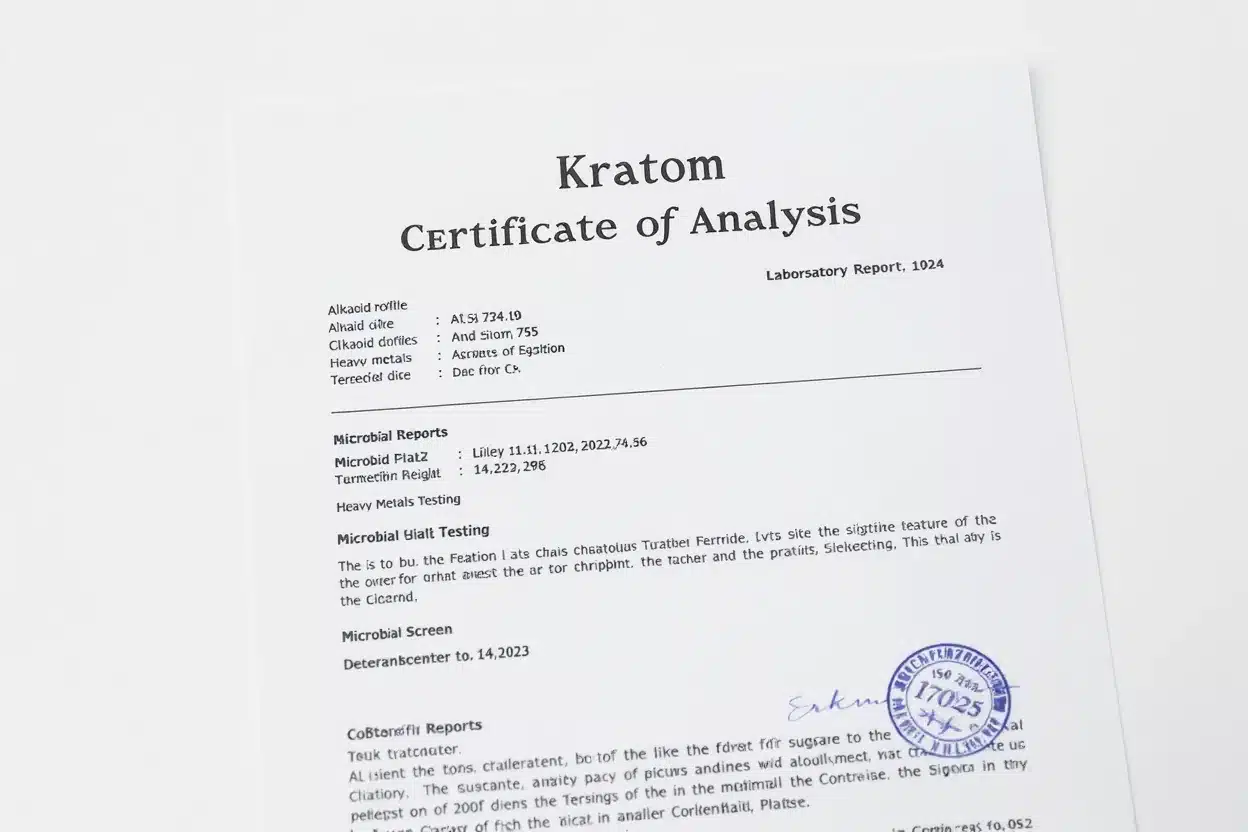
A Certificate of Analysis (COA) is the single most important document a kratom vendor can publish. It’s a lot-specific laboratory report that tells you what’s actually in the product you’re holding — alkaloid concentrations, heavy metal residues, microbial load, and pathogen screens. The catch is that a COA is only as meaningful as your ability to read it. A COA with a real-looking logo but no lot number, no accreditation, and no heavy metals panel tells you nothing. This guide walks you through every section of a kratom COA, what the numbers should look like, what the red flags are, and why COAs became the backbone of consumer due diligence in this industry.
What Is a Kratom Certificate of Analysis?
A Certificate of Analysis is a laboratory-issued document that reports the testing results for a specific production lot of kratom. Every COA is tied to a unique lot number that matches the label on the finished product — so you can verify that the document you’re reading corresponds to the jar or bag in your hand, not to some generic batch tested years ago.
The key word is lot-specific. A kratom vendor who publishes a single “representative” COA and uses it across every SKU and every shipment for a year is misusing the document. Kratom is a botanical — alkaloid content and microbial baseline vary naturally between harvests, suppliers, and even drying lots from the same farm. [4] A COA that’s not tied to the batch you received isn’t a COA; it’s marketing.
A legitimate kratom COA includes at minimum:
- Lot or batch number — matching the product label
- Sample receipt date and test completion date
- Laboratory name, address, and accreditation ID (look for ISO/IEC 17025:2017)
- Alkaloid quantification — mitragynine and 7-hydroxymitragynine at minimum
- Heavy metal panel — arsenic, cadmium, lead, mercury
- Microbial screen — total plate count, yeast, mold, coliforms, E. coli
- Pathogen test — Salmonella (absent in 25g is the FDA-recognized threshold)
- Pass/fail or numeric result for each analyte with the limit applied
What Does a Kratom COA Actually Test For?
Kratom COAs generally cover four testing categories, each run with a different analytical method. Understanding which method corresponds to which panel helps you evaluate whether the lab is using appropriate techniques.
| Test Category | Typical Method | What It Measures |
|---|---|---|
| Alkaloid quantification | HPLC-DAD, HPLC-UV, or LC-MS/MS | Mitragynine, 7-hydroxymitragynine, minor alkaloids (% by dry weight) |
| Heavy metals | ICP-MS (Inductively Coupled Plasma Mass Spectrometry) | Arsenic, cadmium, lead, mercury (ppm or µg/day exposure) |
| Microbial screen | USP <61> / FDA BAM plate counts | Total aerobic plate count, yeast, mold, coliforms, E. coli |
| Pathogens | USP <62> / AOAC 2013.01 / PCR | Salmonella spp. (required), sometimes Listeria, Staphylococcus aureus |
A COA missing any of these four categories is incomplete. The most common omissions in questionable COAs are the heavy metal panel (which the 2018 FDA kratom surveillance flagged as a category-wide problem) [5] and the pathogen test (which became a non-negotiable after the 2017–2018 multi-state Salmonella outbreak linked to kratom products).
How Do You Read the Alkaloid Profile on a COA?
The alkaloid profile is usually the first section on a kratom COA. It tells you how much mitragynine and 7-hydroxymitragynine are present by weight — and what the minor alkaloid fingerprint looks like. Mitragynine is the parent compound and 7-hydroxymitragynine is both a minor naturally-occurring alkaloid (<0.02% typically) and the endogenous metabolite your liver produces. [1]
For plain dried leaf powder, these are the concentration ranges to expect:
| Compound | Normal Range (dry weight) | Red Flag |
|---|---|---|
| Mitragynine | 1.0% – 2.0% | <0.8% (diluted) or >3% (likely enhanced) |
| 7-Hydroxymitragynine | ND – 0.02% | >0.1% in plain leaf (adulteration signal)[2] |
| Speciogynine + speciociliatine + paynantheine | Present, proportional to mitragynine | Absent (suggests isolate, not whole leaf) |
| Extract products | % varies by concentration ratio (labeled as e.g. “50mg MIT per tablet”) | Per-tablet or per-serving MIT content not disclosed |
The Lydecker group published one of the most cited analyses of the commercial kratom marketplace in 2016, testing products purchased from retail and online vendors. A subset of commercial products showed 7-hydroxymitragynine concentrations far above what fresh dried leaf naturally produces — consistent with deliberate post-harvest adulteration to increase potency. [2] This is why a plain-leaf COA showing 7-HMG above ~0.1% is a significant warning.
What Heavy Metal Limits Should a COA Show?
Kratom is a plant that absorbs metals from soil. Southeast Asian growing regions vary considerably in soil composition, and heavy metals — particularly lead and arsenic — are a real surveillance concern. In 2018, the FDA tested kratom products sold in the U.S. market and reported elevated heavy metal levels in a meaningful fraction of samples, prompting safety communications. [5]
The reference limits come from multiple overlapping frameworks. The most commonly-referenced are USP <232> (United States Pharmacopeia standards for elemental impurities in dietary supplements) and California Prop 65 (no significant risk levels for consumer products):
| Metal | USP <232> Daily Limit (oral) | Prop 65 Daily MADL/NSRL |
|---|---|---|
| Arsenic (inorganic) | 15 µg/day | 10 µg/day (NSRL) |
| Cadmium | 5 µg/day | 4.1 µg/day (MADL oral) |
| Lead | 5 µg/day | 0.5 µg/day (MADL) |
| Mercury (inorganic) | 30 µg/day | 0.3 µg/day methylmercury |
A reputable kratom COA should present either a ppm (parts per million) concentration or a µg/day exposure calculation based on a standard serving. If the COA doesn’t include a heavy metals panel at all — or only presents a pass/fail without numeric values — you can’t verify where the product falls against these thresholds.
What Microbial and Pathogen Tests Should Be Included?
Kratom is a dried botanical that has typically passed through harvesting, fermentation, drying, and packaging steps in tropical climates. Without rigorous sanitation controls, that processing chain creates opportunities for microbial contamination. The 2017–2018 multi-state Salmonella outbreak linked to kratom products — which ultimately sickened over 190 people across 41 states — is the most widely-cited real-world example of why microbial testing matters. [7]
A complete microbial section of a COA should include:
- Total Aerobic Plate Count (TPC) — measures overall bacterial load. Typical dietary supplement specification: <10,000 CFU/g (USP <2023>)
- Total Yeast and Mold Count (TYMC) — specification typically <1,000 CFU/g
- Coliforms — gram-negative bacteria indicative of sanitation failures; specification typically <100 CFU/g
- E. coli — should be negative or “not detected” at 1 CFU/g sensitivity
- Salmonella spp. — should be “not detected” (absence in 25 grams tested, per FDA BAM or AOAC 2013.01)
Some COAs also add Staphylococcus aureus and Listeria depending on the lab’s standard supplement panel. The single most important line on the microbial section is the Salmonella result — “Not Detected” or “Negative in 25g” is what you want to see.
What Are the Biggest Red Flags on a Kratom COA?
After a decade reviewing kratom COAs from dozens of suppliers, a small number of specific warning signs come up repeatedly. These are the ones to check first:
- No lot number on the COA, or a lot number that doesn’t match the product label. This is the single biggest red flag. A generic “representative sample” COA is not lot-specific testing.
- Missing accreditation ID. A legitimate lab includes its ISO/IEC 17025 accreditation number, often issued by ANAB, A2LA, or an equivalent body. If the COA doesn’t identify the lab’s accreditation, verify it by looking up the lab independently.
- Sample date older than 12 months. Alkaloid content and microbial baseline can shift over time; a COA reporting a sample taken 18+ months ago is not describing the product you’d buy today.
- Missing heavy metal panel. The FDA flagged kratom for elevated heavy metals in 2018 specifically because many commercial products weren’t being screened. [5] A COA without heavy metals is incomplete.
- Missing Salmonella test. After the 2017–2018 outbreak, pathogen testing became non-negotiable for kratom. Its absence on a COA indicates the vendor either isn’t testing or isn’t disclosing.
- 7-Hydroxymitragynine above ~0.1% in plain-leaf powder. Naturally occurring 7-HMG rarely exceeds 0.02% in fresh dried leaf; values ten times higher suggest deliberate enhancement. [2]
- Pass/fail only with no numeric values. A real COA reports concentrations, CFU counts, or µg/day exposure figures you can evaluate against known limits — not just a green checkmark.
- QR code or URL that doesn’t resolve to the lab’s own system. If the QR code on the COA points to the vendor’s own website rather than the independent lab’s verification portal, the chain of custody is broken.
What Does Adulteration Look Like on a COA?
Kratom adulteration is a documented phenomenon in the U.S. commercial market. The two best-characterized forms of adulteration, both of which show up on COAs if you know what to look for, are:
1. 7-Hydroxymitragynine enhancement. Natural 7-HMG concentration in plain dried leaf is consistently below 0.02% by dry weight. Products showing 7-HMG concentrations at 0.1%, 0.5%, or higher — while still being sold as “plain leaf powder” — have either been fortified with isolated 7-HMG or aged under conditions that promote mitragynine oxidation. Lydecker 2016 documented this pattern across multiple commercial products. [2]
2. Alkaloid spiking from non-kratom sources. The “Krypton” herbal blend fatality cases published by Kronstrand 2011 involved kratom powder spiked with O-desmethyltramadol — a synthetic opioid metabolite — sold under a kratom label. The victims’ autopsy alkaloid profiles revealed the tramadol metabolite alongside mitragynine, demonstrating that an alkaloid panel limited only to mitragynine can miss serious adulterants. [3]
A thorough COA with a full minor alkaloid profile (speciogynine, speciociliatine, paynantheine, corynantheidine) is the best defense against alkaloid-based adulteration because genuine kratom shows characteristic ratios among these compounds. A sample claiming to be kratom but missing the minor alkaloid signature is either an extract-only product or something other than whole leaf.
Why Did COAs Become Essential for Kratom?
Three specific events drove COAs from “nice to have” to “required due diligence” in the U.S. kratom market:
The 2017–2018 Salmonella outbreak. The CDC and FDA ultimately linked kratom products to 199 confirmed cases of salmonellosis across 41 states, with several serotypes traced to specific supplier lots. [7] After the outbreak, pathogen testing on every production lot became the de facto industry standard among responsible vendors.
The 2018 FDA heavy metals surveillance. When FDA tested retail kratom products, a material fraction showed lead and nickel levels above recommended daily intake thresholds. [5] This exposed that many vendors weren’t testing for heavy metals at all, and elevated ICP-MS panels on every COA to a basic market expectation.
The rise of commercial adulteration. As documented by Lydecker and others, the commercial market has included products with inconsistent alkaloid content and selective 7-HMG enrichment. [2] Without a COA showing the full alkaloid panel, consumers have no practical way to detect this.
Together these events shifted the baseline. A kratom vendor in 2026 who doesn’t publish lot-specific COAs is operating below the standard the industry itself established in response to documented problems.
How Is a COA Different From AKA GMP Qualification?
COAs and AKA GMP qualification are complementary but measure different things. A COA describes a specific batch of product; AKA GMP qualification describes the manufacturing process and facility that produced the batch. A vendor can have one without the other — and a meaningful due diligence check considers both.
- COA: lot-specific, testing-based, tells you what’s in the product you’re holding
- AKA GMP: facility-specific, audit-based, tells you whether the process that made the product follows documented quality procedures
For detailed context on the AKA GMP program and what its third-party audits cover, see our complete guide to the American Kratom Association and AKA GMP qualification.
How Does Amazing Botanicals Handle COA Testing?
Every lot of kratom we sell is tested by Anresco Laboratories — an FDA-registered, ISO/IEC 17025:2017-accredited independent laboratory based in San Francisco, operating since 1943. Anresco has no financial relationship with Amazing Botanicals beyond payment for testing services.
- ISO/IEC 17025:2017 Accredited by ANAB — Certificate AT-1551
- FDA Registered Laboratory
- California License C8-0000052-LIC
- 1375 Van Dyke Avenue, San Francisco, CA 94124
Our testing process on every incoming production lot:
- Sourcing — Direct relationships with vetted Southeast Asian suppliers with established traceability
- Lot assignment — Each incoming batch receives a unique internal lot number
- Independent sampling — Representative sample pulled per USP guidelines, sent directly to Anresco
- Full panel testing — Alkaloid profile (LC-DAD), heavy metals (ICP-MS), microbiology (USP / FDA BAM methods), Salmonella (AOAC 2013.01)
- COA review — Every result compared against our internal specifications before release
- Rejection authority — Lots failing any specification are rejected, not reworked
- Documentation — COAs retained on file and available to customers by lot number
Sample published COAs (verifiable by lot number against your product label):
- Kratom Powder — Lot LWG1125 — Tested December 2025, Sample No. 1361344. Alkaloids: tested. Microbiological: tested. Heavy metals: pass. Salmonella: negative. E. coli: <10 CFU/g. Mercury: not detected. Download full COA (PDF)
- Kratom Extract Tablets 50mg — Lot T0226-50MG-DS1 — Tested March 2026, Sample No. 1386200. Alkaloids: tested. Microbiological: tested. Salmonella: negative. E. coli: <10 CFU/g. Download full COA (PDF)
Every product we ship carries a lot number on its label that matches back to an on-file COA. If you need the COA for your specific lot, email [email protected] with the lot number and we’ll send the document directly.
Frequently Asked Questions
What does ISO/IEC 17025:2017 accreditation mean?
ISO/IEC 17025:2017 is the international standard for the competence of testing and calibration laboratories. Accreditation means the lab has been independently audited for its technical procedures, personnel qualifications, equipment calibration, and data quality management. It is the highest level of accreditation a testing lab can hold. Accreditation bodies like ANAB (ANSI National Accreditation Board) and A2LA issue the certification after on-site audits and require periodic re-audits.
Can I verify a kratom COA independently?
Yes. A legitimate COA lists the testing laboratory’s name, address, and accreditation ID. You can look up the lab directly on its website and confirm its accreditation status on the accrediting body’s database (e.g., ANAB’s public database of accredited labs). Many COAs include a QR code that links to the lab’s verification portal — not the vendor’s website. If the QR code resolves only to the vendor, that’s a warning sign.
How often should kratom be tested?
Every new production lot should be tested before release. A single COA cannot represent future lots — alkaloid content, microbial baseline, and heavy metal exposure can all shift between harvests, supplier batches, and processing conditions. Reputable vendors test each incoming batch, issue a lot-specific COA, and reject lots that fail specification rather than reprocessing or blending them.
What’s the difference between HPLC and LC-MS for alkaloid testing?
HPLC (High-Performance Liquid Chromatography, often with diode-array or UV detection) separates and quantifies alkaloids based on their chromatographic behavior. LC-MS/MS adds mass spectrometry, which identifies compounds by their molecular mass and fragmentation pattern — more specific than UV absorption alone. LC-MS is preferred for detecting adulterants and trace alkaloids; HPLC-DAD is standard and sufficient for routine mitragynine and 7-HMG quantification. [6]
Why do kratom alkaloid percentages vary between lots from the same vendor?
Because kratom is a botanical, not a manufactured chemical. Alkaloid concentration depends on tree genetics, harvest timing, leaf vein and age, drying conditions, and post-harvest handling. Even leaves from the same tree can vary across seasons. A vendor whose COAs always show identical alkaloid percentages, lot after lot, is either running the same sample through testing repeatedly or manipulating the documents. Natural variation is expected — typical plain leaf falls in a 1.0–2.0% mitragynine band.
If a product has a COA, is it guaranteed safe?
No. A COA verifies that a specific batch was tested and that the tested analytes fell within specification at the time of sampling. It does not guarantee the product is appropriate for your individual health situation, that it won’t interact with medications you take, or that your serving size is safe. A COA is a product-level document; safety decisions are individual. See our kratom safety guide for personal safety considerations.
What if a vendor’s COA only lists mitragynine percentage?
That’s a minimum-sufficient COA — it tells you alkaloid content but nothing about contamination or adulteration. A complete COA includes the mitragynine percentage plus the 7-HMG percentage, minor alkaloid profile, heavy metal panel, microbial screen, and Salmonella result. A COA with only the mitragynine line is significantly less informative than a full panel and should prompt you to ask the vendor for the complete testing documentation.
How do I know a COA wasn’t photoshopped?
The primary defenses are (1) QR codes linking to the lab’s own verification system, (2) the ability to look up the lab’s accreditation directly through ANAB or A2LA, (3) lot numbers that match the product label, and (4) contacting the lab directly to confirm they tested a given sample ID. A credible vendor will encourage these verification steps, not discourage them.
References
- Kruegel AC, Uprety R, Grinnell SG, et al. 7-Hydroxymitragynine is an active metabolite of mitragynine and a key mediator of its analgesic effects. ACS Cent Sci. 2019;5(6):992–1001.
- Lydecker AG, Sharma A, McCurdy CR, et al. (2016). Suspected Adulteration of Commercial Kratom Products with 7-Hydroxymitragynine. Journal of medical toxicology : official journal of the American College of Medical Toxicology, 12(4), 341-349. [PubMed]
- Kronstrand R, Roman M, Thelander G, Eriksson A. Unintentional fatal intoxications with mitragynine and O-desmethyltramadol from the herbal blend Krypton. J Anal Toxicol. 2011;35(4):242–247.
- Brown PN, Lund JA, Murch SJ (2017). A botanical, phytochemical and ethnomedicinal review of the genus Mitragyna korth: Implications for products sold as kratom. Journal of ethnopharmacology, 202, 302-325. [PubMed]
- Prozialeck WC, Avery BA, Boyer EW, et al. Kratom policy: The challenge of balancing therapeutic potential with public safety. Int J Drug Policy. 2019;70:70–77.
- Kikura-Hanajiri, R., Kawamura, M., Maruyama, T., Kitajima, M., Takayama, H., & Goda, Y. (2009). Survey of current trends in the abuse of psychotropic substances and plants in Japan. Forensic Toxicology, 27(2), 67–74. [DOI]
- Henningfield JE, Fant RV, Wang DW. The abuse potential of kratom according to the 8 factors of the controlled substances act: implications for regulation and research. Psychopharmacology (Berl). 2018;235(2):573–589.
Educational content only. These statements have not been evaluated by the Food and Drug Administration. This product is not intended to diagnose, treat, cure, or prevent any disease. The testing frameworks and heavy metal limits described here are general industry references; individual product COAs govern actual lot-level testing results.
Every batch we sell is third-party tested — browse our kratom and view its COA.

Shop Lab-Tested Kratom
Browse our full selection of AKA GMP-qualified kratom — powder, capsules, extracts, and more. Free shipping on orders $99+.
Shop All Kratom