


Kratom starts as a leaf on a tree in Indonesia and ends as a powder, capsule, tablet, or extract on your shelf. What happens in between — harvest, drying, milling, blending, testing, and packaging — determines whether the product you receive is safe, consistent, and accurately labeled. This guide walks through each stage of the kratom manufacturing chain, explains what can go wrong at each step, and identifies the documentation and quality-control practices that separate responsible operators from the rest of the market.
How Is Kratom Manufactured From Leaf to Finished Product?
Kratom manufacturing is an agricultural processing chain, not a pharmaceutical synthesis. The chain has eight primary stages, each of which introduces either quality risks or quality controls depending on how it’s managed:
| Stage | What Happens | Primary Quality Risk |
|---|---|---|
| 1. Cultivation | Mature Mitragyna speciosa trees grown in tropical climates | Variable soil heavy metals, immature leaf |
| 2. Harvest | Leaves selectively picked by hand | Timing mismatch with vein maturity |
| 3. Drying | Moisture reduced to 8–12% for stability | Microbial growth, alkaloid degradation |
| 4. Milling | Dried leaf ground to fine powder | Cross-contamination, equipment residue |
| 5. Blending | Sub-lots combined to meet spec | Loss of lot traceability if undocumented |
| 6. Formulation | Powder, capsule, tablet, extract, or gummy | Fill weight accuracy, excipient contamination |
| 7. QC testing | Lot sent to ISO 17025 lab for COA | Skipped testing, non-lot-specific COAs |
| 8. Packaging | Lot code applied, sealed, labeled | Label claims exceeding test results |
Each stage has both established best practices and documented failure modes. The rest of this guide walks through them.

Where Is Kratom Grown and How Is It Harvested?
Mitragyna speciosa is native to Southeast Asia and has been cultivated or wildcrafted in Indonesia, Malaysia, Thailand, Myanmar, and parts of Papua New Guinea. Since Malaysia and Thailand restricted domestic kratom trade for much of the past fifty years (Thailand decriminalized in 2021), Indonesia — particularly West Kalimantan and Sumatra — became the dominant source of U.S. commercial kratom. [1]
Cultivation variables that carry through to finished product include:
- Tree maturity: alkaloid concentration increases meaningfully as trees mature past 4–5 years. Immature trees produce leaves with lower and less balanced alkaloid profiles
- Soil composition: heavy metals in soil accumulate in leaves, which is why lead, arsenic, and cadmium surveillance at the finished-product stage is non-negotiable [5]
- Vein maturity at harvest: vein color (red/green/white) reflects leaf age and drying conditions, not a separate plant variety — see our green vs. red kratom guide for detail
- Seasonal conditions: rainfall patterns affect both alkaloid concentration and post-harvest microbial load. A 2023 Thai field study documented meaningful seasonal and geographic variation in leaf alkaloid content across cultivation regions [8]
Harvest itself is hand-performed — kratom trees in commercial cultivation are maintained at a height where pickers can selectively remove mature leaves without stripping the tree. Good harvest practice keeps leaves off the ground (contamination risk) and delivers them to drying within a narrow post-harvest window to prevent unwanted fermentation.
How Are Kratom Leaves Dried After Harvest?
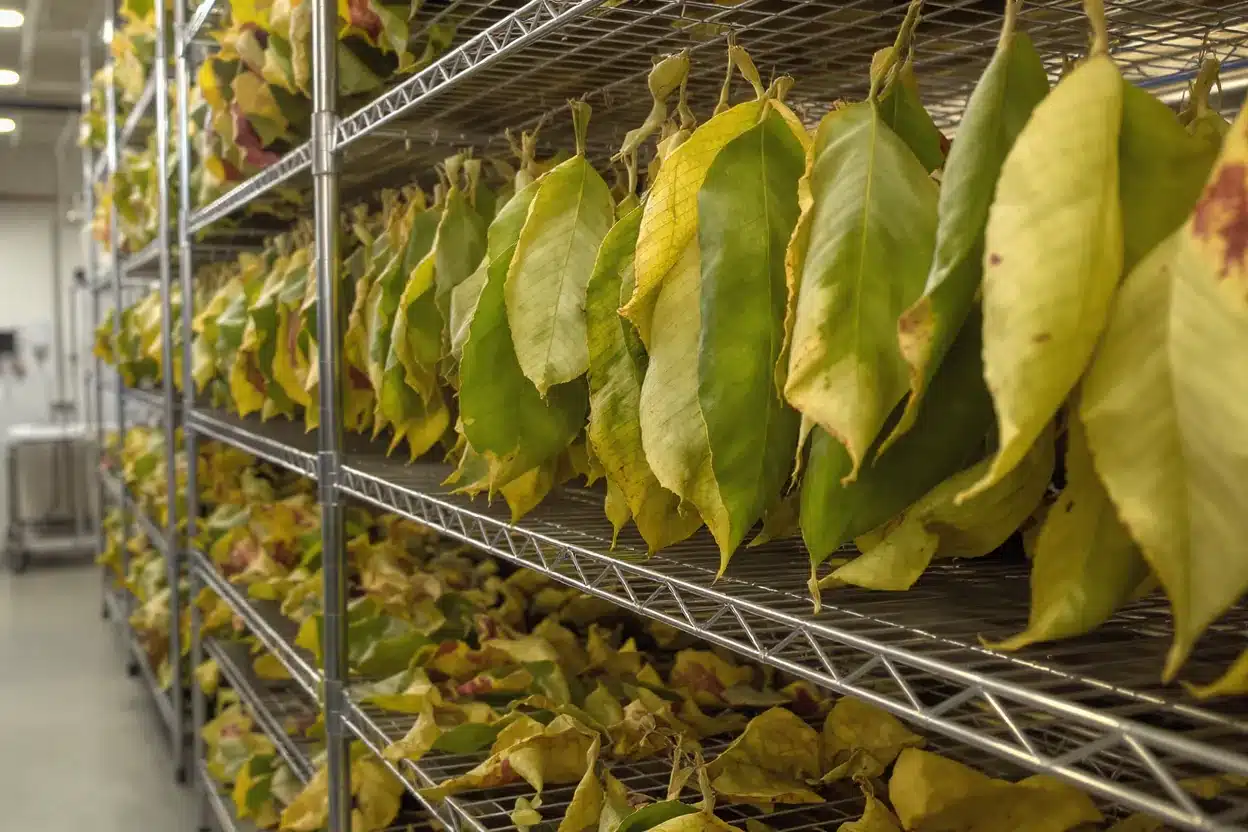
Drying reduces leaf moisture from ~60% fresh to 8–12% in finished material. That range is where the leaf is stable enough for storage and milling without being so dry that it becomes brittle and dusty. Drying practices directly influence three quality dimensions:
- Microbial load. Leaves dried too slowly or in humid conditions support bacterial and fungal growth. This is the upstream origin of the microbial and Salmonella concerns that COAs are designed to catch downstream [6]
- Vein color development. The “vein color” (red, green, white) finished-product label often reflects how the leaf was dried rather than a genetic distinction — indoor versus outdoor, UV exposure, and fermentation timing all affect the final presentation [2]
- Alkaloid retention. Excessive heat or prolonged drying degrades mitragynine. Well-managed drying preserves the characteristic 1.0–2.0% mitragynine range in plain leaf powder
Common drying approaches include shaded outdoor drying on racks, indoor room drying with dehumidifiers, and combined approaches where leaves are partially dried outdoors then finished indoors. The method matters less than whether it’s consistent and documented.
How Is Dried Kratom Leaf Milled Into Powder?
Once dried, leaves are milled into fine powder through a series of grinding steps — typically a coarse pre-grind followed by a fine mill that produces the 40–80 mesh particle size characteristic of U.S. retail kratom powder. The chemistry of the leaf does not change; milling is a physical transformation only.
The quality-control issues at the milling stage are sanitation-focused:
- Equipment cleaning between lots — to prevent cross-contamination between different source lots or different product lines
- Metal detection — fine-milling equipment wear can introduce trace metal particles, which a magnet or metal detector in the product stream catches
- Allergen and non-kratom cross-contamination — relevant when the same facility processes other botanicals
- Dust management — kratom powder is inhalable at fine mesh sizes; operator PPE and facility dust collection are safety requirements
Once milled, powder is passed through sieves to confirm consistent mesh size before it moves to blending or direct packaging.
How Are Kratom Batches Blended for Consistency?
Most commercial kratom products are blended into defined batches rather than sold as single-sublot material. Blending combines multiple sub-lots of milled powder to achieve a target alkaloid specification and a predictable sensory profile. The goal is not to standardize the plant — which isn’t possible for a botanical — but to narrow the range of variation a customer experiences between purchases.
Responsible blending requires:
- Pre-blend sub-lot testing so the blender knows the alkaloid profile of each input
- Calculated blend ratios that target a known mitragynine specification
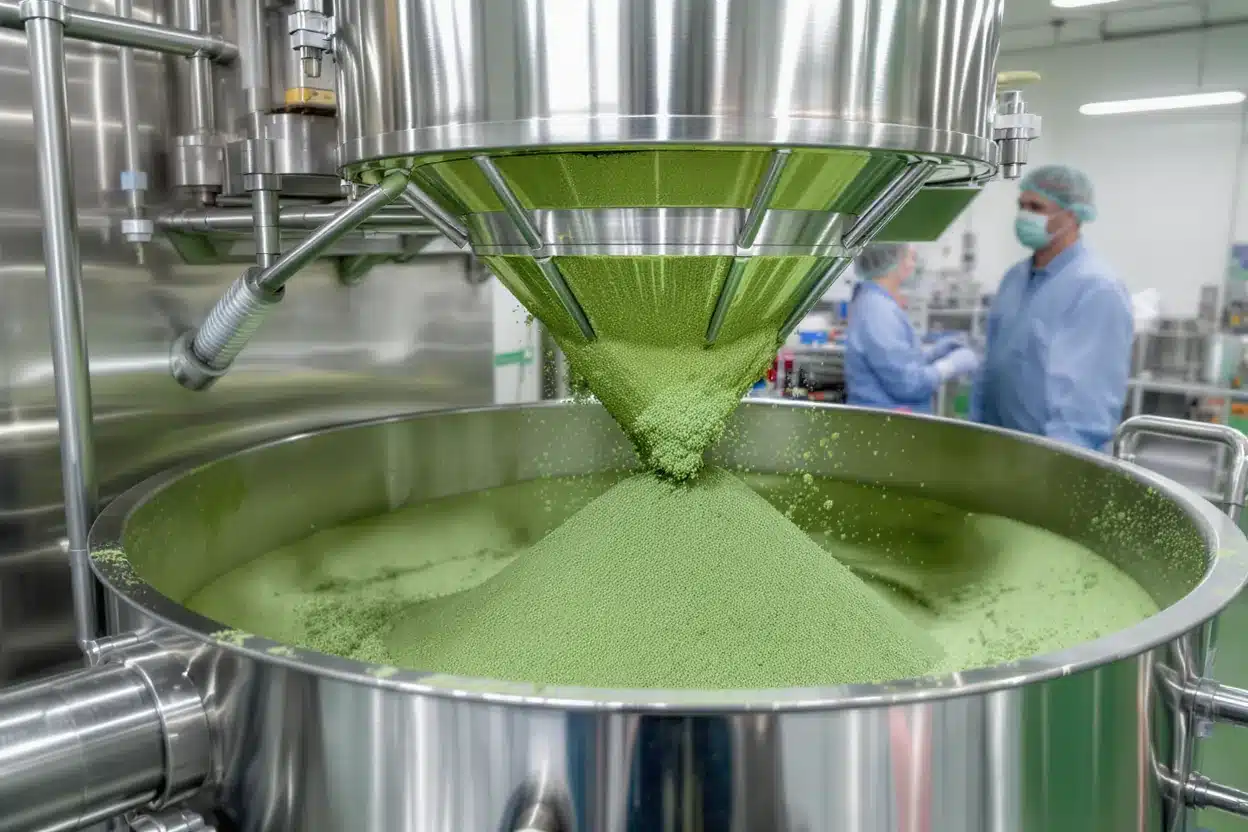
- Complete mixing in ribbon blenders or V-cone mixers to ensure homogeneity
- Post-blend retesting on the finished lot before release
- Documentation linking the final lot number back to its input sub-lots
A blended lot that doesn’t trace back to its component sub-lots is a black box — problems that surface later can’t be diagnosed or recalled effectively. This is the strongest practical argument for blended batches to carry full documentation, not just a single finished-lot COA.
How Are Capsules, Tablets, and Extracts Made Differently?
Kratom is sold in multiple finished forms, each with different manufacturing considerations:
| Form | Additional Processing | Added QC Considerations |
|---|---|---|
| Plain powder | None beyond milling and blending | Minimal — alkaloid and microbial panel |
| Capsules | Powder encapsulated (vegetarian or gelatin shells) | Fill weight accuracy, capsule material verification |
| Tablets | Powder or extract compressed with binders/excipients | Excipient purity, dissolution, weight variance |
| Extracts (resin, paste, isolate) | Solvent extraction, concentration, solvent recovery | Residual solvent testing, potency labeling accuracy |
| Shots / liquids | Extract dissolved in vehicle, preserved | Microbial stability, preservative system |
| Gummies / edibles | Extract blended into confection base | Dose uniformity, matrix interference with testing |
Extracts warrant specific attention. Producing an extract involves selectively concentrating alkaloids via solvent extraction, which changes the chemistry balance of the finished product relative to whole leaf. Extract products require:
- Residual solvent testing (typically ethanol, water, or food-grade alcohols; GC-MS confirmation)
- Precise potency labeling — mitragynine milligrams per serving, not percentage
- Clear differentiation from plain leaf on the label so dose comparisons aren’t made across categories
Extracts are a legitimate product category when manufactured and labeled responsibly. They become a problem when they’re manufactured to selectively enrich 7-hydroxymitragynine beyond what occurs naturally — which was the pattern Lydecker 2016 documented in a subset of commercial products. [3]
How Is Quality Control Performed Before Packaging?
Quality control in kratom manufacturing spans both in-process checks and finished-goods third-party testing. In-process checks happen at the manufacturer and include visual inspection, moisture confirmation, mesh size verification, and blend homogeneity. These are necessary but not sufficient — in-process checks don’t substitute for independent verification.
Third-party testing is the verification layer and is performed by an ISO/IEC 17025:2017-accredited laboratory with no financial relationship to the manufacturer beyond the testing service contract. A complete QC panel covers four categories:
- Identity and alkaloid quantification — HPLC-DAD or LC-MS to confirm the material is kratom and to quantify mitragynine and 7-HMG [4][10]. A 2026 QC study combined DNA barcoding with UHPLC, GC-MS, and LC-MS/QTOF to differentiate Mitragyna speciosa from allied Mitragyna species — relevant because supply chain substitution and adulteration with related species are documented
- Heavy metals — ICP-MS for arsenic, cadmium, lead, and mercury against USP <232> limits. A 2024 review of elemental impurity analyses across commercial U.S. kratom products found that lead and nickel were the most common exceedances, underscoring why lot-by-lot ICP-MS is not optional [9]
- Microbial screen — USP <61> plate counts for TPC, yeast/mold, coliforms, and E. coli
- Pathogens — Salmonella absence in 25g per FDA BAM or AOAC 2013.01
The output of third-party testing is a Certificate of Analysis (COA) tied to the specific lot. A lot without a corresponding COA should not be released to market. For a detailed walkthrough of how to read a COA, see our complete kratom COA guide.
How Are Kratom Products Labeled for Traceability?
Packaging is where the chain closes. Every finished unit should carry a lot code that matches back to its COA — typically printed on the bottom of the container or on the primary label. The lot code is the single piece of information that lets a consumer verify what’s in their jar.
Responsible kratom packaging includes:
- Lot or batch code — unique identifier matching the COA
- Production or package date — so consumers can assess freshness
- Best-by or expiration date — typically 24 months for sealed powder
- Net weight — accurate to stated specification
- Ingredient statement — plain kratom powder should list only “Mitragyna speciosa leaf powder” without additives
- Alkaloid disclosure — voluntary but increasingly standard; mitragynine mg/serving is the useful figure
- Contraindication and age-restriction statements — required in states with active Kratom Consumer Protection Act (KCPA) legislation
- FDA disclaimer — “These statements have not been evaluated by the Food and Drug Administration”
Packaging that’s photographed for consistency across lots but not actually lot-coded is a common problem — it looks professional but breaks the traceability chain. A genuine lot code on a genuine COA is the audit trail that lets manufacturers recall specific lots without pulling the entire product line.
What Can’t Kratom Manufacturing Actually Do?
Even with rigorous manufacturing controls, there are limits intrinsic to kratom as a botanical that no process can eliminate:
- Natural variability doesn’t disappear. Alkaloid ratios, minor alkaloid profiles, and sensory characteristics vary between lots even from the same supplier. Blending narrows the range but does not produce pharmaceutical uniformity [7]
- Individual responses still vary. Two people taking the same product from the same lot can have meaningfully different experiences due to CYP2D6 genetics, body composition, prior exposure, and coadministered food or medications
- Manufacturing is not clinical research. A well-manufactured product is documented and consistent, but that doesn’t establish clinical efficacy for any specific use
- Testing documents a moment in time. COAs reflect lot-level results at the sampling date — storage, exposure to heat or humidity, or extreme time since manufacture can shift the practical quality of a product after testing
These limits are not a manufacturing failure; they’re the nature of a botanical product. Responsible manufacturing manages the variability through documentation and testing rather than overpromising uniformity.
How Does Amazing Botanicals Handle Manufacturing?
Amazing Botanicals has been AKA GMP-qualified since 2019 and operates under a documented quality management system covering sourcing, incoming inspection, sub-lot testing, blending, third-party verification, and finished-goods packaging. Our published practices include:
- Vetted Indonesian suppliers with established traceability and documented agricultural practices
- Lot assignment on incoming material so every batch carries a unique internal identifier from receipt forward
- Third-party laboratory testing on every lot via Anresco Laboratories (ISO/IEC 17025:2017-accredited, FDA-registered, San Francisco)
- Rejection authority — lots that fail alkaloid, microbial, or heavy metal specifications are rejected, not reprocessed
- Lot-coded finished packaging with codes that match their respective COAs
- Annual AKA GMP recertification with third-party on-site audit
For context on the AKA GMP program and what the third-party audit actually inspects, see our complete AKA GMP guide. For a walkthrough of reading the specific COAs our lots are tested against, see our kratom COA guide.
Frequently Asked Questions
Is kratom manufacturing regulated by the FDA?
Kratom is sold as a dietary ingredient, which under U.S. law means it falls under FDA’s 21 CFR 111 current Good Manufacturing Practices for dietary supplements. However, the FDA has taken an adversarial posture toward kratom — issuing import alerts and warning letters — without providing category-specific regulatory guidance. In practice, kratom operators who follow 21 CFR 111 and participate in the AKA GMP program operate at a standard higher than what is actively enforced.
What is cGMP and does it apply to kratom?
cGMP stands for “current Good Manufacturing Practices” — the FDA-enforced standards under 21 CFR 111 for dietary supplement manufacturing. It applies to any supplement sold in the U.S., including kratom. The AKA GMP Standards Program is a kratom-specific voluntary layer built on top of 21 CFR 111 that adds kratom-specific requirements around alkaloid profiling, heavy metal testing, and pathogen screening.
How long does it take from harvest to finished product on a U.S. shelf?
Typical timelines run 4–8 weeks from leaf harvest in Indonesia to finished packaged product available for sale in the U.S. The stages: harvest and drying (1–3 weeks), international shipping (2–3 weeks), customs clearance, incoming inspection, sub-lot testing (3–7 days), blending and finishing (1 week), final third-party testing (5–10 business days), packaging and release. Lots that fail testing restart portions of this cycle.
Why do batches of the same strain vary?
Because kratom is an agricultural product, not a manufactured chemical. Alkaloid content varies between trees, between sub-lots from the same supplier, and between harvests from the same tree across seasons. Responsible blending narrows the variation toward a target specification, but does not eliminate it. A “Green Maeng Da” lot this quarter is not chemically identical to a “Green Maeng Da” lot from last quarter — it’s within the same alkaloid-profile band.
What happens when a production lot fails quality control?
At a responsible operator, the lot is quarantined and rejected rather than reprocessed or blended out. Rejection means the material is either returned to supplier, destroyed, or — in the case of borderline microbial results — disposition-reviewed but never released without re-test documentation. Re-blending a failed lot with a passing lot to meet specification is an unacceptable practice that undermines the entire testing framework.
Is kratom irradiated or pasteurized?
Some manufacturers use ethylene oxide treatment, irradiation, or steam pasteurization to reduce microbial load on incoming raw material. These processes are legal under U.S. regulations when properly labeled. Consumer preference varies; Amazing Botanicals does not use irradiation and addresses microbial risk through upstream sanitation controls, supplier selection, and post-lot microbial testing rather than post-hoc sterilization.
Can kratom be commercially grown in the United States?
Small-scale U.S. cultivation exists in southern Florida, Hawaii, and a few other tropical or subtropical microclimates, but commercial-scale domestic production remains minimal. Kratom trees require tropical conditions and 4–5 years to reach productive maturity, which has made sustained domestic supply economically difficult. Virtually all U.S. retail kratom is sourced from Indonesia.
What’s the difference between contract manufacturing and in-house manufacturing?
Contract manufacturers produce kratom products on behalf of brands that don’t operate their own facilities — the contract manufacturer handles milling, blending, encapsulation, and packaging, then ships finished goods to the brand for distribution. In-house manufacturing means the brand controls every stage. Both can produce quality product if documented and audited properly; the quality question is whether the operator — contract or in-house — is AKA GMP-qualified and tests every lot, not which model they use.
References
- Grundmann O (2017). Patterns of Kratom use and health impact in the US-Results from an online survey. Drug and alcohol dependence, 176, 63-70. [PubMed]
- Brown PN, Lund JA, Murch SJ (2017). A botanical, phytochemical and ethnomedicinal review of the genus Mitragyna korth: Implications for products sold as kratom. Journal of ethnopharmacology, 202, 302-325. [PubMed]
- Lydecker AG, Sharma A, McCurdy CR, et al. (2016). Suspected Adulteration of Commercial Kratom Products with 7-Hydroxymitragynine. Journal of medical toxicology : official journal of the American College of Medical Toxicology, 12(4), 341-349. [PubMed]
- Kikura-Hanajiri, R., Kawamura, M., Maruyama, T., Kitajima, M., Takayama, H., & Goda, Y. (2009). Survey of current trends in the abuse of psychotropic substances and plants in Japan. Forensic Toxicology, 27(2), 67–74. [DOI]
- Prozialeck WC, Avery BA, Boyer EW, et al. Kratom policy: The challenge of balancing therapeutic potential with public safety. Int J Drug Policy. 2019;70:70–77.
- Henningfield JE, Fant RV, Wang DW. The abuse potential of kratom according to the 8 factors of the controlled substances act. Psychopharmacology (Berl). 2018;235(2):573–589.
- Kamble SH, Sharma A, King TI, et al. (2019). Metabolite profiling and identification of enzymes responsible for the metabolism of mitragynine, the major alkaloid of Mitragyna speciosa (kratom). Xenobiotica; the fate of foreign compounds in biological systems, 49(11), 1279-1288. [PubMed]
- Sengnon N, Vonghirundecha P, Chaichan W, et al. Seasonal and geographic variation in alkaloid content of kratom (Mitragyna speciosa) from Thailand. Plants (Basel). 2023;12(4):949.
- Snow Caroti K, Joseph A, Sapowadia A, et al. Elemental impurities (heavy metals) in kratom products: an assessment of published individual product analyses. Clin Toxicol (Phila). 2024;62(10):651–660.
- Anantaworasakul P, Arunotayanun W, Chaichit S, et al. DNA barcoding and chemical profile using UHPLC, GC-MS and LC-MS/QTOF of Mitragyna speciosa variation and allied species for quality control of kratom materials. Plants (Basel). 2026;15(7):992.
Educational content only. These statements have not been evaluated by the Food and Drug Administration. This product is not intended to diagnose, treat, cure, or prevent any disease. Manufacturing practices described are general industry references; individual vendors’ actual practices vary and should be verified through COA documentation and AKA GMP qualification status.
See the finished product — our GMP-qualified kratom powder.

Shop Lab-Tested Kratom
Browse our full selection of AKA GMP-qualified kratom — powder, capsules, extracts, and more. Free shipping on orders $99+.
Shop All Kratom