

The American Kratom Association (AKA) is a U.S. nonprofit consumer-advocacy organization that runs the industry’s only widely-adopted vendor quality program — the AKA Good Manufacturing Practices (GMP) Standards Program. It is not a regulator. It cannot approve products, issue COAs, or enforce federal law. What it does is publish a written standard, commission independent third-party audits, and maintain a public list of vendors who have passed those audits. For a supplement the FDA has refused to regulate, that voluntary framework is one of the few meaningful signals of vendor accountability consumers have.
What Is the American Kratom Association?
The American Kratom Association was founded in 2014 as a 501(c)(4) nonprofit advocacy organization representing kratom consumers and responsible vendors in the United States. Its stated mission is to protect consumer access to safe, unadulterated kratom products and to prevent federal scheduling of the plant.
The organization has three primary functions:
- Legislative and regulatory advocacy — lobbying state legislatures to pass the Kratom Consumer Protection Act and engaging with federal agencies (DEA, FDA, HHS) on scheduling and regulatory decisions
- Public education and media response — producing materials on kratom’s pharmacology, safety profile, and legal status, and responding to media narratives about adverse events
- Industry self-regulation via GMP standards — operating the AKA GMP Standards Program, the voluntary manufacturing-quality program that has become the industry’s de facto benchmark
The AKA was most visibly tested in 2016, when the DEA issued a Notice of Intent to place mitragynine and 7-hydroxymitragynine into Schedule I as emergency substances. The AKA coordinated public comment, petition drives, and Congressional engagement that contributed to the DEA’s withdrawal of the notice in October 2016 — one of very few times the agency has reversed a scheduling action under public pressure. [4]
The organization does not regulate kratom, does not license manufacturers, and does not issue medical guidance. It operates as consumer advocacy paired with a voluntary industry standards program.
Why Does the AKA Exist When the FDA Regulates Supplements?
This is the right question to ask, and the answer explains everything about why the AKA GMP program has the shape it does.
Under the Dietary Supplement Health and Education Act of 1994 (DSHEA), the FDA has authority over dietary supplements — but that authority is primarily reactive. Supplements are not pre-approved for safety or efficacy; instead, the FDA can take action after a product is on the market if it is adulterated, misbranded, or found to cause harm. For a botanical like kratom, the FDA’s position has been unambiguous: it does not consider kratom a dietary supplement eligible for lawful marketing under DSHEA, and it has issued import alerts and warning letters to kratom vendors since 2014.
This produces a regulatory paradox. Kratom is legally sold and consumed in most U.S. states, generates hundreds of millions of dollars in annual commerce, and is used by an estimated 1.7 million adults according to SAMHSA’s 2021 National Survey on Drug Use and Health data. [2] Yet federally, there is no pre-market approval framework, no mandatory manufacturing standard, no required testing regimen, and no label-accuracy enforcement mechanism specific to kratom.
Into that vacuum, the AKA built the GMP program. The specific problems it was designed to address were documented:
- Adulteration with synthetic 7-hydroxymitragynine — Lydecker et al. (2016) found multiple commercial kratom products with 7-HMG at levels impossible from authentic whole-leaf processing, indicating spike-adulteration with synthetic compound [1]
- Salmonella contamination — a 2017–2018 multistate outbreak (CDC investigation) was traced to kratom products from multiple vendors and linked to 199 confirmed cases across 41 states
- Heavy metal contamination — independent testing found lead and nickel levels above acceptable thresholds in some imported material, reflecting uncontrolled sourcing from farms with variable soil quality. A 2022 public-health analysis specifically traced lead in commercial U.S. kratom products to upstream agricultural sourcing and the absence of federal testing mandates [7]
- Label inaccuracy — products labeled as specific strains were often indistinguishable by HPLC, and alkaloid claims frequently exceeded what batches actually contained [1]
- Undisclosed ingredients — some “kratom” products were found to contain kratom alongside other psychoactive compounds (tianeptine, O-desmethyltramadol) [5]
The AKA GMP program is a direct response to those documented failures. Its audit criteria map almost one-to-one onto the specific failure modes observed in the 2016–2018 period. A 2024 Frontiers in Pharmacology review on kratom safety and regulation argued that the evidence base now supports formalized dietary-supplement-style oversight — which is exactly the regulatory shape the AKA GMP + KCPA stack is designed to emulate in the FDA’s absence [8].
What Is the AKA GMP Standards Program?
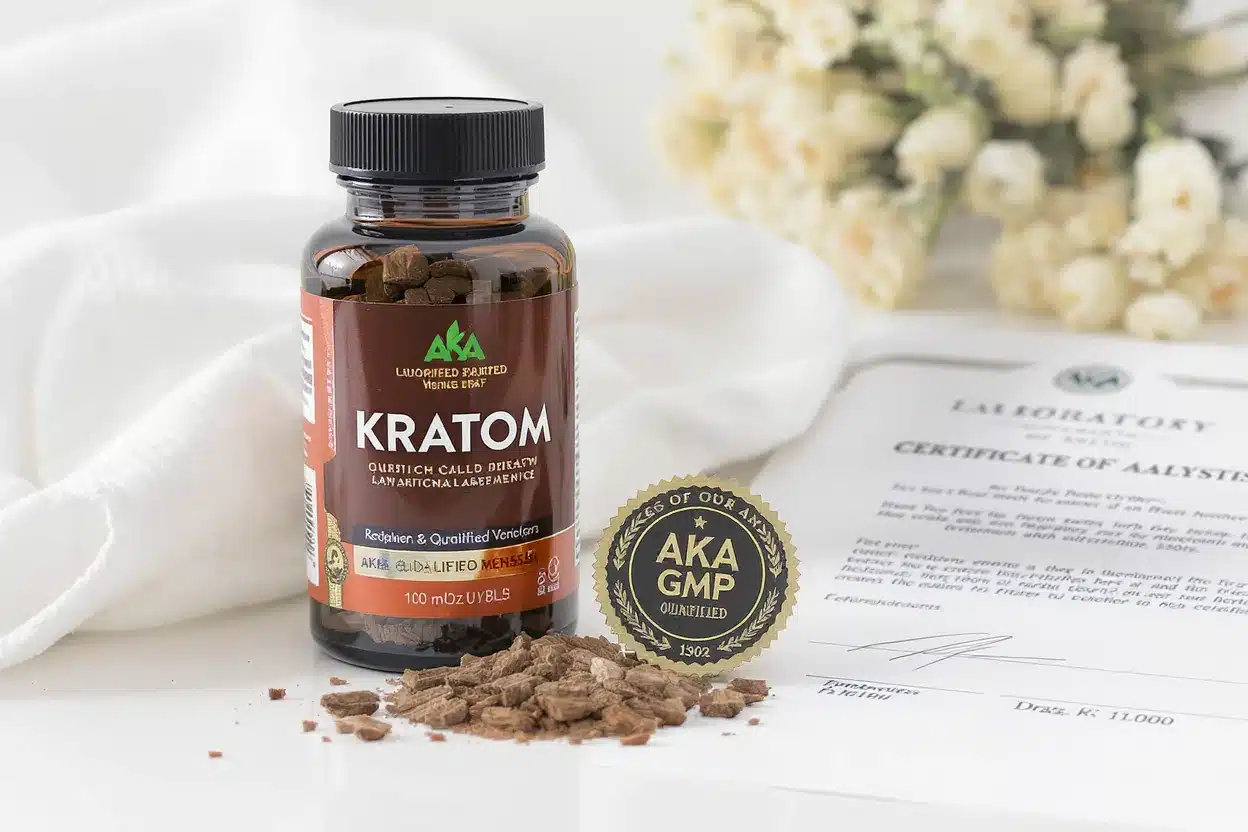
The AKA GMP Standards Program is a voluntary manufacturing-quality program administered by the American Kratom Association. Vendors who wish to become “AKA GMP Qualified” submit to third-party audits against a written standard covering every stage from raw-material receipt through finished-product shipment.
The program has two main components: the written standard (a document published by the AKA detailing required practices) and the audit process (conducted by independent third-party auditing firms not employed by the AKA).
| Category | Required Practices | Verified By |
|---|---|---|
| Facility and sanitation | Dedicated processing area, pest control program, cleaning logs, air quality | On-site audit inspection |
| Raw material sourcing | Supplier qualification, incoming material COAs, quarantine-until-tested protocol | Records review, sample verification |
| Testing and lab requirements | Third-party testing of every batch for microbials, heavy metals, alkaloid profile | COA review, lab accreditation check |
| Batch tracking and traceability | Lot coding, full supply-chain documentation from farm to finished product | Random lot traceback exercise during audit |
| Label accuracy and claims | No unapproved health claims, accurate strain/alkaloid disclosure, proper disclaimers | Label audit vs. COA data |
| Age verification and sales | 21+ verification at checkout, no sales to minors, no sales in prohibited states | Website and checkout flow review |
| Employee training | Documented training on GMP procedures, sanitation, handling | Training record review, employee interviews |
| Recall and adverse-event handling | Written recall plan, adverse event intake process, retention samples | Mock recall exercise during audit |
| Prohibited products | No synthetic 7-HMG isolates, no unapproved blends with other substances | Product line review, lab spot-check |
The specificity of these requirements is important. AKA GMP is not a vague “quality pledge” — it is a written, auditable standard with pass/fail criteria developed in response to the specific adulteration, contamination, and labeling failures the industry had documented.
How Does an AKA GMP Audit Actually Work?
The audit process has several stages, and understanding it clarifies what AKA qualification actually verifies.
Stage 1 — Application and documentation review. A vendor applies to the program and submits a comprehensive document package: facility specifications, SOPs, sourcing documentation, lab accreditation paperwork, and sample COAs. The AKA’s review team assesses whether the documentation meets the written standard before an on-site audit is scheduled.
Stage 2 — On-site third-party audit. The AKA does not conduct audits itself. Audits are performed by independent firms — currently including companies specialized in food-grade and supplement manufacturing audits — that are not employed by the AKA. The auditor spends one to two days on-site, physically inspecting the facility, reviewing records, interviewing staff, and running traceback exercises on randomly selected lots.
Stage 3 — Findings and corrective actions. The audit report documents any non-conformances. Minor findings typically require written corrective action within a defined timeframe. Major findings may require re-audit or prevent qualification until resolved. The AKA has decertified vendors in the past when re-audits revealed unresolved issues.
Stage 4 — Qualification and listing. Once the audit is passed and corrective actions closed, the vendor is listed on the AKA’s public GMP Qualified Vendors page. The qualification is time-bound (typically annual) and requires re-audit for renewal.
In ten years running this business, I’ve been through multiple audit cycles. The program is not rubber-stamped. Auditors have flagged things ranging from cleaning-log timing gaps to labeling language that needed revision to meet the standard. The value isn’t that auditors never find anything — it’s that when they find something, there is a paper trail and a corrective-action requirement.

What Is the Kratom Consumer Protection Act (KCPA)?
The AKA’s most significant legislative initiative is the Kratom Consumer Protection Act, model legislation designed for adoption at the state level. The KCPA creates state-level labeling, testing, and sales requirements for kratom — effectively a state-by-state regulatory framework in the absence of federal action.
Core KCPA provisions typically include:
The regulatory gap KCPA fills keeps widening. A 2026 Public Health Reports commentary flagged that ready-to-drink kratom beverages — a product category KCPA-drafting predates — are now being sold without alkaloid disclosure, age verification, or contaminant testing in states without active KCPA enforcement, illustrating why AKA GMP + KCPA coverage needs to expand to new product formats [10].
- Minimum purchase age of 21 for all kratom products
- Mandatory batch testing for contaminants (microbials, heavy metals, yeast, mold)
- Prohibition of products containing synthetic alkaloids or non-kratom psychoactive additives
- Alkaloid content disclosure (mitragynine and 7-HMG percentages)
- Manufacturer registration and product registration with the state
- Enforcement mechanisms — typically state agriculture or health department oversight with civil penalties
State adoption has accelerated significantly since 2019. As of early 2026:
| Status | States | What It Means |
|---|---|---|
| Full KCPA enacted | Utah, Georgia, Arizona, Nevada, Oklahoma, Colorado, Virginia, West Virginia, Mississippi, Louisiana, Florida (partial), Texas, others | Regulatory framework in place; vendors must comply to sell in state |
| Pending legislation | Multiple states with active bills | Consumer should monitor; framework may change |
| Kratom banned | Alabama, Arkansas, Indiana, Rhode Island, Vermont, Wisconsin (+ selected local jurisdictions) | Kratom is illegal to possess or sell; KCPA does not apply |
| No specific kratom legislation | Remainder of states | Kratom legal but unregulated at state level; federal status applies |
The KCPA framework is significant because it effectively codifies many AKA GMP requirements into state law. A vendor who is AKA GMP-qualified is generally already in compliance with KCPA requirements — the two programs were designed to reinforce each other. A 2024 analysis of nationally representative U.S. use data found that state KCPA adoption is associated with meaningful differences in consumer use patterns and perceived product safety, supporting the practical impact of state-level regulatory action [9].
What AKA Qualification Is Not
Equally important to understanding what AKA qualification means is understanding what it does not mean. Misunderstanding this is common in consumer discussions and vendor marketing.
AKA GMP is not FDA approval. The FDA has not approved kratom as a dietary supplement, and AKA GMP qualification does not change that. No AKA-qualified vendor can legally make therapeutic claims about their products under FDA law, and AKA qualification does not shield vendors from FDA enforcement action if such claims are made.
AKA GMP is not a safety guarantee. The program verifies process compliance — that a vendor follows documented procedures for sourcing, testing, labeling, and handling. It does not guarantee that every batch is safe for every consumer, that no adverse events will occur, or that the product is suitable for any particular purpose. Kratom is a botanical with known pharmacological activity; individual responses vary regardless of manufacturing quality. [3] A 2023 Substance Abuse Treatment, Prevention, and Policy study that evaluated the educational content published by AKA GMP-qualified vendors found wide variation in how well consumer-facing dosing, interaction, and contraindication information was presented — a reminder that qualification reflects manufacturing process, not the caliber of public-facing health communication [6].
AKA GMP is not equivalent to USDA organic or GFSI-benchmarked food certifications. Those programs have different scopes, longer histories, and (in the case of GFSI) benchmarking against internationally recognized food safety schemes. AKA GMP is a kratom-industry-specific program and should be understood as such.
AKA GMP does not test products or issue COAs. The AKA does not operate a lab. It verifies that the vendor is using an ISO-accredited third-party lab, reviewing COAs, and acting on test results. The COAs themselves come from labs like Greenleaf, Tahoma, and Eurofins — not from the AKA.
AKA GMP is not universally adopted. Many kratom vendors — including some with large market share — are not AKA GMP-qualified. This does not automatically mean their products are unsafe, but it does mean consumers cannot verify the same process standards. The absence of qualification is a piece of information; its interpretation depends on what other quality signals are available.
How Do You Verify a Vendor’s AKA GMP Status?
This is important because the AKA GMP badge appears on many vendor websites, and not all of those claims are current or accurate.
The authoritative source is the AKA’s public GMP Qualified Vendors page, maintained at americankratom.org. The list shows:
- The vendor’s company name (and any d/b/a names)
- The date of most recent audit
- Current qualification status (qualified, in-process, lapsed, decertified)
If a vendor claims AKA GMP qualification but does not appear on that list, the claim is either out of date or inaccurate. The AKA updates the list as audits complete or lapse, and the organization has publicly delisted vendors whose qualifications were not renewed or whose follow-up audits revealed issues.
Amazing Botanicals has been on this list since our initial qualification in 2019, with uninterrupted re-audit renewal. Our current audit documentation and COAs are available on our lab testing page.
When assessing a vendor, the pragmatic check is:
- Confirm AKA GMP listing on americankratom.org
- Request a current-batch COA showing mitragynine percentage, 7-HMG, microbials, and heavy metals
- Verify the COA is from an ISO-accredited lab (the lab name and accreditation number should be on the COA)
- Check that the date on the COA matches the lot code on the product you received
Those four checks together give you meaningful verification. AKA qualification alone, without a COA, does not. A COA alone, from a vendor with no manufacturing-quality oversight, also does not. The combination is what provides assurance.
How Does AKA GMP Compare to Other Third-Party Certifications?
AKA GMP is one of several quality signals in the broader supplement and natural-products landscape. Understanding where it fits helps calibrate expectations.
| Program | Administered By | Scope | Applies to Kratom? |
|---|---|---|---|
| AKA GMP Standards Program | American Kratom Association (nonprofit) | Kratom-specific manufacturing and labeling | Yes — the only kratom-specific program |
| FDA cGMP (21 CFR 111) | FDA | Mandatory for dietary supplements | FDA does not recognize kratom as a lawful supplement; unclear application |
| NSF/ANSI 173 | NSF International | Supplement content verification | Not commonly applied to kratom vendors |
| USP Verified | U.S. Pharmacopeia | Pharmaceutical-grade verification | Not applicable to kratom |
| ISO 17025 (lab accreditation) | Various accreditation bodies | Testing laboratory competence | Applies to the lab performing COA testing, not the kratom vendor |
The practical takeaway: AKA GMP is the only certification program designed specifically for kratom manufacturers. It should be evaluated on its own terms — as a kratom-industry standard filling the gap left by federal non-regulation — not as equivalent to or a substitute for USP or NSF programs, which serve different product categories.
Why Did Amazing Botanicals Pursue AKA GMP Qualification?
This is worth addressing directly, because our decision was based on specific reasoning rather than marketing.
When I started AB over a decade ago, the kratom industry was largely unregulated at every level. Vendors could claim anything. COAs, when they existed, were often from sources of questionable independence. The 2016 DEA scheduling attempt was one wake-up call; the 2017–2018 Salmonella outbreak was another. Both made it clear that “we’re a good vendor, trust us” wasn’t going to work long term — for consumers or for the industry.
We pursued AKA GMP qualification for three reasons:
Consumer verification. The program creates a publicly verifiable third-party signal that our manufacturing and testing practices have been independently audited. Consumers who want to verify this can do so without taking our word for it.
Operational discipline. The audit process imposes documentation and procedural discipline that improves actual operations. When auditors come on-site annually, SOPs get followed in ways they might not if no one outside the building ever saw them. The audit isn’t theater — it changes how work is done.
Industry accountability. Broad adoption of AKA GMP across the industry is the most plausible path to preserving consumer access to kratom long-term. If vendors self-regulate effectively through AKA GMP and KCPA compliance, the case for federal scheduling becomes weaker. If vendors don’t, the case strengthens. Our qualification is partly a bet on the industry’s long-term regulatory future.
We maintain active AKA GMP qualification, publish batch-specific COAs from ISO-accredited labs, and participate in KCPA-compliant operations in every state that has adopted the framework. For the full current status, see our lab testing page.

Frequently Asked Questions
Is AKA GMP qualification the same as FDA approval?
No. The FDA does not recognize kratom as a lawful dietary supplement, so kratom is not eligible for FDA approval under current policy. AKA GMP is a voluntary industry standards program administered by a nonprofit advocacy organization — not a federal regulatory certification. AKA qualification means a vendor has passed third-party audits against the AKA’s written standard, not that the products have been reviewed or approved by any government agency. Consumers should understand AKA GMP as an industry self-regulation signal, meaningful within its scope but not equivalent to FDA pre-market review.
How do I check if a vendor is actually AKA GMP qualified?
Go to americankratom.org and find the AKA GMP Qualified Vendors page. The AKA maintains a current public list of qualified vendors, including audit dates and qualification status. If a vendor displays an AKA GMP badge on their site but does not appear on the list, the claim may be out of date, inaccurate, or false. The list is the authoritative source — not the vendor’s own claims. The AKA has delisted vendors whose qualification lapsed or who failed re-audits, so checking the current list matters even for well-known vendors.
What does the AKA GMP audit actually check?
The audit covers nine core categories: facility sanitation, raw material sourcing, laboratory testing of every batch, batch tracking and traceability, label accuracy, age verification (21+), employee training, recall and adverse-event handling, and prohibited products (no synthetic 7-HMG isolates, no undisclosed additives). An on-site auditor spends one to two days physically inspecting the facility, reviewing records, conducting traceback exercises on random lots, and interviewing staff. The audit report identifies any non-conformances with corrective-action requirements. Minor findings are typical; major findings can prevent qualification until resolved.
Is kratom illegal if a vendor doesn’t have AKA GMP?
No. AKA GMP qualification is entirely voluntary. Vendors who are not AKA GMP-qualified are not operating illegally — they are simply not participating in the voluntary industry standards program. The legal status of kratom is governed by federal law (no current federal scheduling) and state law (varies widely, including full bans in several states and KCPA frameworks in others). AKA GMP status is a quality-assurance signal, not a legal requirement. Consumers should evaluate vendors using multiple signals, including AKA GMP status, COA transparency, lab accreditation, and vendor history.
Does AKA GMP guarantee my kratom is safe?
No — and this is important to understand. AKA GMP verifies process compliance, meaning the vendor follows documented procedures for sourcing, testing, labeling, and handling. Process compliance reduces the probability of adulteration, contamination, and labeling errors. It does not guarantee that every batch will be suitable for every consumer, eliminate pharmacological risks inherent to kratom, or prevent all adverse events. Kratom is a botanical with known pharmacological activity; individual response varies regardless of manufacturing quality. AKA GMP reduces manufacturing-side risk; it does not eliminate consumer-side pharmacological variability.
Why does the AKA lobby against FDA regulation if it wants quality standards?
This is a frequent point of confusion. The AKA does not oppose regulation in principle — it opposes specific regulatory approaches it views as inappropriate, particularly the 2016 DEA attempt to schedule kratom as a controlled substance and certain FDA actions treating kratom as an unapproved drug. The AKA’s preferred regulatory path is state-level KCPA legislation plus federal recognition of kratom as a lawful dietary supplement with dedicated manufacturing standards. The organization’s position is that kratom should be regulated, but regulated appropriately — not banned or treated as a controlled substance.
How often are AKA GMP audits conducted?
AKA GMP qualification is typically renewed on an annual basis, with full re-audits required to maintain qualification. Between full audits, vendors must maintain ongoing compliance with the standard — the qualification can be revoked between audit cycles if the AKA receives credible reports of non-compliance. Some findings from a re-audit can be resolved with corrective actions within a defined timeframe; others may require immediate suspension of qualification pending resolution. In my decade of running this business, the audit cycle has been genuinely rigorous — not rubber-stamped — and has driven documented improvements in our operations.
Is the AKA funded by kratom vendors?
The AKA receives funding from multiple sources, including vendor membership fees, consumer donations, and foundation grants. Vendor fees for participation in the AKA GMP Standards Program are a significant revenue source. This is disclosed on the AKA’s website and in its IRS filings as a 501(c)(4) organization. Critics have pointed out the potential conflict — an organization that advocates for the industry and is partly funded by that industry. Supporters note that this structure is common for trade associations and that AKA GMP audits are conducted by independent third parties, not by the AKA itself. Consumers can factor this into their interpretation of the program.
Can a vendor lose AKA GMP qualification?
Yes. The AKA has decertified vendors in the past for failing re-audits, not resolving corrective actions, or substantive violations of the GMP standard. Decertified vendors are removed from the public Qualified Vendors list. This has happened to multiple vendors over the program’s history, which is one reason the program has credibility as a quality signal rather than a paper credential. The AKA has publicly defended its audit rigor by pointing to its track record of enforcement actions against non-compliant participants.
What other kratom industry groups exist?
The AKA is the largest and most visible kratom advocacy organization, but not the only one. Other groups include the Global Kratom Coalition (focused on international trade and supply-chain standards), regional consumer advocacy groups, and academic research coalitions focused on kratom pharmacology. Vendor-side trade associations have also formed at various points. None of these groups operate a GMP program equivalent to AKA’s, so for consumer-facing quality assurance in the U.S., AKA GMP remains the primary industry-standards signal. See our broader kratom legality guide for more on the policy landscape.
References
- Lydecker AG, Sharma A, McCurdy CR, et al. (2016). Suspected Adulteration of Commercial Kratom Products with 7-Hydroxymitragynine. Journal of medical toxicology : official journal of the American College of Medical Toxicology, 12(4), 341-349. [PubMed]
- Grundmann O (2017). Patterns of Kratom use and health impact in the US-Results from an online survey. Drug and alcohol dependence, 176, 63-70. [PubMed]
- Swogger, M.T., Smith, K.E., Garcia-Romeu, A., et al. (2022). Understanding kratom use: A guide for healthcare providers. Frontiers in Pharmacology, 13, 801855. [PubMed]
- Henningfield, J.E., Fant, R.V., & Wang, D.W. (2018). The abuse potential of kratom according the 8 factors of the controlled substances act: Implications for regulation and research. Psychopharmacology, 235(2), 573–589. [PubMed]
- Kronstrand, R., Roman, M., Thelander, G., & Eriksson, A. (2011). Unintentional fatal intoxications with mitragynine and O-desmethyltramadol from the herbal blend Krypton. Journal of Analytical Toxicology, 35(4), 242–247. [PubMed]
- Hill K, Gibson S, Grundmann O, et al. (2023). Evaluating health information provided to kratom consumers by good manufacturing practice-qualified vendors. Substance Abuse Treatment, Prevention, and Policy, 18(1), 21. [PubMed]
- Prozialeck W, Fowler A, Edwards J. (2022). Public health implications and possible sources of lead (Pb) as a contaminant of poorly regulated kratom products in the United States. Toxics, 10(7), 398. [PubMed]
- Henningfield JE, Grundmann O, Huestis MA, et al. (2024). Kratom safety and toxicology in the public health context: research needs to better inform regulation. Frontiers in Pharmacology, 15, 1403140. [PubMed]
- Ellis MS, Buttram ME, Forber A, et al. (2024). Associations between kratom-related state policy environments and kratom use in a nationally representative population in the United States. Journal of Psychoactive Drugs, 56(3), 333–341. [PubMed]
- Perry T, Chin S. (2026). The unregulated rise of kratom drinks: emerging challenges and policy recommendations. Public Health Reports, 333549251403378. [PubMed]
Disclaimer: This article is for educational purposes only and is not wellness advice. Kratom is not FDA-approved to diagnose, manage, resolve, or prevent any condition. AKA GMP qualification is an industry standards program and does not constitute FDA approval or a safety guarantee. Consult a qualified healthcare provider before starting, changing, or stopping any supplement regimen.
Shop our AKA GMP-Qualified kratom.

Shop Lab-Tested Kratom
Browse our full selection of AKA GMP-qualified kratom — powder, capsules, extracts, and more. Free shipping on orders $99+.
Shop All Kratom