


Kratom and CBD are both plant-derived compounds used for relaxation, mood support, and discomfort relief — but they work through completely different mechanisms, carry different risk profiles, and are regulated very differently. This guide compares them directly using 2023–2026 pharmacology, pharmacokinetic, and epidemiology research: how each works, what recent studies say about combining them, and how to think about the differences if you are evaluating either option.
How Do Kratom and CBD Work Differently?
The core difference between kratom and CBD is pharmacological: they act on entirely different receptor systems.
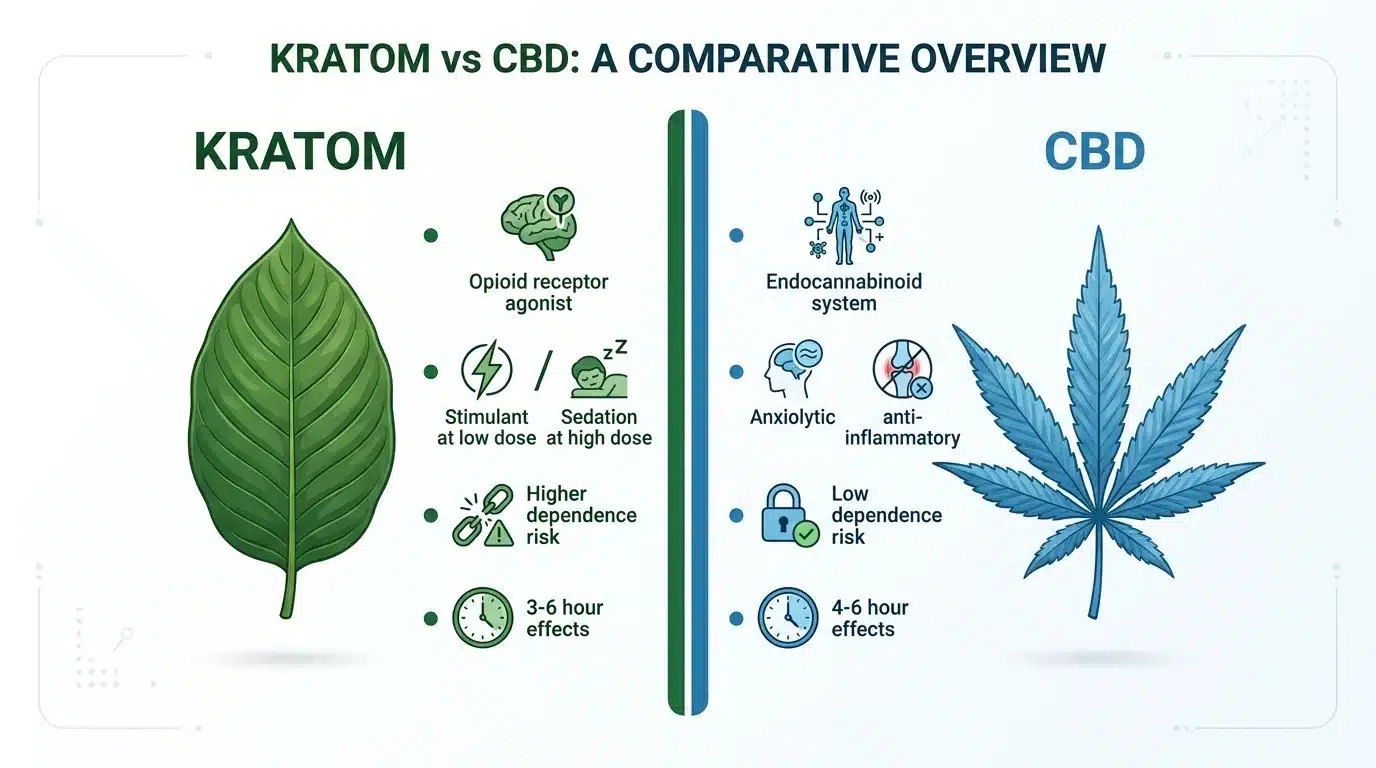
Kratom — The primary active alkaloid in kratom, mitragynine, is an indole alkaloid that acts as a partial agonist at mu-opioid receptors and also engages delta-opioid and adrenergic receptors. A 2023 mechanistic study by Farkas et al. showed that cannabinoid receptor pathways also contribute to mitragynine’s analgesic efficacy — confirming that kratom’s pharmacology involves more than the opioid system alone, though opioid-receptor activity remains central to its analgesic and dependence-related effects.[1] At lower doses, adrenergic receptor activity predominates, producing stimulant effects. At higher doses, opioid receptor activation dominates, producing sedation and analgesia.
CBD — Cannabidiol (CBD) is a phytocannabinoid from Cannabis sativa that does not meaningfully bind to mu-opioid receptors. It acts on the endocannabinoid system (indirect CB1 and CB2 modulation), serotonin receptors (5-HT1A), vanilloid receptors (TRPV1), and other targets, without producing psychoactive intoxication. A 2025 review by Farkas et al. on kratom alkaloids and cannabinoids in chronic pain laid out their side-by-side mechanistic differences and noted that CBD’s therapeutic signal is cleaner in anxiety and anti-inflammatory endpoints, while kratom’s signal is stronger in analgesia and energy.[2]
In short: kratom operates through the opioid receptor system. CBD does not. This is the fundamental distinction that determines their different effects, risks, and interactions.
What Effects Does Each Produce?
The effects of each compound flow directly from their receptor profiles — and differ significantly depending on dose.
Kratom effects are highly dose-dependent. At low-moderate doses (1–5 g), commonly reported effects include increased energy, improved mood, social ease, and reduced discomfort. At higher doses (5 g+): sedation, pain relief, and cognitive dulling. A 2025 network analysis of kratom consumers by Yang et al. linked regular kratom use to reductions in self-reported depression and anxiety symptoms, while also noting that higher-dose chronic use correlated with opposite effects (increased anxiety between doses).[3] A 2025 study specifically examining bedtime kratom use by Mun et al. found that users reported both sleep-promoting and sleep-disrupting effects depending on strain, dose, and dependency status — an important finding for anyone evaluating kratom as a sleep aid.[4]
CBD effects are not dose-dependent in the same biphasic way. CBD’s primary studied effects are anxiolytic (anxiety reduction), anti-inflammatory, and anticonvulsant. Unlike kratom, CBD does not produce stimulant or opioid-analgesic effects — a person seeking strong energy or potent pain relief would find CBD largely insufficient. CBD’s clinical signal is strongest in anxiety endpoints and in FDA-approved Epidiolex indications (Lennox-Gastaut, Dravet, and tuberous sclerosis complex seizures).
How Do Kratom and CBD Compare Directly?
| Feature | Kratom (Mitragynine) | CBD (Cannabidiol) |
|---|---|---|
| Plant source | Mitragyna speciosa (Southeast Asia) | Cannabis sativa (hemp) |
| Primary mechanism | Mu-opioid partial agonism + adrenergic; secondary cannabinoid contribution to analgesia | Endocannabinoid modulation, 5-HT1A, TRPV1 |
| Psychoactive? | Yes — mood, energy, sedation depending on dose | Mild — anxiolytic without intoxication |
| Low-dose effects | Stimulant — energy, alertness, mood elevation | Calm, mild anxiety relief, mild anti-inflammation |
| High-dose effects | Sedation, analgesia, cognitive dulling | More sedation, drowsiness, similar profile |
| Duration of effects | 3–6 hours (moderate dose) | 4–6 hours (product dependent) |
| Dependence potential | Yes — opioid-type with chronic daily use | Low — not associated with significant physical dependence |
| Cardiac safety | Case reports of QTc prolongation and reversible Brugada pattern with high doses/overdose | No significant cardiac signal at normal doses |
| Drug test risk | Not on standard panels; kratom-specific tests exist | CBD itself not tested; impure products may contain THC that triggers tests |
| FDA status | Not approved; not a controlled substance (federally) | Not approved for most uses; Epidiolex approved for specific seizure disorders only |
| Legal status (US) | Legal federally; banned or restricted in some states; KCPA adopted in many others | Legal federally (hemp-derived, <0.3% THC); state laws vary |
What Are the Risk Profiles?
Kratom risks are more pronounced than CBD’s and more similar to those of opioid-class substances. Key considerations:
- Dependence — Daily kratom use can produce physical dependence, with discontinuation symptoms including irritability, muscle aches, insomnia, and anxiety. These are opioid-type withdrawal symptoms consistent with mu-opioid receptor adaptation. The 2025 network analysis of depression, anxiety, and kratom use found that frequent, high-dose users were at the greatest risk of mood and dependence-related outcomes.[3]
- CYP enzyme interactions and polypharmacy — A 2026 physiologically based pharmacokinetic (PBPK) model by Chiang et al. quantified kratom’s inhibition of CYP3A4 and CYP2D6, translating preclinical data into clinically meaningful drug-interaction predictions. This is the strongest evidence to date that kratom has real interaction potential with common prescriptions.[5]
- Cardiac effects at high exposure — A 2025 case report by Miller et al. documented reversible Brugada pattern and QTc prolongation after heavy kratom use, reinforcing the need to take cardiac symptoms seriously in heavy users or those combining kratom with other QT-prolonging medications.[6]
- Dose-dependent side effects — nausea (especially at higher doses or on empty stomach), constipation, dizziness, sedation, and cognitive fog at high doses.
- Quality and purity variation — Without federal FDA oversight, kratom products vary in potency. COA-verified products from AKA GMP-qualified vendors with disclosed mitragynine percentages significantly reduce dosing uncertainty.
CBD risks are generally milder but should not be dismissed:
- Drug interactions — CBD inhibits CYP450 enzymes, which can affect medications including blood thinners (warfarin), seizure medications, and other drugs. This interaction is the basis of the Epidiolex prescribing precautions.
- Liver enzyme elevation — High-dose CBD has been associated with elevated liver enzymes in clinical studies, though this is typically reversible with discontinuation.
- Contamination risk from THC — Mislabeled or low-quality CBD products may contain more THC than labeled, which can produce psychoactive effects and cause a positive drug test.
- Drowsiness — Particularly at higher doses, CBD can cause drowsiness that may interfere with activities requiring alertness.
Bottom line on risk: Kratom carries meaningfully higher dependence potential due to opioid receptor activity — this is the central pharmacological reason. CBD’s risk profile is closer to a mild supplement in comparison, though both share CYP450 drug-interaction concerns that matter for anyone on other medications.
Can You Combine Kratom and CBD Safely?
This is the question where the research has moved most significantly in the last three years. Until recently, any guide comparing kratom and CBD could only say “the combination is unstudied.” That is no longer accurate.
Epidemiology — co-use is common. A 2024 US survey study by Hill et al. found that a substantial share of people who consume kratom also use cannabinoid products (including CBD and THC), with many reporting that they combine the two deliberately for complementary effects.[7] This makes the interaction question clinically relevant, not hypothetical.
Pharmacokinetics — the interaction is real. A 2024 animal study by Chiang et al. measured pharmacokinetic changes when CBD and mitragynine were co-administered in rats: CBD altered mitragynine plasma exposure in ways consistent with CYP-mediated metabolic competition.[8] A separate 2023 preclinical study by Farkas et al. found that CBD and mitragynine produced differential interactive effects in pain models — not simply additive, and in some endpoints attenuating rather than amplifying each other.[9]
What this means practically. Co-use is not automatically dangerous, but it is not pharmacologically neutral either. Both compounds affect CYP enzymes, and the interaction between them — let alone between that combination and any other medications — is complex. Anyone considering daily co-use, especially while taking prescription medications, should discuss the plan with a qualified healthcare provider.
For anyone already combining kratom and CBD without other medications: start with low doses of each, give at least two hours between them to observe effects separately, and watch for any unusual sedation, dizziness, or GI symptoms that might indicate an interaction.
How Are Kratom and CBD Regulated Differently?
As of April 2026:
- Kratom is not a federally controlled substance under the Controlled Substances Act. The DEA considered scheduling kratom in 2016 but withdrew the proposal. Several states have enacted their own bans (Alabama, Arkansas, Indiana, Rhode Island, Vermont, Wisconsin), while many others have adopted the Kratom Consumer Protection Act (KCPA), which establishes age restrictions, labeling standards, and product-quality requirements without banning the plant. A 2026 policy analysis by Perry et al. highlighted the rapid, largely unregulated growth of kratom drinks and concentrated extracts, arguing that this is where the next wave of regulatory attention is most likely to land.[10]
- CBD derived from hemp (<0.3% THC) is legal federally following the 2018 Farm Bill. The FDA permits CBD in dietary supplements but has not approved it for food products or health claims beyond Epidiolex (the prescription CBD for seizure disorders). State regulations for CBD products vary, and the FDA has repeatedly stated that the current regulatory framework for CBD dietary supplements needs congressional action.
- Both compounds can create employment or legal exposure in specific circumstances — kratom through kratom-specific testing panels and CBD through THC contamination of impure products triggering standard drug tests.
Anyone with legal or professional concerns about either compound — particularly probation, DOT-regulated employment, or medication interactions — should consult an attorney or healthcare provider before use.
Which Is Better for What?
This question has no single answer because the two compounds serve overlapping but distinct use cases. Here is how they differ in practical terms:
| Goal | Kratom | CBD |
|---|---|---|
| Energy & focus | Yes — primary low-dose use case (white/green vein) | No — CBD does not produce stimulant effects |
| Anxiety & stress | Some evidence at low doses; chronic high-dose use can worsen anxiety between doses[3] | Stronger research base for anxiety reduction via 5-HT1A activity |
| Pain relief | Yes — opioid-receptor-mediated analgesia at higher doses | Mild — anti-inflammatory, not opioid-receptor analgesic |
| Sleep | Mixed — red vein sedating for some; disruptive for others, especially with tolerance[4] | Moderate — drowsiness at higher doses without significant REM disruption |
| Mood support | Strong at low-moderate doses via opioid and adrenergic pathways | Mild — more anxiolytic than euphoriant |
| Anti-inflammation | Limited direct evidence | More established — endocannabinoid and COX-mediated pathways |
| Drug test risk | Low on standard panels; some kratom-specific panels exist | Low with pure CBD; THC contamination in some products creates risk |
| Dependence risk | Moderate-high with daily use | Low |
The compounds are not interchangeable, and which is “better” depends entirely on the specific goal. Kratom has more pronounced effects across energy, mood, and pain relief at the cost of higher dependence risk.[2] CBD has a cleaner safety profile with more established anxiolytic and anti-inflammatory evidence, at the cost of less potent effects on energy or analgesia.[2]
Neither compound should be selected as a substitute for medical treatment without consulting a qualified healthcare provider. These are not FDA-approved treatments.
Frequently Asked Questions
Can you take kratom and CBD together?
Recent research (2023–2024) shows this combination is common in US kratom consumers and that the two compounds produce measurable pharmacokinetic interactions in animal studies.[7][8] Both inhibit CYP450 liver enzymes, and co-administration can alter plasma exposure of either compound or of other medications. The combination is not automatically dangerous, but is not pharmacologically neutral — anyone taking other medications or combining them regularly should consult a healthcare provider.
Is kratom stronger than CBD?
For most applications users are comparing — energy, pain relief, mood — kratom produces more pronounced effects at therapeutic-range doses. This is because kratom directly activates opioid receptors, which produce stronger analgesic and euphoric effects than CBD’s endocannabinoid mechanisms.[2] However, “stronger” also means higher dependence risk and a narrower therapeutic window before side effects emerge.
Does kratom show up on a drug test the way CBD does?
Neither kratom nor CBD itself appears on standard 5- or 10-panel drug tests. The CBD concern with drug tests is THC contamination from impure products (THC does appear on standard panels). Kratom’s concern is specialized kratom-specific panels that some employers or probation programs use. See our detailed guide: Does Kratom Show Up on Drug Tests?
Is CBD better for anxiety than kratom?
The research base for CBD’s anxiolytic effects is more robust than for kratom. CBD’s 5-HT1A serotonin receptor activity is a well-characterized anxiolytic mechanism with multiple human clinical studies. A 2025 network analysis of kratom consumers found that low-dose kratom use was associated with reduced anxiety but chronic high-dose use often worsened it — a confounder that does not appear in the CBD literature.[3] For anxiety relief without dependence risk, CBD has a stronger evidence base.
Is kratom natural? Is CBD natural?
Both are plant-derived. “Natural” does not mean safe or without risk — morphine, cocaine, and many other potent drugs are also plant-derived. The relevant questions are mechanism, risk profile, and how the product is quality-controlled. Both markets have products of highly variable quality and purity; COA-verified products from established vendors reduce purity-related risk for both compounds.
Can CBD help with kratom withdrawal?
There is no controlled human evidence for CBD as a kratom withdrawal aid, though some preclinical work shows cannabinoid pathways interact with mitragynine’s opioid effects.[9] Some users anecdotally report that CBD helps with anxiety and sleep disruption during tolerance breaks, but these are unverified individual reports. Significant kratom dependence warrants medical supervision regardless of what adjunct compounds are considered.
Which is more regulated?
CBD is more thoroughly regulated at the federal level. Hemp-derived CBD is regulated under the 2018 Farm Bill, and the FDA has an approved drug (Epidiolex) in the CBD class. Kratom has no federal approval pathway and operates in a looser regulatory space, though the American Kratom Association’s GMP program and state-level Kratom Consumer Protection Acts are moving toward more standardized oversight. Recent policy analysis suggests the next wave of kratom regulation will focus on concentrated extracts and kratom drinks.[10]
Is kratom safer for the heart than CBD?
No — the cardiac safety signal actually runs the other direction. CBD has no significant cardiac signal at normal doses. Kratom has been associated with case reports of QTc prolongation and reversible Brugada pattern at high exposure or overdose levels.[6] This is a consideration for heavy users or those combining kratom with other QT-prolonging medications.
References
- Farkas DJ (2023). Cannabinoid mechanisms contribute to the therapeutic efficacy of the kratom alkaloid mitragynine against neuropathic, but not inflammatory pain. Life sciences. [PubMed]
- Farkas DJ (2025). Kratom Alkaloids, Cannabinoids, and Chronic Pain: Basis of Potential Utility and Role in Therapy. Cannabis and cannabinoid research. [PubMed]
- Yang Y (2025). A network analysis of depression, anxiety, and their associations with kratom (Mitragyna speciosa) use among people who previously used methamphetamine. Journal of psychoactive drugs. [PubMed]
- Mun CJ (2025). Is bedtime use of kratom (Mitragyna speciosa) a sleep aid or disruptor? Examining its daily effects and individual differences. Experimental and clinical psychopharmacology. [PubMed]
- Chiang YH (2026). Physiologically Based Pharmacokinetic Model for Clinical Translation and Prediction of Drug Interaction of the Major Kratom Alkaloid, Mitragynine. ACS pharmacology & translational science. [PubMed]
- Miller AHF (2025). Kratom Cardiotoxicity: Reversible Brugada Pattern and QTc Prolongation. JACC. Case reports. [PubMed]
- Hill K (2024). Use of Cannabinoids by People Who Consume Kratom in the United States. Journal of addiction medicine. [PubMed]
- Berthold EC (2024). Pharmacokinetic Interaction of Kratom and Cannabidiol in Male Rats. Pharmaceutics. [PubMed]
- Ortiz YT (2023). Cannabidiol and mitragynine exhibit differential interactive effects in the attenuation of paclitaxel-induced mechanical allodynia, acute antinociception, and schedule-controlled responding in mice. Pharmacological reports : PR. [PubMed]
- Perry T (2026). The Unregulated Rise of Kratom Drinks: Emerging Challenges and Policy Recommendations. Public health reports (Washington, D.C. : 1974). [PubMed]
Disclaimer: This article is for educational purposes only and is not medical advice. Neither kratom nor CBD is FDA-approved to diagnose, treat, cure, or prevent any condition. Individual experiences vary. Consult a qualified healthcare provider before use, particularly if you take medications or have underlying health conditions.
Shopping around? Browse our lab-tested kratom.

Shop Lab-Tested Kratom
Browse our full selection of AKA GMP-qualified kratom — powder, capsules, extracts, and more. Free shipping on orders $99+.
Shop All Kratom