


Medically reviewed
Reviewed for clinical accuracy and senior-population safety considerations by Brian Trappler, MD — Board-Certified Psychiatrist (ABPN), Associate Professor in Clinical Psychiatry (retired), SUNY Downstate Medical Center. Last reviewed: April 26, 2026.
Kratom’s pharmacological profile is not age-neutral. While most published kratom research studies younger adult populations, the physiological changes that accompany aging — slower hepatic metabolism, declining renal clearance, increased medication burden, and greater CNS sensitivity — create a meaningfully different safety equation for adults over 60. This guide applies the peer-reviewed pharmacokinetic evidence directly to the senior context, so older adults can make genuinely informed decisions.[5]
Why does age change kratom’s risk profile?
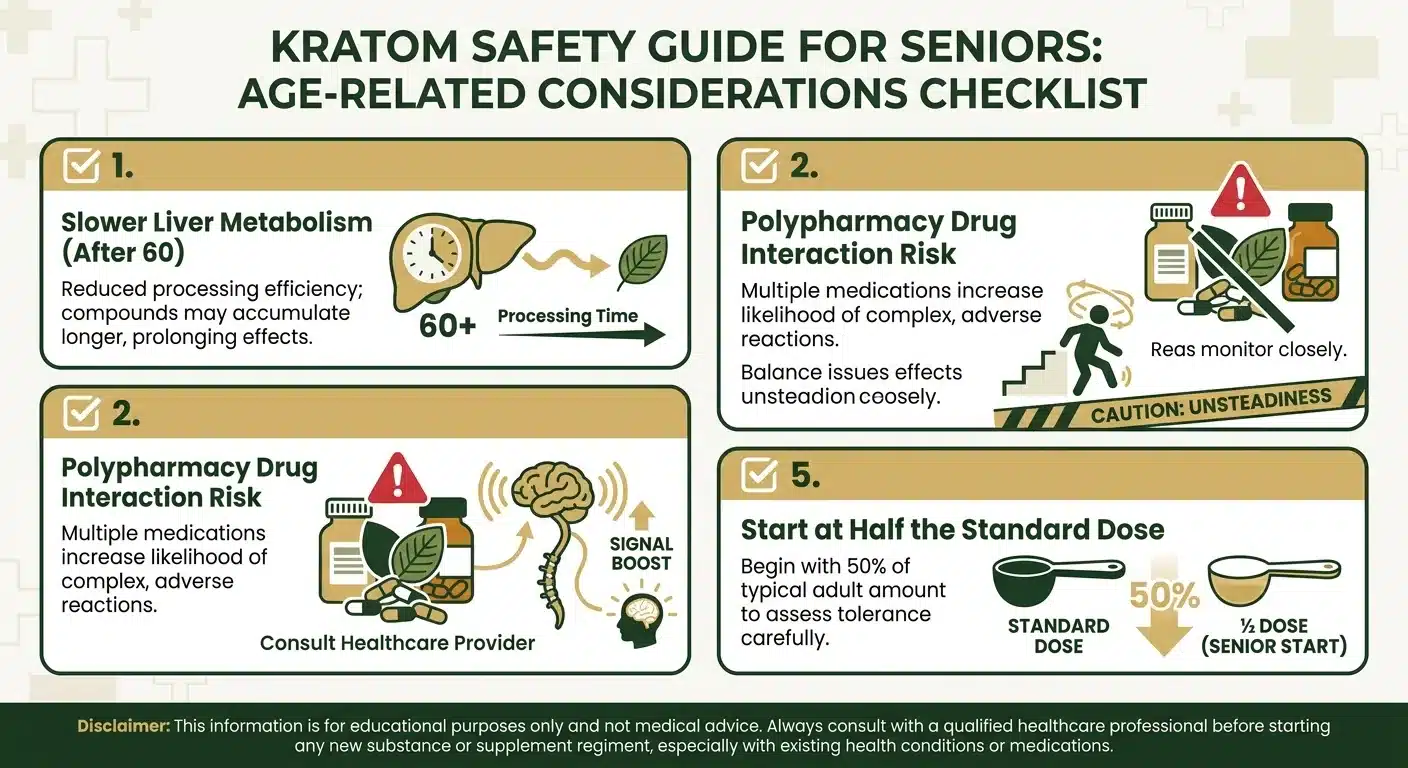
Kratom’s primary alkaloid, mitragynine, is metabolized primarily by hepatic CYP3A4 enzymes and cleared renally. Both pathways decline measurably with age:[5]
- Hepatic blood flow decreases ~40% between age 25 and 75, reducing first-pass metabolism and raising peak mitragynine plasma concentrations at the same oral dose
- CYP enzyme activity declines with age, meaning mitragynine is metabolized more slowly — extending its plasma half-life and duration of effect beyond the 9–24 hours documented in younger adults[3]
- Renal clearance declines ~1% per year after age 30 — for a 70-year-old, this represents roughly 40% reduced clearance compared to a 30-year-old, affecting alkaloid elimination
- Body composition shifts — increased fat-to-muscle ratio alters drug distribution volumes, potentially extending the effective half-life of lipophilic alkaloids like mitragynine
- Blood-brain barrier permeability may increase with age, making older adults more sensitive to CNS-active compounds at equivalent plasma concentrations
The practical consequence: an older adult taking the same gram dose as a younger user may experience stronger effects that last longer — and may not recognize this is happening until they’re already experiencing side effects. This is not a reason to avoid kratom categorically, but it is a pharmacological reality that demands adjusted dosing and heightened vigilance.
How should older adults dose kratom differently?
The general harm-reduction principle for all medications in older adults — “start low, go slow” — applies directly to kratom. A 2022 survey of regular US kratom users found that greater severity of cessation effects was associated with more weeks of regular use, underscoring the importance of conservative initial dosing to establish the lowest effective dose before any escalation.[4]
Recommended Starting Doses by Format — Adults 60+
| Format | Standard Beginner Dose | Recommended for 60+ | Notes |
|---|---|---|---|
| Powder | 1.5–2g | 0.75–1g | Use digital scale; do not estimate with spoons |
| Capsules (0.5g each) | 3–4 capsules (1.5–2g) | 1–2 capsules (0.5–1g) | Onset 30–60 min; wait the full window before assessing |
| Kratom Tea | 2–3g leaf equivalent | 1–1.5g leaf equivalent | Gentler extraction; good starting format for older adults |
| Extracts | Per COA mitragynine mg | Avoid until well-established baseline | High potency; not appropriate for first-time or new senior users |
Key dosing principles for older adults:
- Wait a full 60 minutes before assessing effects — slower gastric motility and hepatic blood flow in older adults means onset may be delayed compared to younger users
- Never redose the same day during the first month — accumulation risk is higher with reduced clearance
- Use kratom no more than 2 days per week — daily use in older adults with slower clearance will produce drug accumulation more rapidly than in younger users[1]
- Avoid evening use initially — sedative effects that extend overnight increase fall risk on nighttime bathroom trips, a disproportionate cause of serious injury in adults over 65
For the full general dosage guide, see: Kratom Dosage Guide
Which drug interactions matter most for seniors?
This is the most critical section for older adults. The average adult over 65 takes 4–5 prescription medications. Kratom alkaloids inhibit multiple CYP450 enzymes — the liver’s primary drug-metabolizing system — which can raise plasma concentrations of co-administered drugs and amplify their effects or toxicity.[5]
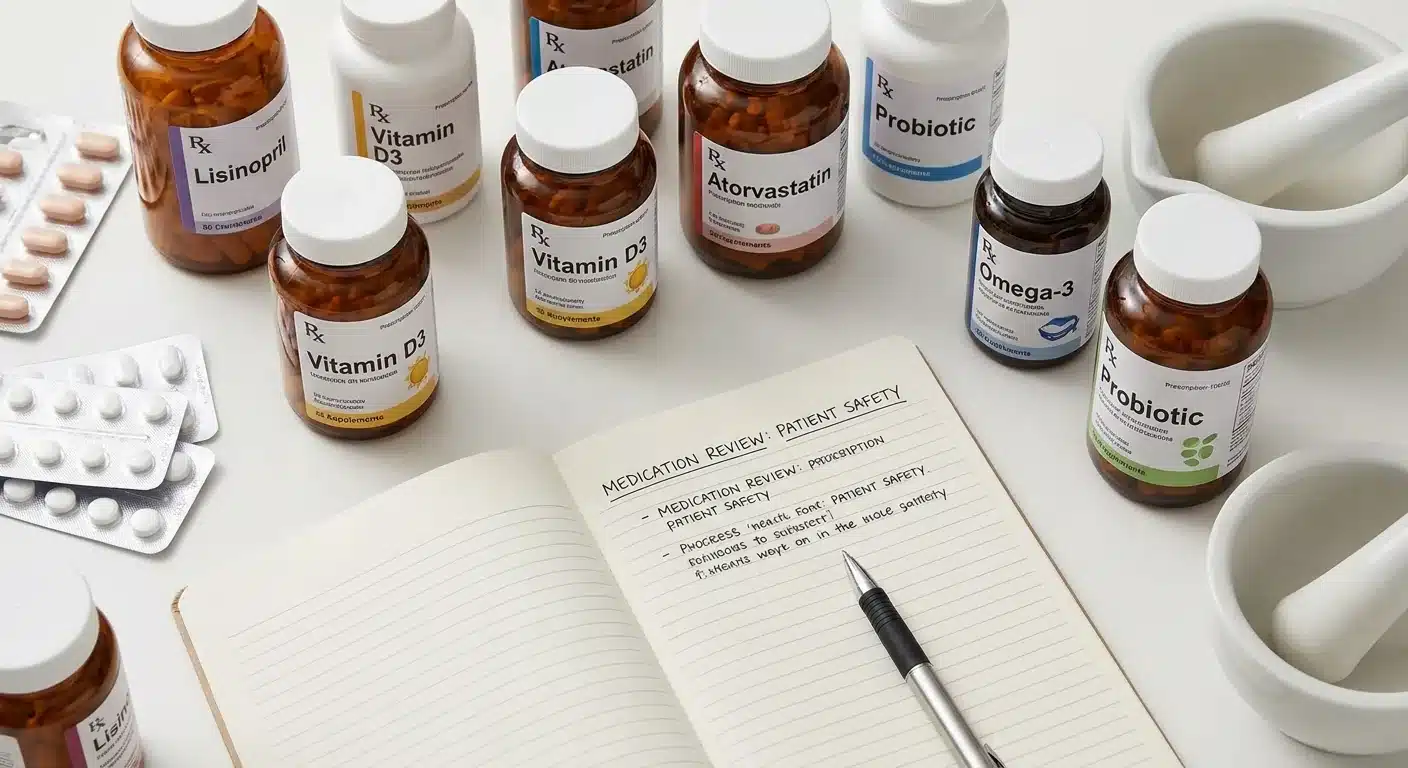
A landmark 2022 clinical pharmacokinetic study by Tanna et al. confirmed this in human participants: kratom consumption produced a ~40% increase in midazolam exposure (a CYP3A4 substrate), directly validating in vitro inhibition findings in living adults.[3] This is clinically significant — a 40% increase in benzodiazepine plasma levels has real-world consequences for sedation, cognitive function, and respiratory depression risk.
In vitro enzyme inhibition data from Hanapi et al. (2021) and Kong et al. (2011) characterized the inhibition constants:[5][6]
- CYP2D6: IC₅₀ of 0.45 μM — strong inhibition; metabolizes ~25% of all clinical drugs
- CYP3A4: IC₅₀ of 0.78 μg/mL (extract) — strong inhibition; metabolizes ~50% of all medications
- CYP2C9: Moderate noncompetitive inhibition — relevant for warfarin, NSAIDs, sulfonylureas
High-Priority Drug Interactions for Adults 60+ on Common Medications
| Medication Category | Common Examples | CYP Pathway | Risk for Seniors |
|---|---|---|---|
| Benzodiazepines | Alprazolam (Xanax), lorazepam (Ativan), diazepam, midazolam | CYP3A4 | Very High — 40% exposure increase confirmed in vivo; sedation, fall risk, respiratory depression[3] |
| Blood thinners | Warfarin (Coumadin) | CYP2C9 | High — INR alteration; bleeding risk; extremely common in 65+ for AFib and stroke prevention[5] |
| Statins | Atorvastatin (Lipitor), simvastatin, lovastatin | CYP3A4 | High — elevated statin levels increase myopathy (muscle breakdown) risk; taken by majority of 65+ adults[5] |
| Opioid pain medications | Codeine, tramadol, oxycodone, hydrocodone | CYP2D6, CYP3A4 | Very High — additive CNS and respiratory depression; avoid this combination entirely |
| Antidepressants | Fluoxetine (Prozac), paroxetine (Paxil), sertraline | CYP2D6, CYP3A4 | Moderate-High — altered drug levels; serotonergic interaction risk; consult prescriber[5] |
| Calcium channel blockers | Amlodipine, diltiazem, verapamil | CYP3A4 | Moderate — elevated blood pressure medication levels; hypotension and dizziness risk |
| Diabetes medications | Glipizide, glyburide (sulfonylureas) | CYP2C9 | Moderate — hypoglycemia risk from elevated drug exposure[5] |
| Sleep aids | Zolpidem (Ambien), eszopiclone | CYP3A4 | High — additive sedation; significantly elevated fall risk overnight[6] |
Sources: Hanapi et al. 2021[5]; Kong et al. 2011[6]; Tanna et al. 2022[3].
Bottom line: bring your complete medication list to your pharmacist or physician before starting kratom. The interaction risk is pharmacologically established — it is not theoretical.
Which health conditions increase kratom risk?
Certain conditions common in older adults specifically amplify kratom’s risks:
- Liver disease (hepatitis, cirrhosis, fatty liver disease). Kratom is hepatically metabolized; impaired liver function reduces clearance and increases exposure. Kratom-associated hepatotoxicity, while rare, is documented — pre-existing liver disease significantly increases vulnerability. Avoid kratom if you have any active liver condition without explicit physician guidance.
- Chronic kidney disease (CKD). Reduced renal clearance extends mitragynine’s effective half-life, increasing accumulation risk with regular use.
- Atrial fibrillation (AFib). Very common in seniors; most AFib patients take warfarin or newer anticoagulants metabolized via CYP pathways. Kratom’s CYP2C9 inhibition creates meaningful INR alteration risk.[5]
- Hypertension. Kratom’s adrenergic receptor activity at low doses may affect blood pressure, potentially interacting with antihypertensive medications.
- Osteoporosis / fall risk history. Any substance producing sedation or dizziness — including kratom at moderate-to-high doses — elevates fracture risk in those with reduced bone density or prior fall history.
- History of opioid use disorder. Kratom’s mu-opioid receptor partial agonism means it should not be used as an unsupervised substitute for opioid maintenance therapy. Consult an addiction medicine specialist.
- Cognitive impairment / dementia. Kratom’s cognitive effects at higher doses (sedation, mental dulling) are particularly concerning in those with existing cognitive vulnerability.
How should a senior approach their first kratom experience?
A structured protocol specifically calibrated for older adults:
- Get medical clearance first. This is not optional for seniors on prescription medications. Bring a list of your current medications to your pharmacist and ask specifically about CYP3A4 and CYP2D6 interactions. Many pharmacists are familiar with kratom questions.
- Choose capsules or tea as your first format. These provide the most controlled onset — no bitter powder to choke on, predictable fill weight, manageable onset curve. Crushed leaf tea is particularly gentle due to lower alkaloid extraction than powder ingestion.
- Start at 0.75–1g — half the standard beginner dose. This establishes your individual pharmacokinetic baseline without risking overshooting.
- Take in the morning, after a light breakfast. Avoid evening sessions until you understand your duration of effect. A light meal reduces nausea risk without blunting effects as severely as a full meal.[4]
- Have someone with you the first time. In the unlikely event of an adverse reaction, having another person present is important. This is particularly prudent for adults 70+.
- Wait a full 60–75 minutes before concluding effects are insufficient. Slower gastric motility in older adults means onset may be meaningfully delayed.
- Do not redose the same day. Accumulation risk is higher with reduced clearance. If 1g produced no perceptible effect, try 1.5g in a separate session, not the same day.
- Log every session — strain, dose, time, food status, effects at 30/60/90/120 minutes. This creates a personal pharmacokinetic dataset that helps you identify your optimal dose with precision.
For a detailed beginners protocol applicable to any age, see: Kratom Beginner’s Guide
What is the dependence risk for older users?
Physical dependence risk is the same pharmacological mechanism regardless of age — mu-opioid receptor downregulation from daily use — but older adults have additional reasons to be vigilant:[1]
- Slower clearance means each dose produces a longer window of receptor activation, potentially accelerating downregulation at the same gram dose
- Kratom withdrawal symptoms — muscle aches, insomnia, irritability — overlap significantly with common aging complaints, making dependence harder to recognize
- The behavioral pattern of dose escalation to overcome tolerance (documented in Singh et al. 2014 among daily users) is particularly problematic in seniors on fixed incomes or with polypharmacy constraints[1]
Singh et al. (2014) found that regular kratom users consuming 3+ servings daily had significantly higher odds of developing dependence. For older adults, the conservative recommendation is to use kratom no more than 2–3 days per week, with at least 2 consecutive rest days each week.[1]
For guidance on managing tolerance and planning breaks: Kratom Tolerance Break Guide
What should seniors look for in a kratom product?
Product quality matters for any user — but for seniors, the stakes of a contaminated product are higher. Key criteria:[2]
- Third-party COA with heavy metals panel. Kratom lead contamination has been documented in substandard products. Even low-level chronic lead exposure has disproportionate consequences in older adults (cognitive, renal, cardiovascular). Verify the heavy metals panel specifically — not just alkaloid content.
- AKA GMP qualification. The American Kratom Association’s GMP Standards Program provides the most credible third-party quality signal available. Buy from qualified vendors only.
- Plain leaf powder or capsules — no extracts. Concentrated extract products remove the alkaloid balance safety margin and make precise micro-dosing impossible. Seniors should stay with plain-leaf products indefinitely until thoroughly familiar with their response.
- Mitragynine % on the label. Quality vendors display current batch mitragynine percentage. This allows direct dose calculation in milligrams rather than guessing from grams alone — more precise for conservative dosing.
Frequently asked questions about kratom safety for seniors
Is kratom safe for adults over 65?
There is no published clinical data specifically studying kratom in adults over 65. Based on established pharmacokinetics — slower hepatic metabolism, reduced renal clearance, higher medication burden — older adults face meaningfully higher risk than younger adults at the same dose. “Safe” depends entirely on individual health status, current medications, and dosing approach. Many older adults use kratom without significant issues; the key is reduced starting doses, medical clearance if on prescription medications, and avoiding daily use.[3]
Can kratom interact with blood pressure medications?
Yes — in two ways. Kratom alkaloids inhibit CYP3A4, which metabolizes many calcium channel blockers (amlodipine, diltiazem) and some ACE inhibitors, potentially raising their plasma concentrations. Additionally, mitragynine’s adrenergic receptor activity may directly affect blood pressure, particularly at lower doses where stimulant effects dominate. Anyone on antihypertensive medications should consult their prescribing physician before using kratom.[5]
Can kratom interact with warfarin or blood thinners?
Yes — this is one of the highest-priority interactions for seniors. Kratom alkaloids inhibit CYP2C9, which is the primary metabolic pathway for warfarin.[5] CYP2C9 inhibition can raise warfarin plasma levels, increasing INR and bleeding risk. Warfarin requires tight therapeutic window management — any CYP2C9 inhibitor should be disclosed to the prescribing physician immediately and INR monitoring increased if kratom use begins.
Does kratom increase fall risk in older adults?
At moderate-to-high doses, yes. Kratom’s sedative and analgesic effects at higher doses can produce dizziness, loss of coordination, and reduced alertness — all established fall risk factors in older adults. This is compounded if kratom is combined with other CNS-active medications (benzodiazepines, sleep aids, opioids). Falls are a leading cause of serious injury and hospitalization in adults 65+, making this a non-trivial risk consideration. Limit doses, avoid evening sessions initially, and never combine with other CNS depressants.
What is the safest kratom strain for seniors?
Green vein strains are generally most appropriate for first-time and senior users because they occupy the middle of kratom’s stimulant-to-sedative spectrum — less stimulating than white veins, less sedating than red veins. Red vein strains at higher doses produce the strongest sedative and analgesic effects, which carry the most falls risk. White vein strains at low doses are least likely to produce sedation but may produce unwanted stimulant effects in cardiovascularly sensitive individuals. Start with a green vein at a conservative dose.[4]
My doctor doesn’t know anything about kratom — what should I tell them?
Bring the key facts: kratom’s primary alkaloid (mitragynine) is metabolized by CYP3A4 and inhibits CYP3A4, CYP2D6, and CYP2C9. A 2022 clinical study demonstrated approximately 40% increased midazolam exposure in healthy adults who consumed kratom.[3] Ask your physician to review your medication list for CYP3A4 and CYP2D6 substrates. Most pharmacists will recognize the clinical implications immediately even if they’re unfamiliar with kratom specifically.
Can kratom help with arthritis or chronic pain in seniors?
Many older adults report using kratom for chronic pain management — Grundmann’s 2017 survey found pain management was the most common self-reported reason for use (68% of respondents).[2] However, kratom is not FDA-approved to treat, manage, or prevent any medical condition. Any existing pain management plan involving prescription medications should be discussed with your physician before adding kratom. The drug interaction risk with opioid pain medications is particularly significant.
How is kratom different from CBD for seniors?
CBD and kratom have completely different mechanisms. CBD acts primarily on the endocannabinoid system (CB1/CB2 receptors) and 5-HT1A receptors — it does not activate opioid receptors. Kratom’s primary effects are mediated through opioid receptors (mitragynine as partial MOR agonist) and adrenergic receptors. CBD has a better established safety profile for older adults including better tolerability and lower interaction risk, though CBD also inhibits CYP enzymes. For a full comparison: Kratom vs. CBD
References
- Singh D, Müller CP, Vicknasingam BK (2014). Kratom (Mitragyna speciosa) dependence, withdrawal symptoms and craving in regular users. Drug and alcohol dependence, 139, 132-7. [PubMed]
- Grundmann O. Patterns of kratom use and health impact in the US. Drug Alcohol Depend. 2017.
- Tanna RS, et al. Clinical pharmacokinetic assessment of a kratom (Mitragyna speciosa) product. Clin Transl Sci. 2022.
- Smith KE, et al. Self-reported kratom dose-effect relationships among a sample of US adults. Drug Alcohol Depend. 2022.
- Hanapi NA, et al. Kratom alkaloids: interactions with enzymes, receptors, and cellular barriers. Front Pharmacol. 2021.
- Kong WM, et al. Evaluation of the effects of Mitragyna speciosa alkaloid extract on cytochrome P450 enzymes. Molecules. 2011.
Buy with confidence — every batch of our kratom ships with a published Certificate of Analysis.

Shop Lab-Tested Kratom
Browse our full selection of AKA GMP-qualified kratom — powder, capsules, extracts, and more. Free shipping on orders $99+.
Shop All Kratom