


Medically reviewed
Reviewed for clinical accuracy and psychiatric considerations by Brian Trappler, MD — Board-Certified Psychiatrist (ABPN), Associate Professor in Clinical Psychiatry (retired), SUNY Downstate Medical Center. Last reviewed: May 3, 2026.
Mental health challenges affect nearly one in five American adults annually, driving many to explore natural alternatives alongside conventional approaches. Kratom (Mitragyna speciosa) has emerged as one of the most actively researched intersections in ethnopharmacology, with a growing body of preclinical studies and user surveys suggesting this Southeast Asian botanical influences depression, anxiety, and emotional well-being through multiple neurochemical pathways. This guide examines what the peer-reviewed evidence actually shows — and where significant gaps remain.[2]
How does kratom affect mood neurochemically?
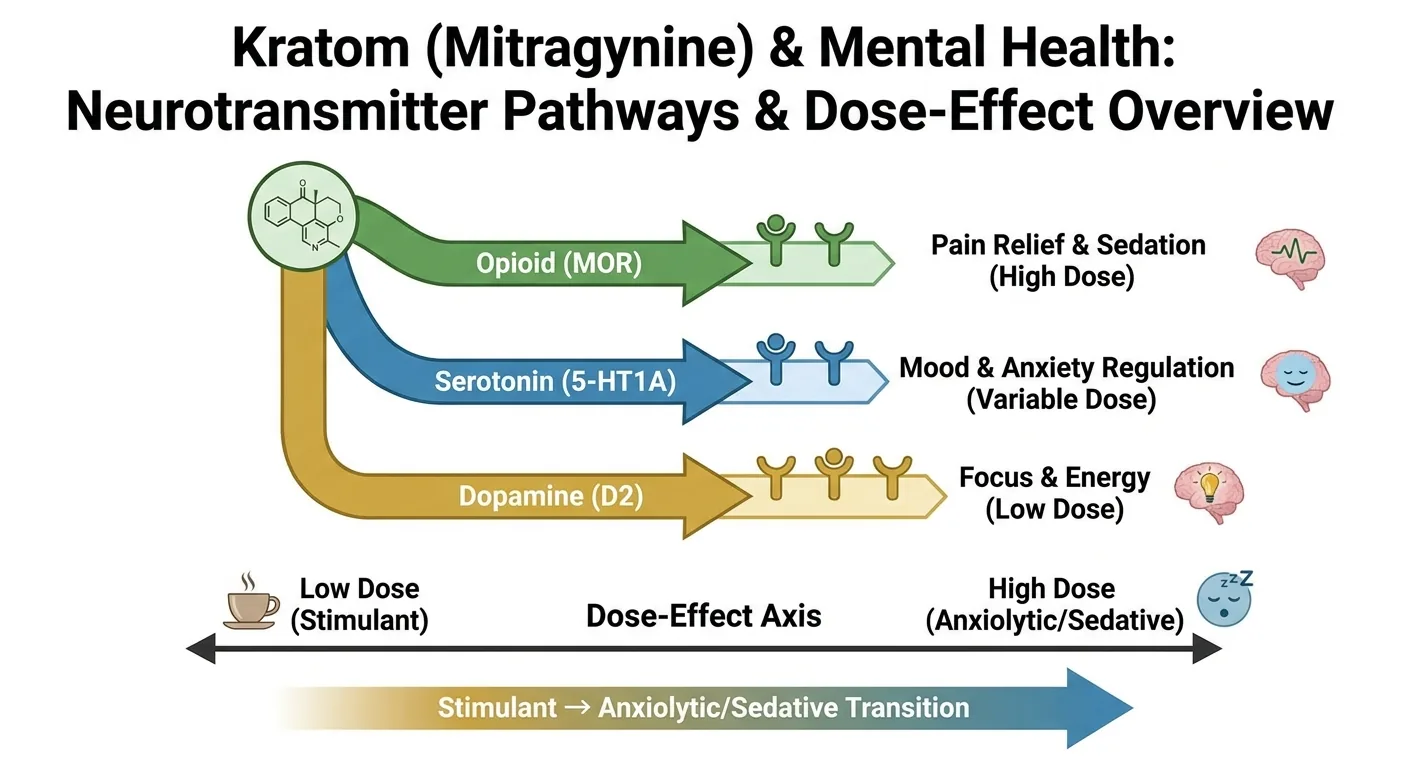
Kratom contains over 40 alkaloids, but its mood-relevant effects are primarily attributed to mitragynine (60–66% of alkaloid content) and 7-hydroxymitragynine (7-HMG), along with secondary alkaloids paynantheine and speciogynine.
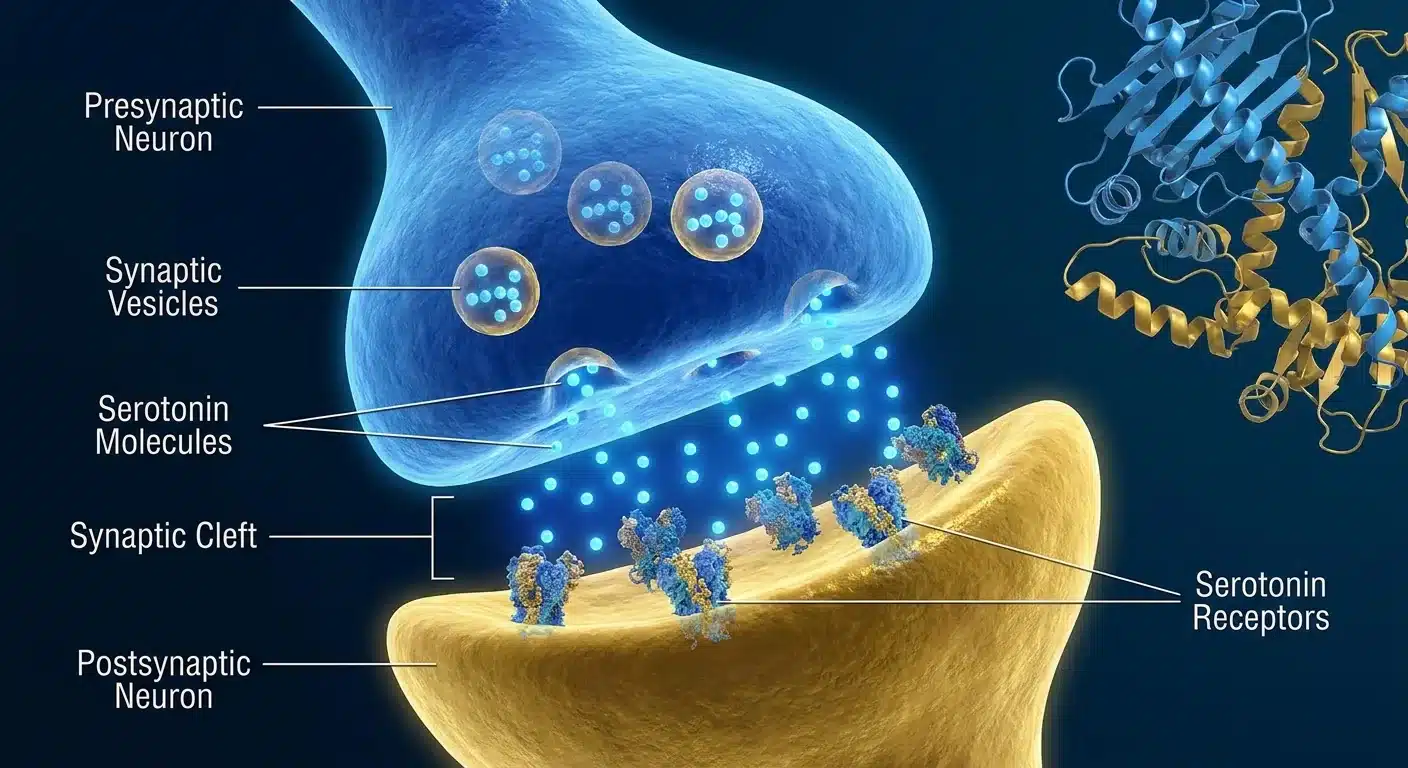
Opioid Receptor Interactions
Mitragynine and 7-HMG are partial agonists at mu-opioid receptors (MOR) — the same receptors targeted by endogenous endorphins. Crucially, they function as biased agonists, preferentially activating G-protein signaling over beta-arrestin recruitment.[4] This biased agonism may explain why kratom produces mood elevation and anxiolysis with a different side-effect profile than classical opioids. Kratom alkaloids also interact with kappa- and delta-opioid receptors, which regulate stress response, dysphoria, and emotional regulation.[5]
Serotonergic Pathways
Mitragynine’s indole moiety is structurally related to serotonin (5-HT). Research identifies interactions with 5-HT1A, 5-HT2C, and 5-HT7 receptors — all implicated in mood regulation and anxiety.[6] Paynantheine and speciogynine demonstrate 5-HT1A receptor agonism, the same target as the anti-anxiety medication buspirone, providing a plausible mechanism for anxiolytic effects independent of opioid receptor action.[7]
Dopaminergic and GABAergic Systems
Kratom’s mood-enhancing properties are partially mediated through dopamine pathways. Mitragynine’s anxiolytic effects were blocked by both the D1 antagonist SCH 23390 and the D2 antagonist sulpiride in animal studies, confirming dopaminergic involvement.[3] The same anxiolytic effects were also blocked by the GABA-benzodiazepine antagonist flumazenil, indicating GABAergic involvement — a coordinated multi-pathway mechanism unlike any single conventional psychiatric medication.[3]
Kratom Alkaloid Receptor Profiles — Mental Health Relevance
| Alkaloid | Primary Receptor Targets | Mental Health Relevance |
|---|---|---|
| Mitragynine | MOR (biased partial), 5-HT1A, 5-HT2C, D1, D2, alpha-2 adrenergic, GABA | Mood elevation, anxiolysis, antidepressant-like effects in preclinical models |
| 7-Hydroxymitragynine | MOR (partial, ~13× potency of morphine), kappa-opioid | Sedation, anxiolysis at higher doses, stress relief |
| Paynantheine | 5-HT1A agonist, smooth muscle relaxant | Potential antidepressant, relaxation — buspirone-like mechanism |
| Speciogynine | 5-HT1A agonist, smooth muscle relaxant | Anxiolytic potential; may contribute to green vein calming effects |
| Corynantheidine | Opioid antagonist/partial agonist | May modulate and temper overall opioid-pathway effects |
What does research show about kratom for depression?
Depression is one of the most commonly cited reasons people use kratom, and a growing body of preclinical research offers preliminary evidence for antidepressant-like activity.
Preclinical Evidence
In the Porsolt forced swim test — a standard preclinical screening model for antidepressant activity — Mitragyna speciosa methanolic extract at 100, 200, and 400 mg/kg significantly reduced immobility time in mice, comparable to conventional antidepressants.[6] Researchers attributed this to mitragynine’s serotonin receptor interactions, particularly the 5-HT1A and 5-HT2C pathways.
These findings align with earlier work confirming antidepressant-like effects in both the forced swimming test and the tail suspension test — two complementary rodent models of depression.[5]
Survey and Observational Data
Grundmann’s 2017 survey of 8,049 US kratom users found that 66% reported using kratom for emotional or mental conditions, with depression ranking among the top three reasons alongside anxiety and pain management.[1] The Johns Hopkins survey (Garcia-Romeu et al., 2020; n=2,798) found ~65% reported using kratom for anxiety and/or depression, with 91% rating it effective for their conditions.
The systematic review by Swogger & Walsh (2018) concluded that across available literature, kratom “enhances mood and relieves anxiety among many users”, with withdrawal symptoms appearing milder than classical opioids for most users.[2]
Critical Limitations
Most depression-related evidence comes from animal models, which do not reliably translate to human outcomes. No randomized controlled trials have evaluated kratom for depression. Survey data is subject to selection bias — respondents tend to be recruited through pro-kratom communities — and self-reported efficacy cannot be separated from placebo effects. A 2025 network analysis by Yang et al. of 403 males with methamphetamine-use history found that those co-using kratom reported lower depressive symptoms in a dose- and frequency-dependent pattern — a correlational signal, not a causal one, but consistent with the directional trend across other surveys.[9] A 2021 case report by Müller et al. documents the opposite edge: a 63-year-old patient whose seven years of stable kratom-based self-management for major depression and generalized anxiety failed under acute stress load, requiring detoxification and conventional pharmacotherapy.[10] Both findings reinforce why kratom cannot substitute for clinician-supervised care.
What does research show about kratom for anxiety?
Anxiety disorders are the most prevalent mental health conditions worldwide, and “kratom for anxiety” is among the most searched topics in kratom research. The available evidence is methodologically limited but directionally consistent.

Animal Model Evidence
A well-designed 2014 study evaluated mitragynine’s anxiolytic effects using the open-field test and elevated plus-maze in Sprague-Dawley rats. At 10, 20, and 40 mg/kg doses, mitragynine significantly increased exploration of anxiogenic zones (central zone and open arms) — an effect comparable to diazepam (Valium) at 10 mg/kg.[3]
These anxiolytic effects were blocked by four different antagonists: naloxone (opioid), flumazenil (GABA-benzodiazepine), sulpiride (D2 dopamine), and SCH 23390 (D1 dopamine).[3] This multi-antagonist blockade demonstrates that kratom’s anti-anxiety mechanism involves coordinated opioidergic, GABAergic, and dopaminergic systems simultaneously — not a single pathway.
Human Reports
Qualitative analysis of firsthand kratom reports on Erowid.org found that anxiety reduction was a major theme, with users describing relief from social anxiety, generalized anxiety, and anxiety-related restlessness — often without the cognitive impairment associated with benzodiazepines.[8]
A 2024 systematic review and multilevel meta-analysis confirmed that kratom users frequently report relying on the plant to address depression, anxiety, and PTSD symptoms, though the authors emphasized the need for prospective clinical trials before therapeutic conclusions can be drawn.
Strain Considerations
While clinical evidence for strain-specific effects is absent, users consistently report that red vein kratom strains — which have higher ratios of 7-HMG to mitragynine — are preferred for stress relief and relaxation. Green strains are reported to offer balanced mood support with less sedation. These patterns are observational, not clinically validated.
Does kratom have antipsychotic-like properties?
A distinct and intriguing line of research explores kratom’s potential antipsychotic-like effects. A 2016 study in Frontiers in Pharmacology found that kratom leaf extract inhibited apomorphine-induced climbing behavior (a model for positive psychotic symptoms) and facilitated social interaction in ketamine-treated mice (a negative symptom model).[6]
This dual activity against both positive and negative symptom models is notable because many conventional antipsychotics address only positive symptoms. The effect is attributed to kratom’s antidopaminergic activity — it binds D2 dopamine and serotonin 5-HT2C receptors, the same targets as atypical antipsychotics like clozapine and risperidone.[6]
This is purely preclinical, animal-model research. No human studies on kratom for psychotic disorders exist. Individuals with psychotic conditions should not use kratom as a replacement for antipsychotic medications, and there are case reports of psychiatric complications — including manic episodes — in patients with complex psychiatric histories.
How does dose determine kratom’s mental health effects?
Kratom’s biphasic, dose-dependent effect profile is one of its most clinically relevant characteristics for mental health applications. The same plant produces stimulant effects at low doses and sedative/anxiolytic effects at higher doses — a distinction that matters significantly for targeting specific symptoms.[1]
Dose-Effect Relationship — Mental Health Applications
| Dose Range | Primary Effects | Dominant Mechanism | Mental Health Context |
|---|---|---|---|
| Low (1–3 g) | Stimulation, alertness, sociability, motivation | Adrenergic + dopaminergic (mitragynine-dominant) | May support mood, motivation, social engagement; useful for depression-related fatigue |
| Moderate (3–5 g) | Balanced mood enhancement, mild anxiolysis, focus | Balanced MOR + serotonin + dopamine activation | Most commonly reported “sweet spot” for mood and anxiety; most survey use in this range |
| High (5–8 g) | Sedation, strong anxiolysis, physical pain relief | Increased 7-HMG activity; stronger MOR engagement | May help with severe anxiety and restlessness; meaningfully elevated side-effect risk |
| Very High (8+ g) | Strong sedation, nausea, “wobbles,” cognitive fog | Saturated MOR activity | Diminishing mental health returns; adverse effects predominate — not recommended |
Grundmann’s 2017 survey confirmed this dose-response relationship: negative effects — primarily nausea and constipation — increased significantly at doses of 5 grams or more per dose and with 22 or more doses per week.[1] For mood and anxiety applications, the lowest effective dose in the 1–5g range is consistently recommended.
What do large-scale surveys show about kratom and mental health?
Large-scale surveys provide the most direct human evidence available, even though they cannot establish therapeutic efficacy.
Major Survey Studies — Kratom and Mental Health
| Study | Sample | Mental Health Findings |
|---|---|---|
| Grundmann (2017) Drug & Alcohol Dependence |
8,049 users | 66% used kratom for emotional/mental conditions; depression and anxiety in top 3 reasons alongside pain |
| Swogger et al. (2015) Journal of Psychoactive Drugs |
161 Erowid reports | Mood elevation and anxiety reduction among most common reported benefits; qualitative themes |
| Swogger & Walsh (2018) Drug & Alcohol Dependence |
Systematic review (1960–2017) | “Enhances mood and relieves anxiety among many users”; withdrawal generally milder than classical opioids |
| Johns Hopkins Survey (2020) Drug & Alcohol Dependence |
2,798 users | ~65% used kratom for anxiety and/or depression; 91% rated it “very effective” or “effective” |
| Yang et al. (2024) European Addiction Research |
Systematic review + meta-analysis | Confirmed frequent self-reported use for depression, anxiety, PTSD; called for prospective clinical trials |
These surveys consistently show that a large majority of kratom users report mental health motivations and perceive benefit. The inherent limitations are equally consistent: self-selected samples, no clinical verification of diagnoses, placebo effects cannot be ruled out, and most respondents were recruited through pro-kratom channels.
What are the mental health risks of regular kratom use?
An evidence-based assessment requires honest treatment of risks alongside potential benefits.
Physical Dependence and Withdrawal
Regular kratom use can lead to physical dependence. Swogger & Walsh (2018) found that while withdrawal is milder than classical opioids for many users, “for some users, withdrawal is highly uncomfortable and maintaining abstinence becomes difficult.”[2] Withdrawal symptoms — irritability, anxiety, restlessness, muscle aches, mood disturbances — can temporarily worsen the very symptoms users were attempting to address.
Drug Interactions with Psychiatric Medications
Kratom alkaloids are metabolized primarily by CYP3A4 and CYP2D6 enzymes, creating pharmacokinetic interactions with common psychiatric medications:[6]
- SSRIs/SNRIs: Kratom’s serotonergic activity adds to serotonin load — concurrent use may increase serotonin syndrome risk
- Benzodiazepines: CYP3A4 inhibition can raise benzo plasma levels; combined CNS depression is clinically significant
- Antipsychotics: CYP2D6 inhibition affects metabolism of many atypical antipsychotics (aripiprazole, risperidone, quetiapine)
- MAOIs: Combined serotonergic activity — do not use concurrently
Psychiatric Complications
Case reports document emergence or worsening of psychiatric symptoms with kratom use, including manic episodes in patients with PTSD and depressive symptoms. Individuals with bipolar disorder, psychotic disorders, or complex psychiatric histories should exercise particular caution.
The Dose-Dependence of Risk
Many of the mental health risks of kratom are dose-dependent. At the 1–3g range used for mood and focus, opioid receptor engagement is relatively modest. As doses climb toward 6–8g+, MOR activation deepens and withdrawal severity upon cessation increases. The harm-reduction principle of using the lowest effective dose directly reduces this risk gradient.
Who should avoid kratom for mental health reasons?
- Anyone currently taking psychiatric medications (SSRIs, SNRIs, MAOIs, antipsychotics, benzodiazepines) — consult prescribing physician before use
- Individuals with bipolar disorder (risk of manic episodes reported)
- Those with a history of psychotic disorders
- Pregnant or breastfeeding individuals
- People with a history of substance use disorder (may use with professional guidance, but heightened dependence risk)
- Anyone with active liver disease (impairs CYP metabolism, raising alkaloid levels)
- Anyone under 18 years of age
For those who do proceed, the following harm-reduction principles are consistently recommended: start at 1–2g, wait 45 minutes before re-dosing, avoid daily use, rotate strains to limit tolerance, disclose use to prescribing physicians, and do not use kratom as a replacement for professional mental health care.
FAQ
Can kratom help with depression?
Animal studies show antidepressant-like effects via serotonergic and dopaminergic pathways, and large user surveys report mood benefits in 65–91% of users. However, no randomized controlled trials confirm kratom as a treatment for depression in humans. Kratom is not FDA-approved for any psychiatric condition. Always consult a healthcare provider if you are experiencing depression.[1]
Is kratom effective for anxiety?
Preclinical studies in rats demonstrate anxiolytic effects at human-equivalent doses, mediated through opioid, GABA, and dopamine systems — effects comparable to diazepam in the elevated plus-maze model.[3] User surveys consistently report anxiety relief. However, controlled human clinical trials have not been conducted.
What kratom strain is best for anxiety?
No clinical studies compare strain-specific anxiolytic effects. Based on user reporting, red vein strains are preferred for stress relief and relaxation (higher 7-HMG ratio), while green strains offer balanced mood support with less sedation. White strains are generally more stimulating and energizing. Individual responses vary significantly.
How does kratom affect serotonin?
Paynantheine and speciogynine demonstrate 5-HT1A agonism — the same receptor as buspirone.[7] Mitragynine also interacts with 5-HT2C and 5-HT7 receptors. This multi-serotonin receptor engagement is a likely contributor to kratom’s mood and anxiety effects, though the clinical significance in humans is not yet established.
Can I take kratom with antidepressants?
Do not combine kratom with antidepressants without consulting your physician. Kratom’s serotonergic activity can interact with SSRIs, SNRIs, and MAOIs, increasing serotonin syndrome risk. CYP2D6/CYP3A4 inhibition also alters antidepressant plasma levels. Disclose kratom use to your prescribing physician.[6]
What dose of kratom is used for mood support?
Survey evidence suggests low-to-moderate doses (1–5g) are most commonly used for mood enhancement. Low doses (1–3g) produce stimulant and motivation effects; moderate doses (3–5g) produce balanced mood and anxiolysis. Grundmann (2017) found adverse effects increase significantly above 5g per dose.[1]
Is kratom addictive?
Regular use can produce physical dependence and withdrawal. Swogger & Walsh (2018) found withdrawal is milder than classical opioids for most users, but some experience significant difficulty stopping.[2] Harm-reduction practices — lowest effective dose, avoiding daily use, regular breaks — meaningfully reduce dependence risk.
Can kratom cause psychiatric side effects?
Yes. Case reports document manic episodes and worsening of psychiatric symptoms in some users, particularly those with pre-existing bipolar disorder or PTSD. Individuals with complex psychiatric histories should consult a mental health professional before any kratom use.
References
- Grundmann O (2017). Patterns of Kratom use and health impact in the US-Results from an online survey. Drug and alcohol dependence, 176, 63-70. [PubMed]
- Swogger MT, Hart E, Erowid F, et al. (2015). Experiences of Kratom Users: A Qualitative Analysis. Journal of psychoactive drugs, 47(5), 360-7. [PubMed]
- Hazim, A.I., Ramanathan, S., Parthasarathy, S., Muzaimi, M., & Mansor, S.M. (2014). Anxiolytic-like effects of mitragynine in the open-field and elevated plus-maze tests in rats. The Journal of Physiological Sciences, 64(3), 161–169. [DOI]
- Kruegel AC, et al. Synthetic and receptor signaling explorations of the Mitragyna alkaloids. J Am Chem Soc. 2016;138(21):6754–6764. PubMed 27192616
- Suhaimi FW, Yusoff NH, Hassan R, et al. (2016). Neurobiology of Kratom and its main alkaloid mitragynine. Brain research bulletin, 126(Pt 1), 29-40. [PubMed]
- Johnson LE, Balyan L, Magdalany A, et al. (2020). The Potential for Kratom as an Antidepressant and Antipsychotic. The Yale journal of biology and medicine, 93(2), 283-289. [PubMed]
- Hamid HA, Ramli AN, Yusoff MM (2017). Indole Alkaloids from Plants as Potential Leads for Antidepressant Drugs: A Mini Review. Frontiers in pharmacology, 8, 96. [PubMed]
- Swogger MT, Hart E, Erowid F, et al. (2015). Experiences of Kratom Users: A Qualitative Analysis. Journal of psychoactive drugs, 47(5), 360-7. [PubMed]
- Yang Y, et al. A network analysis of depression, anxiety, and their associations with kratom (Mitragyna speciosa) use among people who previously used methamphetamine. J Psychoactive Drugs. 2025. PubMed 41454713
- Müller E, et al. Kratom use for depression/anxiety self-management: challenges during the COVID-19 pandemic — a case report. Heliyon. 2021;7(6):e07039. PubMed 34136676

Shop Lab-Tested Kratom
Browse our full selection of AKA GMP-qualified kratom — powder, capsules, extracts, and more. Free shipping on orders $99+.
Shop All Kratom