

Green and red are the two most common kratom vein color categories, yet they are widely misunderstood — often treated as if they reliably predict specific effects or guaranteed alkaloid ratios. In reality, the green/red distinction reflects a combination of leaf maturity, drying method, and vendor processing — not a fixed chemical formula. This guide explains what the science actually shows about these two categories, where the labels are genuinely useful, and where they can mislead you.[2]
What do green and red kratom actually mean?
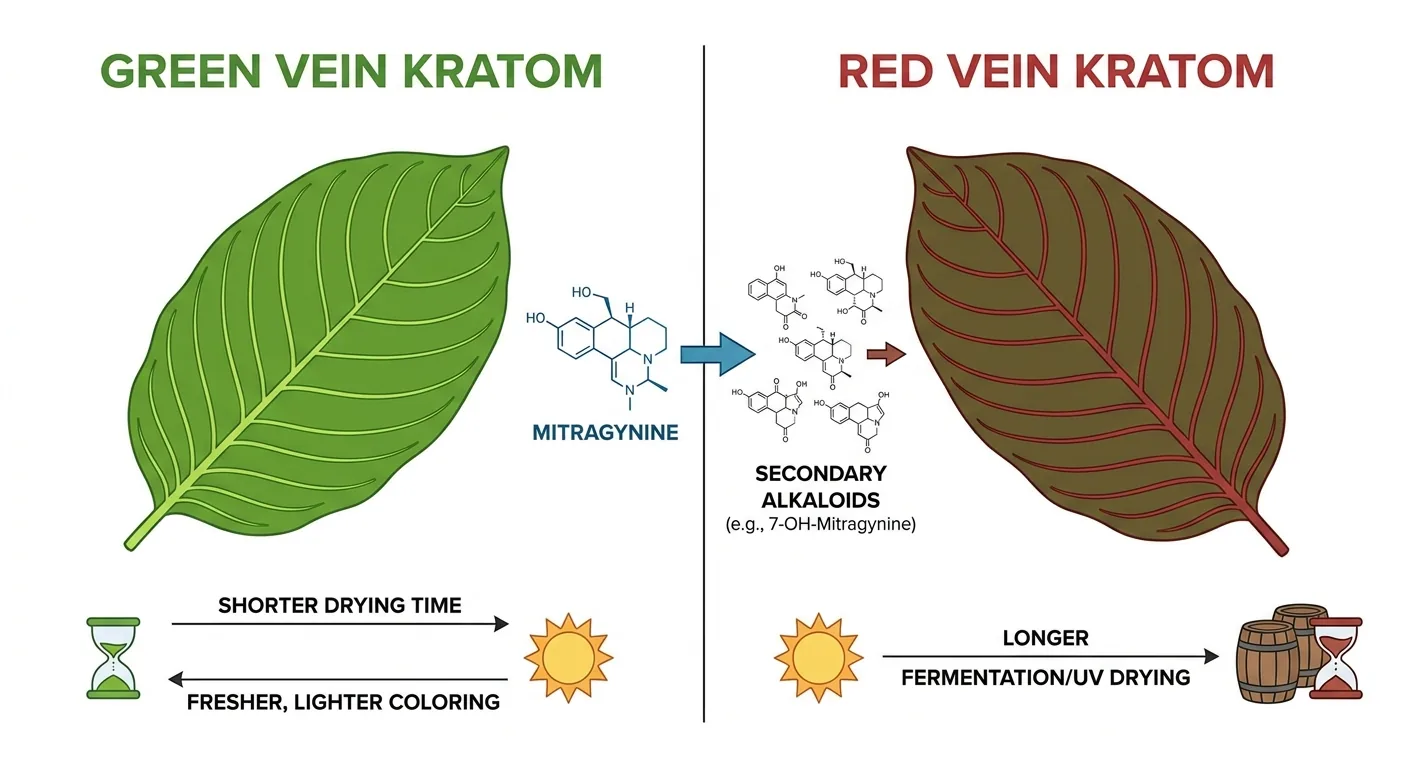
Kratom is derived from the leaves of Mitragyna speciosa, a tropical tree native to Southeast Asia. Green and red do not represent different species or genetically distinct plants — they are processing and maturity categories that emerged as informal industry conventions, not botanical classifications.[2]
The two categories generally reflect:
- Leaf maturity at harvest: Green kratom is typically harvested from leaves at intermediate maturity, while red kratom comes from more mature leaves
- Drying duration and conditions: Red kratom is typically dried longer, sometimes in direct sunlight or with UV light exposure, or using fermentation-style (in-bag) handling
- Post-harvest blending: Many commercial products blend leaf material from multiple sources and maturity levels, then assign a color label based on target effect profile
These distinctions developed organically in Southeast Asian kratom markets and were formalized (loosely) by the international kratom trade. They provide useful shorthand for broad effect tendencies, but they are not standardized across vendors and do not guarantee a specific alkaloid composition.[3]
Do green and red kratom have different alkaloid profiles?
Yes — measurably so, on average. HPLC alkaloid analysis across multiple kratom strains and vein colors consistently shows that processing conditions affect alkaloid ratios. But batch-to-batch variation within vein colors can be as large as the average difference between vein colors — which is why color alone is insufficient to predict what you’re buying.[1]

Key findings from alkaloid research:[1]
- Mitragynine (MG) content tends to be higher in green-processed leaf material — Green Malay strains commonly test at 55–65% MG as a proportion of total alkaloids
- Red-processed material typically shows lower MG percentages and higher concentrations of secondary alkaloids including speciociliatine, speciogynine, and paynantheine
- 7-Hydroxymitragynine (7-HMG) is present in very small quantities in both (typically under 2%), but is formed in higher relative amounts through UV-light oxidative processing used in some red production
- Total alkaloid count can differ: Red Bali has been reported to contain up to 24 unique identifiable alkaloids — among the highest for any single strain
Alkaloid Profile Tendencies by Vein Color (HPLC Research)
| Alkaloid | Green Tendency | Red Tendency | Effect Relevance |
|---|---|---|---|
| Mitragynine | Higher % (55–65% of alkaloids) | Lower % (processing converts some to secondary) | Stimulant, mood, focus at low-moderate doses |
| Speciociliatine | Moderate | Higher (UV/fermentation processing increases) | Modulates opioid receptor activity |
| Speciogynine | Present | Higher in mature/red leaf | 5-HT1A agonist; smooth muscle relaxant; anxiolytic |
| Paynantheine | Present | Typically higher in red-processed | 5-HT1A agonist; relaxation; potential antidepressant |
| 7-Hydroxymitragynine | Very low (<1%) | Slightly higher in UV-processed red | High-potency MOR agonist; pain relief, sedation |
Tendencies based on HPLC alkaloid research (Boffa et al. 2018). Actual values vary significantly by vendor, batch, and region of origin.
How does processing create the difference between green and red?
Processing is the primary variable that differentiates green from red kratom — not leaf genetics. The same tree can produce leaf material that is processed into either green or red products depending on how it is handled post-harvest.[3]
Green Processing
- Drying environment: Shaded indoor or brief outdoor drying — preserves more of the native alkaloid profile close to fresh-leaf composition
- Drying duration: Shorter — typically 1–3 days
- Effect on alkaloids: Mitragynine is relatively preserved; secondary alkaloid conversion is minimal
Red Processing
- UV light exposure: Extended outdoor drying in direct sunlight, or artificial UV exposure — UV radiation drives oxidative conversion of mitragynine to secondary alkaloids including speciociliatine and traces of 7-HMG
- Fermentation-style handling: Some red kratom involves in-bag fermentation (similar to Bentuangie processing) that further alters alkaloid ratios and produces a distinctly different flavor profile
- Extended drying duration: Typically 3–7+ days
- Effect on alkaloids: Lower MG proportion; higher secondary alkaloid content; may have more pronounced relaxing/sedating character due to alkaloid entourage shift
This processing science explains why color labels do have some pharmacological basis — but it also explains why the effect is not guaranteed. Two different vendors using “red processing” with different UV intensity, duration, temperature, and leaf age will produce meaningfully different alkaloid profiles even if both products are labeled “Red Bali.”[1]
How do green and red kratom compare for different use cases?
With the caveats about label variability established, the following comparison reflects the tendencies most commonly observed across user surveys and alkaloid research — not guarantees.[2][4]
Green vs Red Kratom — Practical Comparison
| Dimension | Green Kratom | Red Kratom |
|---|---|---|
| Leaf maturity | Intermediate (less mature) | More mature at harvest |
| Processing | Shorter indoor drying; UV-minimal | Longer outdoor/UV drying; sometimes fermented |
| Mitragynine level | Higher proportion | Lower proportion (some converted to secondary) |
| Secondary alkaloids | Lower (speciociliatine, speciogynine) | Higher (UV drives conversion) |
| User-reported effect tendency | Balanced energy + mood; moderate stimulant; less sedating | Relaxing, calming, heavier; stronger for pain and sleep |
| Dose-effect curve | More stimulant at low dose; less sharp sedation shift | Sedation onset at lower doses relative to green |
| Common use context (surveys) | Energy, focus, mood, daytime use, anxiety (mild) | Pain relief, relaxation, sleep, anxiety (stronger), evening use |
| Flavor profile | More bitter; “fresher” taste | Earthier; some reds (fermented) are distinctly different |
| Batch consistency | Variable — depends on vendor processing rigor | Variable — UV/fermentation conditions hard to standardize |
Grundmann’s 2017 survey of 8,049 kratom users found that while users reported a wide range of motivations, pain and relaxation were among the top three reasons — with those uses more commonly associated with red vein products — while energy and mood motivations were more commonly associated with green and white varieties.[2]
Why are kratom color labels unreliable without lab testing?
The single most important thing to understand about green vs red kratom labels is that they are vendor-assigned conventions, not standardized chemical specifications. Two products with identical color labels from different vendors may have substantially different alkaloid profiles.[1]
Key sources of within-color variability:
- Vendor processing inconsistency: Different UV exposure durations, temperatures, and drying environments produce different alkaloid conversions even with the same “red processing” intention
- Geographic and seasonal variation: Kratom alkaloid content varies by growing region, season, soil conditions, and tree age — independent of processing
- Blending practices: Many vendors blend leaf material from multiple sources or batches and assign color labels based on target profile rather than actual measured alkaloid content
- No regulatory standard: There is no industry-wide, government-enforced definition of what constitutes “green” or “red” kratom
A Certificate of Analysis (COA) from a third-party laboratory — specifically one that includes HPLC alkaloid quantification, not just microbial and heavy metals panels — is the only way to know the actual mitragynine content of a specific product lot. This is why AKA GMP-certified vendors who publish per-lot COAs with alkaloid data provide meaningfully different value than those who test only for safety panels.[3]
How should you choose between green and red kratom?
Given the above, the most practical framework for choosing between green and red is:
- Use color as a starting hypothesis, not a guarantee. If you’re looking for daytime energy and mood support, start with green. If you’re looking for evening relaxation or pain relief, start with red.
- Request a COA. Reputable vendors provide third-party lab results for each product lot. Alkaloid content (especially mitragynine %) gives you actual data, not just a color label.
- Track your own responses. Individual pharmacokinetics, tolerance, and body composition mean that the same product can feel meaningfully different between two people. Keep a dose journal.
- Rotate between green and red. Many experienced users report that rotating vein colors reduces tolerance build-up more effectively than staying within one color category — likely because the secondary alkaloid profiles differ, reducing the receptor adaptation rate.
- Start at the same dose regardless of color. Don’t assume red kratom requires a smaller dose to produce sedation. Begin at your usual starting dose and observe the actual effect before adjusting.
For a deeper understanding of why individual experiences vary even with the same product, see our guide on why kratom feels different. For information on how alkaloid content is measured and what to look for in a COA, see kratom lab testing and COA reading.
FAQ
Which is stronger: green or red kratom?
“Stronger” depends on what effect you’re measuring. Red kratom tends to produce more pronounced sedation and relaxation effects at lower doses — in that sense it may feel “stronger” for those uses. Green kratom tends to produce more stimulating and focusing effects at low-moderate doses. Neither is categorically more potent — it depends on the specific alkaloid profile and what you’re trying to achieve.[4]
Is red kratom better for pain?
User surveys and anecdotal reporting consistently place red vein kratom as the preferred choice for pain relief, likely because red processing produces a higher secondary alkaloid load (speciogynine, paynantheine) and, in some cases, slightly elevated 7-HMG relative to green — all of which contribute to a more opioid-like pain-relieving profile. However, “better” depends on the specific product and its alkaloid content, which varies by batch.[2]
Is green kratom better for energy and focus?
Yes, by tendency. Green-processed leaf material preserves more mitragynine as a proportion of total alkaloids, and higher mitragynine at low doses produces stimulant effects via adrenergic and dopaminergic pathways. Most kratom users who report using kratom for energy, productivity, or focus prefer green or white varieties. This is a tendency, not a guarantee — always verify with a COA.[5]
Can the same kratom plant produce both green and red kratom?
Yes. Green and red kratom from the same tree are entirely possible — and common. The color category is primarily determined by harvest timing and processing, not by plant genetics. A farmer can harvest leaves from the same tree at two different maturity levels and process them differently to produce green and red products.
Does red kratom have more 7-HMG than green kratom?
7-HMG is present in very small quantities in both vein colors — typically under 1–2% of total alkaloids. Red-processed kratom that uses extended UV light exposure may have slightly higher 7-HMG due to oxidative conversion from mitragynine, but the absolute amounts remain small. The idea that red kratom has dramatically more 7-HMG than green is not supported by current HPLC data.[1]
What is Bentuangie kratom?
Bentuangie is a specific type of red kratom that undergoes fermentation — the leaves are sealed in bags while still fresh, allowing enzymatic and microbial activity to alter the alkaloid profile before drying. Bentuangie is typically described as more sedating and relaxing than standard red vein products, with a distinctly earthier flavor. It represents one end of the processing spectrum within the red vein category.
Should I rotate between green and red kratom?
Many experienced users do rotate between vein colors to manage tolerance. The rationale is that the secondary alkaloid profiles differ between green and red, potentially providing partial cross-tolerance break. There is no clinical research confirming this mechanism, but it is a widely practiced harm-reduction strategy. Rotating also helps you understand your personal response to each category.
What does a good kratom COA show for vein color differences?
A meaningful COA (Certificate of Analysis) for alkaloid comparison should include HPLC quantification showing mitragynine content as a percentage or mg/g, 7-HMG content, and ideally a broader alkaloid panel. Products labeled “green” should generally test at higher mitragynine percentages (55%+ of alkaloids) while “red” products may show lower MG with more secondary alkaloids — if the processing was done properly. If a COA only shows microbial and heavy metal testing, it cannot confirm any vein color claim.[1]
References
- Boffa L, et al. Alkaloid content of dried Kratom leaves at different maturity and processing stages. Nat Prod Commun. 2018. (HPLC alkaloid profile data across kratom strains)
- Grundmann O (2017). Patterns of Kratom use and health impact in the US-Results from an online survey. Drug and alcohol dependence, 176, 63-70. [PubMed]
- Prozialeck WC, Jivan JK, Andurkar SV (2012). Pharmacology of kratom: an emerging botanical agent with stimulant, analgesic and opioid-like effects. The Journal of the American Osteopathic Association, 112(12), 792-9. [PubMed]
- Swogger MT, Hart E, Erowid F, et al. (2015). Experiences of Kratom Users: A Qualitative Analysis. Journal of psychoactive drugs, 47(5), 360-7. [PubMed]
- Suhaimi FW, Yusoff NH, Hassan R, et al. (2016). Neurobiology of Kratom and its main alkaloid mitragynine. Brain research bulletin, 126(Pt 1), 29-40. [PubMed]
Ready to choose? Shop green vein kratom or red vein kratom.

Shop Lab-Tested Kratom
Browse our full selection of AKA GMP-qualified kratom — powder, capsules, extracts, and more. Free shipping on orders $99+.
Shop All Kratom