
If you’ve compared notes with other kratom users, you’ve probably noticed that the same product can produce dramatically different experiences — or that your own experience shifts over time with no obvious cause. This variability is not imaginary, not a quality problem, and not unique to kratom. It is the predictable result of pharmacokinetic and pharmacogenomic factors that cause the same nominal dose to deliver meaningfully different alkaloid concentrations to different people under different conditions. This guide explains the specific mechanisms.[2]
How do genetics affect kratom’s effects?
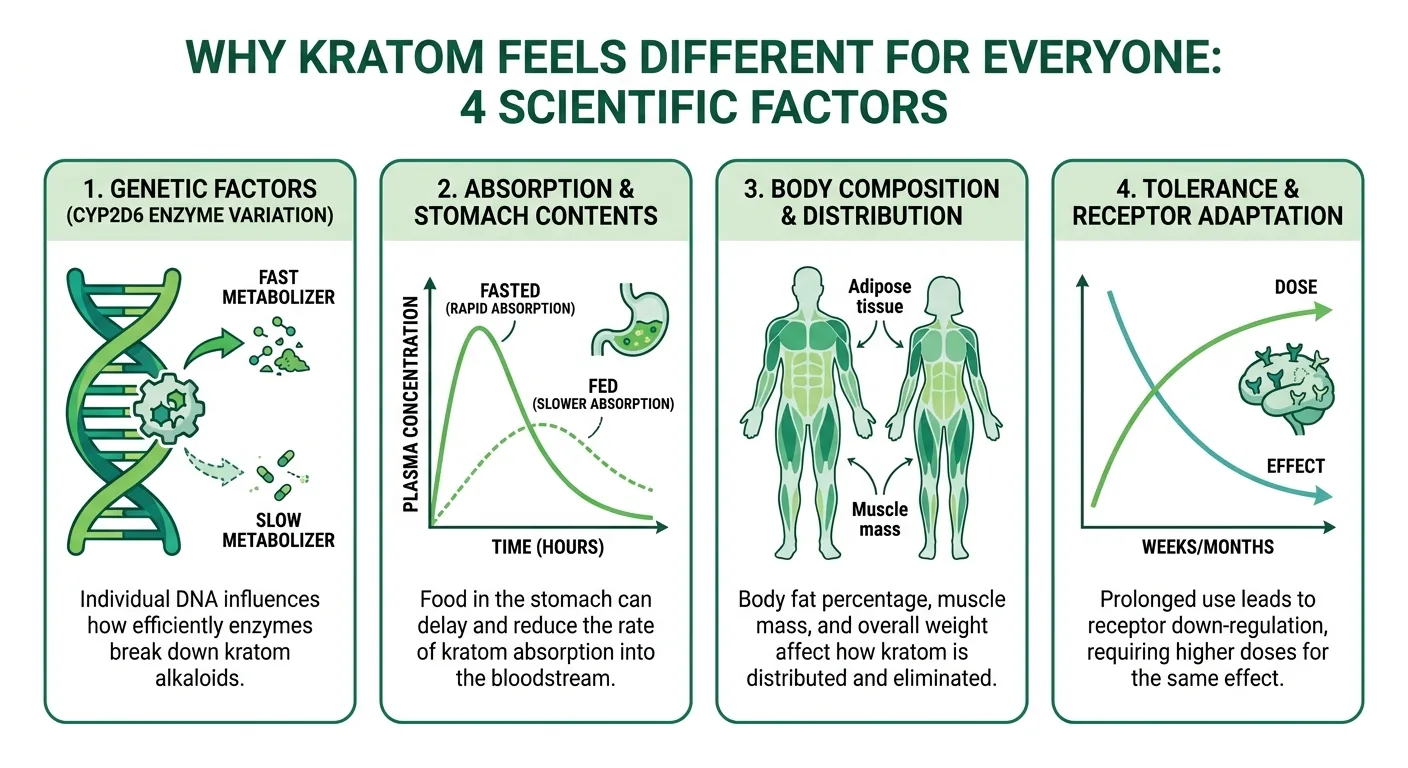
The most important genetic variable in kratom metabolism is CYP2D6 polymorphism. Mitragynine is metabolized primarily by hepatic CYP3A4, but CYP2D6 plays a significant secondary role in its biotransformation — and CYP2D6 is one of the most genetically variable enzymes in human pharmacology.[3]
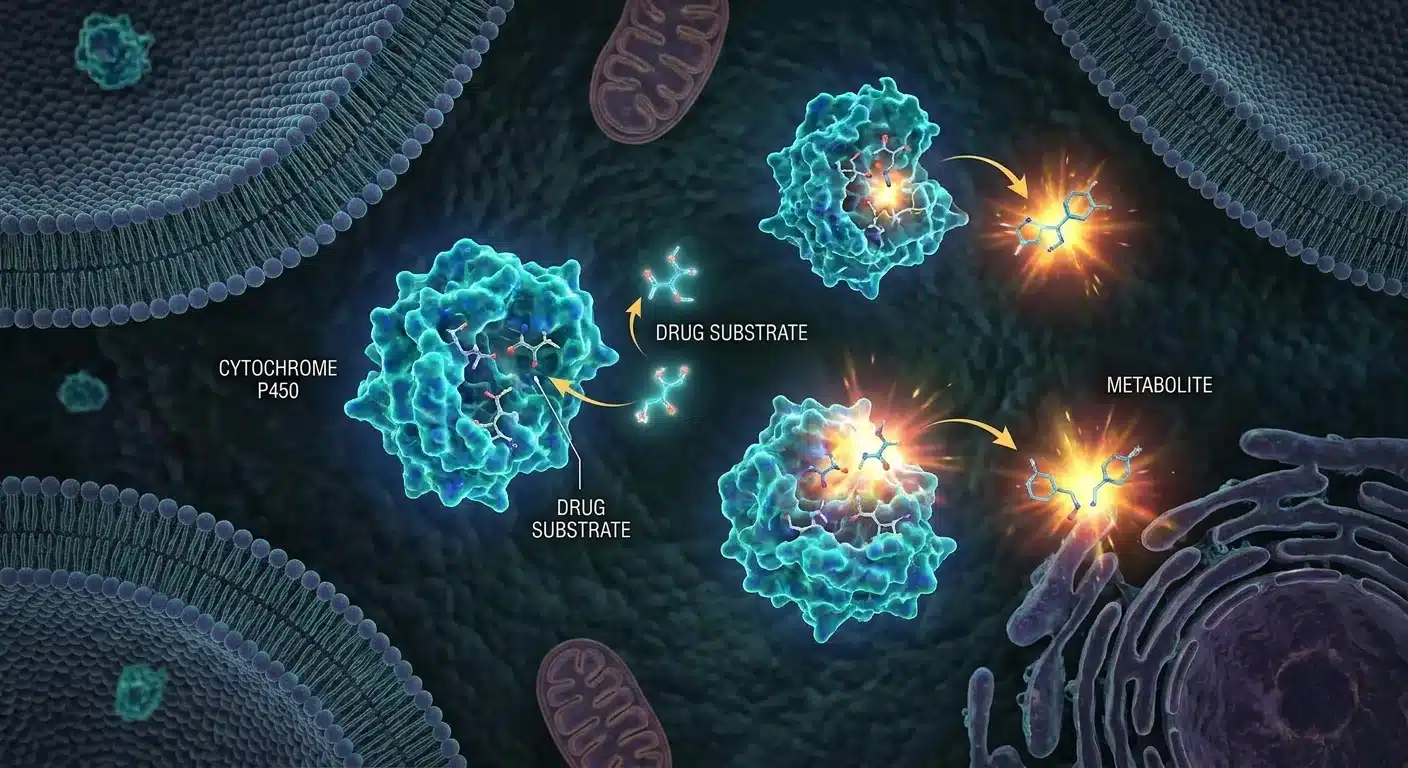
CYP2D6 metabolizer phenotypes, and their estimated prevalence:
CYP2D6 Phenotypes — Population Frequency and Effect on Kratom
| Phenotype | Prevalence | What It Means for Kratom |
|---|---|---|
| Poor Metabolizer (PM) | 7–10% European, ~1% Asian | Mitragynine clears much more slowly; plasma levels accumulate; same gram dose produces stronger, longer effects |
| Intermediate Metabolizer (IM) | ~50% of population | Slightly slower clearance than extensive; moderate accumulation with daily use |
| Extensive Metabolizer (EM) | ~35–40% of population | Normal kratom clearance rate; effects closest to “average” study participants |
| Ultra-rapid Metabolizer (UM) | 1–10% (varies by ancestry) | Mitragynine clears very quickly; same dose produces weaker, shorter effects — users may feel kratom “doesn’t work” at standard doses |
This genetic variation alone can produce a 2–4× difference in plasma mitragynine concentration between two people who took the same dose at the same time under the same conditions. It is the primary reason why personal dose-finding matters and why copying someone else’s dose is unreliable.[3]
CYP2D6 inhibitors (including SSRIs like fluoxetine and paroxetine, and some antihistamines) can temporarily convert extensive metabolizers to effective poor metabolizers — meaning the same person can experience significantly stronger effects if they start or stop a CYP2D6-affecting medication.
Why does food timing change the kratom experience?
Kratom alkaloids are absorbed primarily through the gastrointestinal tract. The presence or absence of food in the stomach significantly affects absorption kinetics:[1]
- Empty stomach: Gastric emptying is faster; alkaloid absorption into the bloodstream begins sooner; peak plasma concentration (Cmax) is higher — typically 40–60% above fed-state
- Fed state: Food slows gastric emptying; alkaloid absorption is delayed and blunted; peak concentration is lower but the absorption window is extended, producing a more gradual onset
- High-fat meals specifically: Fat slows gastric emptying most significantly; can extend Tmax (time to peak) by 1–2 hours while reducing Cmax
The practical consequence: the same 3-gram dose taken on an empty stomach may feel notably stronger and faster-onset than the same dose taken after a full meal. Users who eat unpredictably between doses will experience unpredictable kratom intensity — not because the product changed, but because their GI physiology did.
Food Timing Effects on Kratom Pharmacokinetics
| State | Onset | Peak Concentration | Duration |
|---|---|---|---|
| Empty stomach | 20–40 min | Higher (↑40–60%) | Standard |
| Light meal (1–2h prior) | 30–60 min | Moderate | Standard to slightly extended |
| Full meal (within 1h) | 45–90 min | Lower (↓30–50%) | Extended, more gradual |
How does body composition affect kratom?
Mitragynine is a lipophilic (fat-soluble) compound with a relatively large volume of distribution — meaning it distributes into body tissues, not just plasma. The implication: in users with more body fat, a given dose of mitragynine distributes into a larger tissue volume, resulting in lower effective plasma and CNS concentrations per gram of product consumed.[2]
This is the same reason that many medications (particularly lipophilic drugs and anesthetics) are dosed by body weight. Kratom is not typically weight-dosed in practice — the convention is “grams of powder” — which means a 90 kg user with 25% body fat may experience materially weaker effects than a 65 kg user with 15% body fat at the exact same gram dose.
Hydration state also matters: dehydration increases effective plasma concentration by reducing the plasma volume that alkaloids distribute into, potentially intensifying effects. This explains why some users report that kratom feels stronger when dehydrated — which is also when it’s riskiest.
Why does kratom hit harder for daily users?
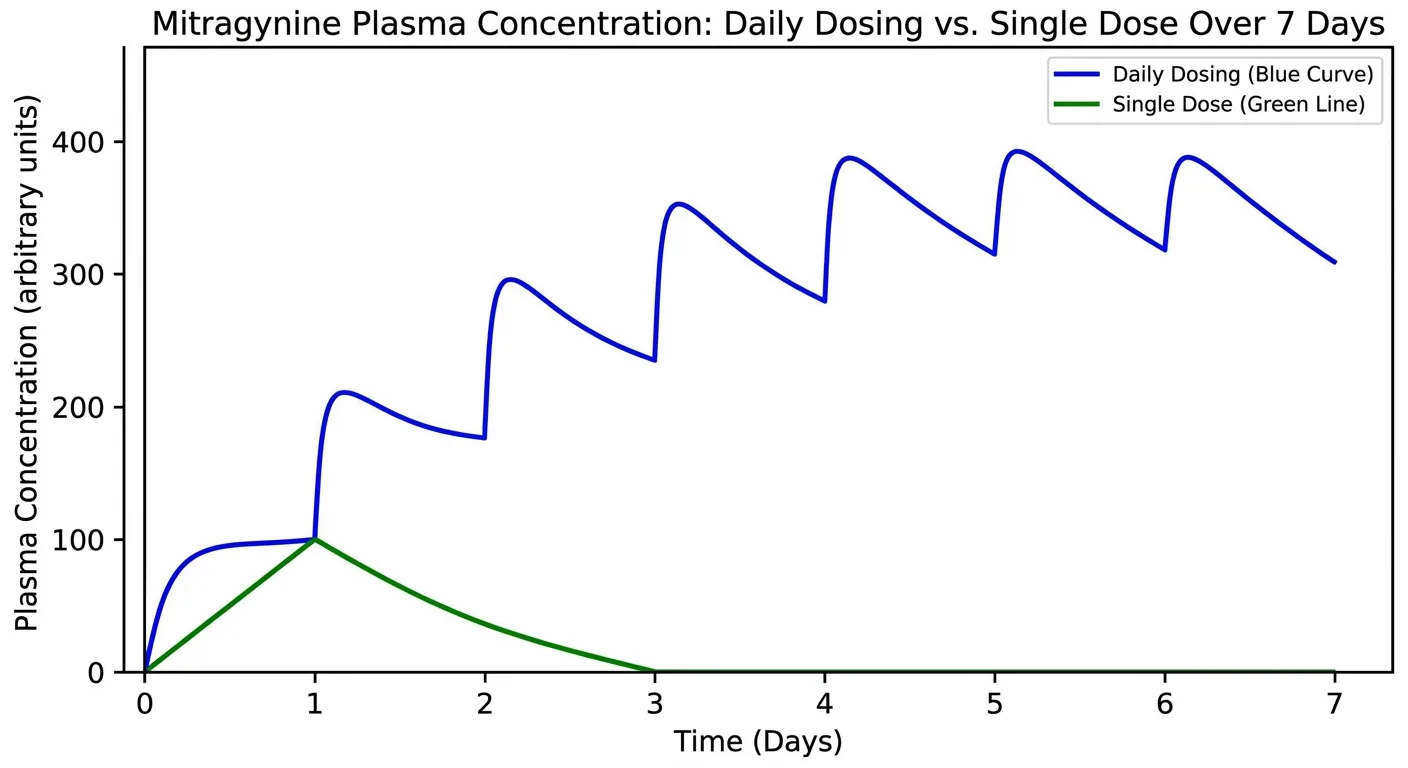
The Tanna et al. (2022) FDA-registered clinical trial made a finding that has significant implications for daily users: mitragynine’s terminal plasma half-life is approximately 45.3 hours — far longer than the commonly cited 9–24 hours.[1]
A 45-hour half-life means:
- After a single dose, mitragynine is still at ~50% plasma concentration 45 hours later
- Users who dose once daily reach steady-state accumulation at 3–5× single-dose levels within a week
- Users who dose twice daily accumulate even higher — well above what any single-dose study shows
This is why daily users frequently report that their “effective dose” seems to decrease over time, and why users who take breaks often find kratom substantially more potent when they return. The effect is not tolerance alone — it is the elimination of weeks of accumulated alkaloid load from the system during abstinence, dropping back to near-baseline pharmacokinetics.[4]
It also explains why occasional users (once a week or less) systematically experience different effects than daily users at the same dose: the occasional user is always dosing from a clean baseline, while the daily user operates at a chronically elevated alkaloid background.
Why do two batches of the same product feel different?
Even when all the individual factors above are held constant, kratom products vary batch-to-batch due to natural agricultural and processing variation.[5] Sources of batch variation include:
- Seasonal alkaloid fluctuation: Kratom alkaloid content varies with season, rainfall, and temperature — the same tree at peak vs. off-season harvest produces measurably different alkaloid concentrations
- Leaf maturity at harvest: Younger leaves have different alkaloid ratios than mature leaves — harvest timing affects the mitragynine-to-secondary-alkaloid balance
- Drying variation: UV exposure duration, temperature, and humidity during drying affect alkaloid conversion (mitragynine → speciociliatine and other secondary alkaloids)
- Blending differences: Many commercial products blend leaf material from multiple sources; batch-to-batch differences in source material composition propagate into the final product
This is why HPLC-verified Certificates of Analysis (COAs) are the only reliable way to know what you’re buying. Two packages of “Red Bali” with the same label can test at 1.2% and 1.8% mitragynine — a 50% potency difference at the same gram dose. See our kratom COA lab testing guide for how to read and interpret a COA.
How does tolerance change the equation?
Tolerance to kratom develops through two primary mechanisms:[4]
- Receptor downregulation (pharmacodynamic tolerance): Chronic mu-opioid receptor (MOR) agonism leads to reduced receptor expression and/or G-protein uncoupling — fewer functional receptors at the same alkaloid concentration produces a weaker effect
- Metabolic tolerance (pharmacokinetic): Chronic kratom use may upregulate CYP enzyme expression, increasing the rate of mitragynine clearance — requiring higher doses to reach the same plasma concentration
Singh et al. (2014) found that users consuming 3 or more servings per day had significantly higher odds of dependence than lower-frequency users — consistent with both tolerance and physical dependence developing at high-frequency use patterns.[4]
Tolerance is partially reversible with breaks: receptor upregulation occurs over days of abstinence, meaning even 3–5 day breaks can meaningfully reset sensitivity. Strain rotation (alternating between different alkaloid profiles) may provide partial cross-tolerance break, though this is not clinically confirmed.
What does this mean practically?
Understanding these mechanisms leads to actionable harm-reduction strategies:
Variability Factors — Practical Implications
| Factor | What To Do |
|---|---|
| Genetics (CYP2D6) | Start low regardless of others’ doses; treat your personal effective dose as data, not a character flaw. If on SSRIs (CYP2D6 inhibitors), reduce dose and expect stronger effects |
| Food timing | Keep food timing consistent between doses to get consistent results. If reducing tolerance, taking on empty stomach lets you use a smaller dose for the same effect |
| Body composition | Consider weight-adjusted dosing: larger individuals often need modestly higher doses; smaller individuals should be especially conservative with initial doses |
| Accumulation (45h half-life) | If you use daily, your baseline is much higher than occasional users. After breaks of 3+ days, expect significantly stronger effects from the same dose — dose conservatively when returning |
| Batch variation | Always request a COA when switching to a new batch/vendor. Treat a new batch like a new product until you’ve established your response to it |
| Tolerance | Take regular 3–7 day breaks rather than escalating dose. Rotate between different alkaloid profiles (green/red/white) to slow cross-tolerance |
Keeping a dose journal — recording product, batch, dose, food timing, and observed effects — is the most practical tool for understanding your personal pharmacokinetics and making consistent decisions over time.
FAQ
Why does kratom feel different every time I use it?
Multiple compounding factors shift your pharmacokinetics between uses: food timing at the time of dosing, hydration state, accumulated alkaloid load from prior doses (given the 45-hour half-life), and tolerance changes from frequency of use. Even without changing the product, these variables can produce meaningfully different experiences from the same dose.[1]
Why does kratom feel stronger for some people than others at the same dose?
CYP2D6 genetic polymorphism is the primary driver. Poor metabolizers (7–10% of European populations) clear mitragynine 2–4× more slowly than extensive metabolizers, producing substantially higher plasma concentrations at the same dose. Body composition, CYP-inhibiting medications, and current tolerance level also contribute to inter-individual differences.[3]
Why did kratom stop working as well as it used to?
Two mechanisms: (1) tolerance — chronic MOR agonism leads to receptor downregulation, requiring higher alkaloid concentrations for the same effect; and (2) accumulation — daily users develop a chronically elevated alkaloid baseline that masks the acute effects of individual doses. Tolerance breaks of 3–7 days substantially reset both.[4]
Why does kratom hit harder on an empty stomach?
An empty stomach allows faster gastric emptying, leading to quicker and more complete absorption of mitragynine into the bloodstream. Peak plasma concentration (Cmax) is typically 40–60% higher when taken fasted compared to the fed state. This is not a different pharmacological effect — it’s the same alkaloid at a higher effective concentration.
Does body weight affect how kratom works?
Yes. Mitragynine is lipophilic and distributes into body tissues. Users with more body fat have a larger volume of distribution, meaning the same gram dose gets “diluted” across more tissue — resulting in lower effective plasma concentrations. Heavier users with higher body fat often need modestly larger doses to achieve effects comparable to lighter users.[2]
Why does kratom feel stronger after a break?
Given mitragynine’s 45-hour half-life, daily users carry a substantial accumulated alkaloid burden. After 3+ days of abstinence, this load is eliminated — dropping plasma concentrations to near-zero before the next dose. The subsequent dose hits a system with near-zero tolerance and zero accumulated background, producing much stronger effects than the same dose taken during regular daily use.[1]
Can medications make kratom stronger or weaker?
Yes, significantly. CYP2D6 inhibitors (fluoxetine, paroxetine, bupropion, diphenhydramine) slow mitragynine clearance, making kratom effectively stronger. CYP3A4 inhibitors (some antifungals, grapefruit juice) have a similar effect on the primary metabolic pathway. CYP3A4 inducers (rifampin, St. John’s Wort, carbamazepine) can make kratom significantly weaker by accelerating clearance.[3]
How do I get more consistent results from kratom?
Control the variables you can: (1) standardize food timing relative to dosing; (2) stay well-hydrated; (3) use the same product batch until it’s gone, then verify the new batch with a COA; (4) track doses and effects in a journal; (5) take regular tolerance breaks to prevent creeping dose escalation; (6) avoid CYP-inhibiting medications without consulting your physician about timing.
References
- Tanna RS, Nguyen JT, Hadi DL, et al. (2022). Clinical Pharmacokinetic Assessment of Kratom (Mitragyna speciosa), a Botanical Product with Opioid-like Effects, in Healthy Adult Participants. Pharmaceutics, 14(3). [PubMed]
- Prozialeck WC, Jivan JK, Andurkar SV (2012). Pharmacology of kratom: an emerging botanical agent with stimulant, analgesic and opioid-like effects. The Journal of the American Osteopathic Association, 112(12), 792-9. [PubMed]
- Tanna RS, Nguyen JT, Hadi DL, et al. (2022). Clinical Pharmacokinetic Assessment of Kratom (Mitragyna speciosa), a Botanical Product with Opioid-like Effects, in Healthy Adult Participants. Pharmaceutics, 14(3). [PubMed]
- Singh D, Müller CP, Vicknasingam BK (2014). Kratom (Mitragyna speciosa) dependence, withdrawal symptoms and craving in regular users. Drug and alcohol dependence, 139, 132-7. [PubMed]
- Grundmann O (2017). Patterns of Kratom use and health impact in the US-Results from an online survey. Drug and alcohol dependence, 176, 63-70. [PubMed]
Find your match across the full kratom range.

Shop Lab-Tested Kratom
Browse our full selection of AKA GMP-qualified kratom — powder, capsules, extracts, and more. Free shipping on orders $99+.
Shop All Kratom