


Kratom’s noticeable effects typically last 3–6 hours at standard doses, with onset beginning 15–45 minutes after ingestion and peak effects occurring around 1.5–2.5 hours. The actual duration depends significantly on dose, form (powder vs. capsule vs. extract), vein color, stomach contents, and individual metabolism. This guide covers how long kratom lasts by dose and format, what shortens or extends duration, and how effects duration differs from how long kratom stays in your system.
What Is the Typical Kratom Effects Timeline?
The pharmacokinetic profile of kratom’s primary alkaloid, mitragynine, determines the effects timeline. Trakulsrichai et al. (2015) established that peak plasma concentration (Tmax) occurs at approximately 1.5 hours after oral ingestion in a controlled single-dose human study — the point corresponding to what users describe as “peak effects.”[1] The Tanna et al. (2022) clinical pharmacokinetics study using commercial kratom products confirmed similar Tmax timing and extended the data to real-world product scenarios.[2]
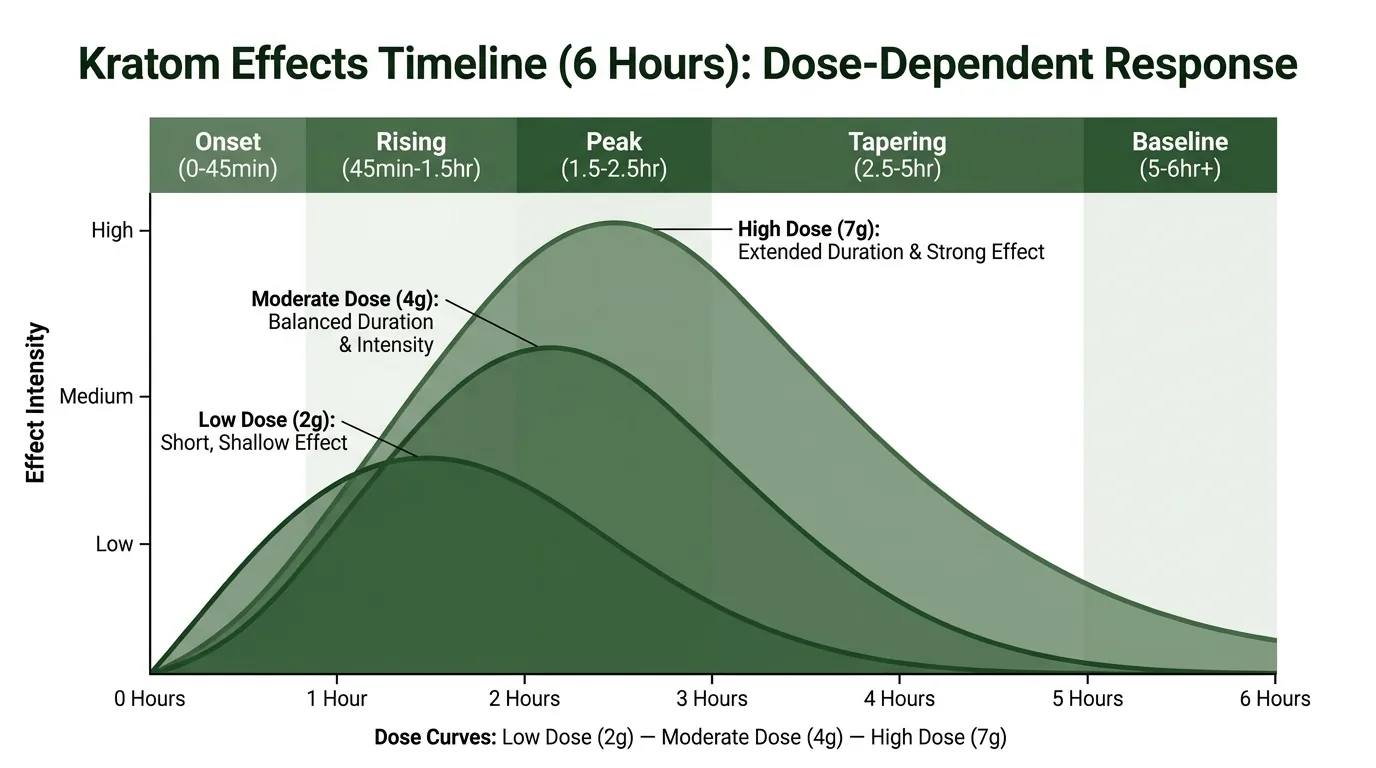
The general timeline for most users at a moderate dose (3–5g of standard kratom powder):
| Phase | Timing | What Happens | Notes |
|---|---|---|---|
| Onset | 15–45 min | First noticeable effects begin — mild alertness, warmth, mood shift | Faster on empty stomach; slower after a large meal |
| Rising | 45 min – 1.5 hr | Effects build steadily toward peak | Common mistake: re-dosing during this phase because “nothing is happening yet” |
| Peak | 1.5–2.5 hr | Full effect reached — matches pharmacokinetic Tmax (~1.5 hr) | Most users describe this as the “window” — 1–2 hours of full effect |
| Tapering | 2.5–5 hr | Effects gradually reduce; no abrupt cutoff | Sedative effects (red vein) tend to taper more gradually than stimulant effects |
| Afterglow / Baseline | 4–6 hr mark | Most users report returning to baseline; mild residual warmth possible | Higher doses extend this to 6–8 hours |
These timelines reflect average user reports at moderate doses — individual variation is significant. Swogger et al. (2015) documented through qualitative analysis that user experiences, including duration, vary substantially based on individual factors and the specific product used.[3]
How Does Dose Affect How Long Kratom Lasts?
Dose is the most significant variable in how long kratom’s effects last. Smith et al. (2022) analyzed self-reported dose-effect relationships across a sample of regular kratom users and found clear dose-dependent patterns in both effect intensity and duration.[4]
| Dose Range | Typical Duration | Character of Effects | Onset Speed |
|---|---|---|---|
| 1–2 g | 2–3 hours | Mild stimulation; subtle mood lift | 15–25 min |
| 3–5 g | 3–5 hours | Full effects — energy or relaxation depending on strain | 20–40 min |
| 5–8 g | 5–7 hours | Strong sedation and analgesia dominate; stimulant effects minimal | 25–45 min |
| 8 g+ | 6–8+ hours | Heavy sedation; significantly elevated side effect risk | Variable; nausea may precede or mask effects |
Higher doses don’t just extend duration — they shift the character of effects. Kratom at low doses produces primarily stimulant, adrenergic-receptor-mediated effects (alertness, motivation, talkativeness). At higher doses, mu-opioid receptor activation dominates, producing sedation, analgesia, and reduced mental clarity. The extended duration at higher doses comes with proportionally increased side effect risk — nausea, dizziness, and constipation are substantially more common above 5g. The minimum effective dose is always preferable.
How Does Kratom Form Affect Duration?
Kratom’s form of consumption affects both onset speed and, to a lesser degree, duration. The key variable is how rapidly mitragynine is absorbed into systemic circulation.
- Powder (toss-and-wash or mixed in liquid) — fastest onset of the standard forms, typically 15–30 minutes, because the loose powder dissolves and absorbs rapidly in the stomach. Duration: 3–5 hours at moderate doses.
- Capsules — 15–30 minutes slower onset than powder because the gelatin or vegetable capsule shell must dissolve before the powder inside can be absorbed. Onset: 30–60 minutes. Duration comparable to powder once absorption begins; the slower onset often produces a smoother, more gradual experience. See our kratom capsules for pre-measured options.
- Kratom tea — onset varies by brewing method and alkaloid extraction efficiency. Teas made with acidic liquid (lemon juice, citric acid) extract alkaloids more efficiently; duration 3–5 hours. See our Kratom Tea Guide for brewing methods that affect extraction.
- Extracts and enhanced powders — significantly higher mitragynine concentration per gram means smaller doses produce stronger effects for longer. A 10x extract taken at the equivalent of 5g standard powder may extend effects 1–2 hours beyond plain leaf at the same effective dose. Extracts also carry substantially higher tolerance-building risk with regular use.
- Kratom shots — liquid format with pre-dissolved alkaloids; fastest onset among commercial formats, typically 10–25 minutes. Duration comparable to equivalent powder dose. See our kratom shots collection.
The clinical pharmacokinetic literature confirms that route and formulation variables that alter Cmax and Tmax directly affect the perceived duration and intensity of effects — not just the speed of onset.[2]
Does Strain or Vein Color Affect Duration?
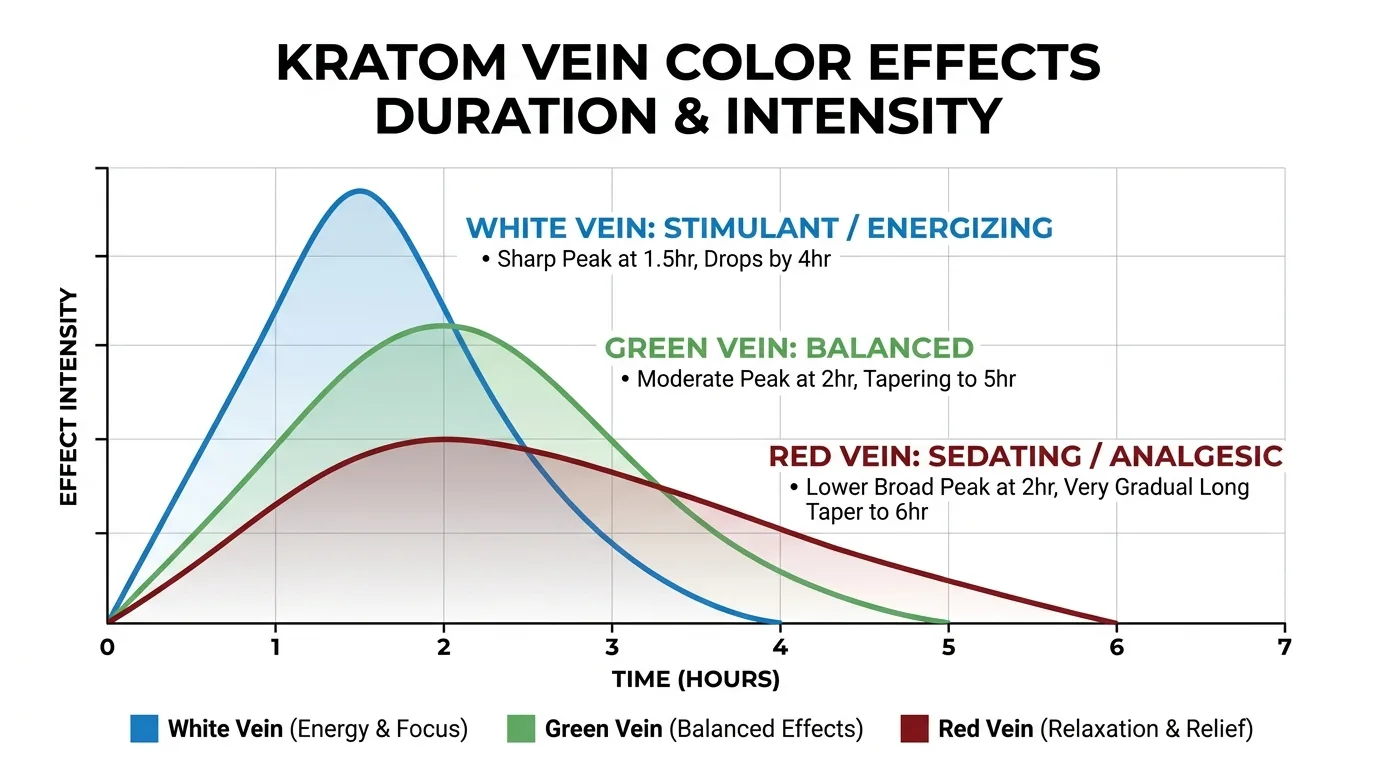
Vein color and strain influence the character of effects more than the total duration, but there are meaningful differences in how long specific effects within the window persist.
- White vein kratom — tends toward more stimulant-dominant profiles. The energizing effects peak quickly and may feel shorter-lived (3–4 hours) because the adrenergic effects wear off faster than the opioid-receptor-mediated effects. Users often report white vein feeling “cleaner” but briefer at the same dose as red vein.
- Green vein kratom — the middle-ground profile: moderate stimulation at onset with more balanced relaxation during taper. Duration typically 4–5 hours at moderate doses. The most versatile duration profile for daytime use.
- Red vein kratom — most sedating profile; the relaxation and analgesia tend to persist longest, often 5–6 hours at moderate doses. The tapering phase from red vein is typically more gradual, with users reporting a “softer landing” compared to white vein.
- Yellow/Gold kratom — typically dried or processed longer, which affects alkaloid ratios. Effects tend toward the green-to-red range in duration (4–6 hours). Duration more variable batch-to-batch than standard veins.
The alkaloid basis for these differences is documented in the HPLC and alkaloid profiling literature: different vein colors and processing methods produce measurably different mitragynine concentrations and secondary alkaloid ratios, which shift the balance between adrenergic and opioid receptor activity and thus the character and perceived duration of effects. These qualitative duration differences by strain type are also reflected in user experience research.[3] See our Kratom Strains Guide for the detailed alkaloid science.
What Shortens or Extends Kratom’s Duration?
Factors that extend duration:
- Higher dose — the most direct lever; each additional gram adds roughly 30–60 minutes to total duration
- Empty stomach — faster absorption reaches peak faster but can also extend the overall window slightly
- Slower individual metabolism (CYP enzyme status)
- Extracts or enhanced products — higher alkaloid concentration per effective dose
- Combining with food rich in fats — slower, more sustained absorption can extend duration and smooth the curve
Factors that shorten duration:
- Tolerance from daily use — the most significant shortener. Grundmann (2017) documented that daily users frequently report needing higher doses and experiencing shorter apparent durations as tolerance develops.[5] This is receptor downregulation reducing the threshold effect window.
- Taking after a large meal — food slows gastric emptying and absorption, reducing peak concentration and making effects feel briefer and milder
- Dehydration — reduces alkaloid distribution efficiency
- High caffeine intake on the same day — adrenergic stimulation from caffeine can mask or compete with kratom’s stimulant effects, making them feel shorter-lived
How Is Effects Duration Different From Detection Time?
This is a question that comes up often because people conflate the two. Effects duration and detection time are completely separate timelines.
Effects end when mitragynine falls below the plasma concentration threshold for noticeable receptor activation — typically around 3–6 hours for standard doses, consistent with the half-life established by Trakulsrichai et al.[1] Detection ends when mitragynine metabolites fall below the analytical sensitivity of the test being used — which can be days after effects have fully resolved.
- Effects resolve: 3–6 hours (standard dose), up to 8 hours (high dose)
- Blood clearance: 24–48 hours (mitragynine parent compound)
- Urine metabolites: 1–9 days depending on use frequency
The fact that you feel completely normal 6 hours after taking kratom does not mean it has left your system in the pharmacokinetic sense. For full clearance timelines, see our How Long Does Kratom Stay in Your System? guide.
Frequently Asked Questions
Why did kratom stop working after 2 hours?
Several possibilities: you took too small a dose for your current tolerance level; you ate a large meal beforehand, which slowed absorption and reduced peak concentration; the product had lower mitragynine content than expected (check the COA); or your tolerance is elevated from frequent daily use, which compresses the effective window. Try taking on an empty or nearly empty stomach, confirm the COA mitragynine percentage on your product, and if daily use is a factor, consider a short tolerance break — see our Kratom Tolerance Break Guide.
Does kratom last longer on an empty stomach?
Taking kratom on an empty stomach typically produces faster and stronger onset — peak effects arrive sooner and at higher intensity. Whether this translates to longer total duration depends on dose: for some users the higher effective peak concentration does extend the window slightly; for others the quicker absorption means faster clearance too. Most users find the net effect is a sharper, faster onset with similar total duration — roughly the same 3–5 hours, but the peak is more pronounced. The trade-off is higher nausea risk on an empty stomach, particularly at doses above 4g.
Can I take more kratom to extend the effects?
Re-dosing to extend effects is common but carries real trade-offs. A second dose taken as the first is tapering (around 3–4 hours in) will extend the session, but the total dose becomes higher than either individual dose alone — increasing side effect risk and contributing to faster tolerance development. If you regularly find that effects don’t last long enough, the better approach is optimizing the initial dose and form (extracts, for example, have inherently longer windows) rather than stacking doses.
Does kratom last longer for beginners than experienced users?
Generally yes. New users typically have no tolerance — their mu-opioid receptors are at full density and sensitivity, so a moderate dose produces a longer and more pronounced effect window. Experienced daily users, with receptor downregulation from chronic use, often report the same dose feeling milder and shorter-lived than it did initially. This is the tolerance mechanism: to get the same duration back, they either increase dose (which drives more tolerance) or take a break to allow receptor upregulation. See our Kratom Tolerance Guide for the receptor biology.
Why do different kratom vendors’ products feel like they last different lengths of time?
Primarily because of mitragynine content variation. A 5g dose of powder with 1.2% mitragynine delivers 60mg of the primary alkaloid; the same 5g of powder with 1.7% delivers 85mg — a 42% difference in effective dose. The batch with higher mitragynine will produce effects that last longer and feel stronger. This is why COA-verified products with disclosed alkaloid percentages matter practically: without that information, you’re guessing at effective dose. At Amazing Botanicals, every batch’s COA is published at our lab testing page.
How long do kratom extracts last compared to plain powder?
Kratom extracts — whether full-spectrum, MIT45, or other concentrated formats — typically last 1–2 hours longer than an equivalent-effect dose of plain powder, because the higher alkaloid density at the same volume produces a higher, more sustained plasma concentration. However, the tolerance trade-off is significant: extracts build tolerance faster than plain leaf at the same subjective effect level. Most experienced users reserve extracts for specific situations rather than daily use, precisely because daily extract use dramatically compresses the effective window over time through accelerated tolerance.
Does mixing kratom strains affect how long it lasts?
Blending green and red vein, for example, can produce a duration profile that sits between the two — the green’s more energetic early phase combined with the red’s longer taper. In practice, blending primarily affects character (the arc of what you feel) rather than dramatically extending total duration. The total alkaloid content determines the pharmacokinetic window; the alkaloid ratio determines the experience within it.
Is a longer-lasting kratom experience better?
Not necessarily — and this framing can lead to dose escalation that causes more problems than it solves. A clean, well-defined 4-hour window at a lower dose is generally preferable to a blurry, heavy 7-hour window at a high dose. The goal of dose optimization is the minimum effective dose that provides the effects you’re seeking — not maximum duration. Extended duration at high doses usually means extended side effects (sedation, constipation, brain fog) alongside the desired effects.
References
- Trakulsrichai S, Sathirakul K, Auparppong S et al. (2015). Pharmacokinetics of mitragynine in man. Drug Design, Development and Therapy. [PubMed]
- Tanna RS, Nguyen JT, Hadi DL et al. (2022). Clinical pharmacokinetic assessment of kratom (Mitragyna speciosa), a botanical product with opioid-like effects, in healthy adult participants. Clinical Pharmacology & Therapeutics. [PubMed]
- Swogger MT, Hart E, Erowid F et al. (2015). Experiences of kratom users: a qualitative analysis. Journal of Psychoactive Drugs. [PubMed]
- Smith KE, Feldman AZ, Rogers JM et al. (2022). Searching for a signal: self-reported kratom dose-effect relationships among a sample of US adults with regular kratom use histories. Drug and Alcohol Dependence. [PubMed]
- Grundmann O. (2017). Patterns of kratom use and health impact in the US — results from an online survey. Drug and Alcohol Dependence. [PubMed]
Disclaimer: This article is for educational purposes only and is not medical advice. Kratom is not FDA-approved to diagnose, manage, resolve, or prevent any condition. Individual experiences vary. Consult a qualified healthcare provider with health-related questions.

Shop Lab-Tested Kratom
Browse our full selection of AKA GMP-qualified kratom — powder, capsules, extracts, and more. Free shipping on orders $99+.
Shop All Kratom