


Kratom is available in several forms — powder, capsules, tea, extracts, and shots — each with different onset speeds, preparation requirements, and practical trade-offs. The method you choose affects how quickly effects begin, how intense they feel, and how easy the experience is to control. This guide covers each form, how to use it correctly, and the practical decisions that determine whether your first sessions with kratom go well or poorly.
What Forms Does Kratom Come In?
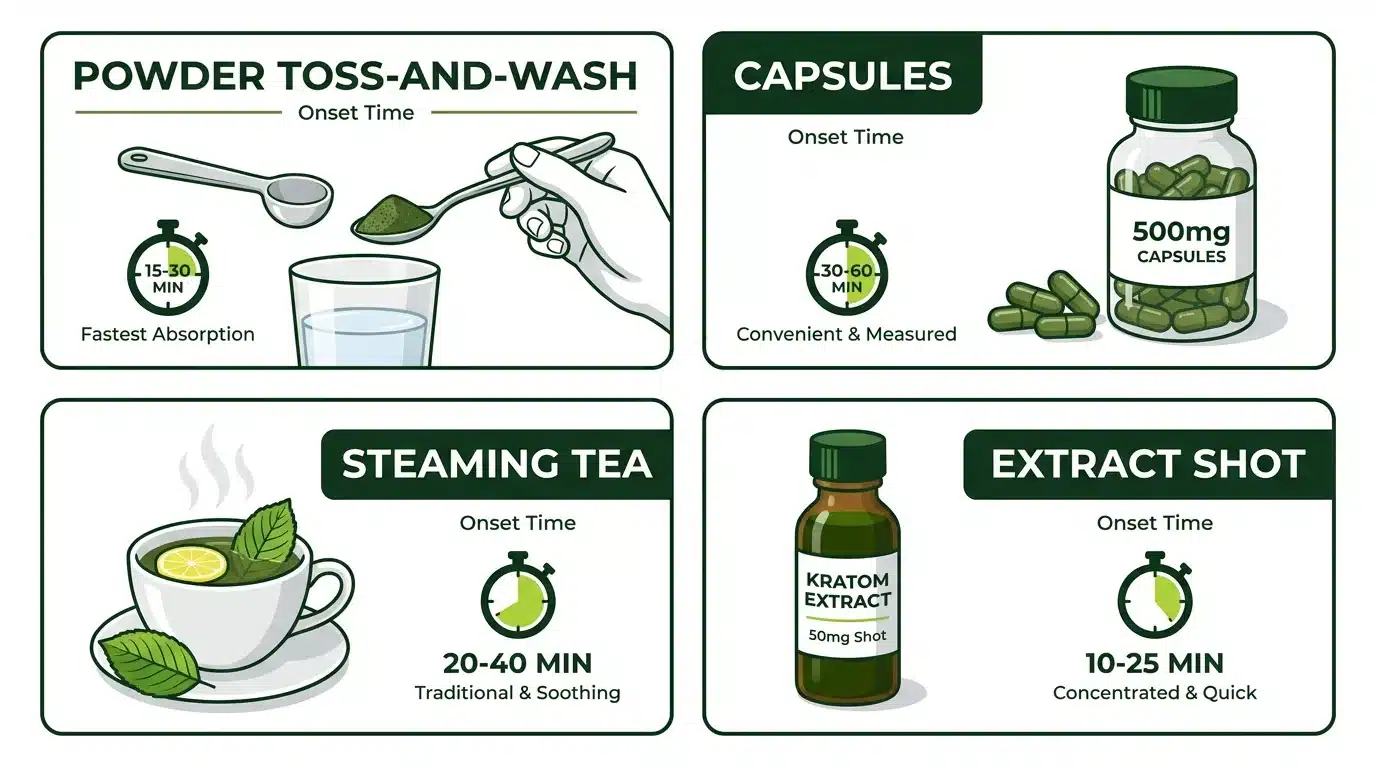
Understanding the difference between kratom forms is the most practical first step, because the form determines onset speed, potency control, and how easy it is to adjust your dose.
| Form | Onset | Dose Control | Best For | Drawbacks |
|---|---|---|---|---|
| Powder | 15–30 min | Excellent (scale to 0.1g) | Precision dosing, experienced users, maximum versatility | Bitter taste; requires a scale |
| Capsules | 30–60 min | Good (pre-measured per capsule) | Convenience, tasteless, consistency, travel | Slower onset; more capsules needed at higher doses |
| Tea | 20–40 min | Variable (extraction efficiency varies) | Gentle onset, ritual, lower nausea risk | Preparation time; alkaloid yield depends on method |
| Extracts | 15–25 min | Difficult (high potency, small margin) | Experienced users; specific high-potency needs | Rapid tolerance development; overdose risk higher |
| Shots | 10–25 min | Fixed per bottle | Convenience, fast onset, on-the-go use | Higher cost per dose; like extracts, faster tolerance |
For first-time users, capsules or powder at a low, measured dose are the recommended starting points — both allow precise dose control, which is the single most important factor in having a predictable first experience.
How Do You Use Kratom Powder?
Kratom powder is dried, ground kratom leaf — typically a fine, slightly fibrous green-to-brown powder. It’s the most versatile form and the one that allows the most precise dose control when used with a kitchen scale accurate to 0.1g.
Toss and wash — the most common method: measure your dose into a spoon or cup, place it on the tongue or in the back of the throat, and wash it down immediately with water or juice. The goal is not to taste the powder — chase it immediately with liquid. Kratom is bitter and earthy; toss-and-wash minimizes contact time with the taste buds.
Mix in liquid — measure the powder into 4–8 oz of liquid (orange juice, lemonade, or flavored beverage works well), stir vigorously, and drink quickly before it settles. Acidic liquids help suspension and may marginally improve alkaloid solubility. Avoid mixing in protein shakes or milk — fat content slows absorption and changes the onset timing.
Oblate discs — a thin, tasteless starch film (available online) can be loaded with 2–3g of powder, folded, and swallowed like a capsule. This is a popular solution among experienced users who want powder-speed onset without the taste, without the delay of gelatin capsules.
Equipment needed:
- Digital kitchen scale accurate to 0.1g — do not estimate by teaspoon. A level teaspoon of kratom powder is roughly 2–2.5g, but density varies by grind and product. Precision matters when the therapeutic dose range is 2–5g.
- Something to chase it with — citrus juice is popular for masking the flavor.
How Do Kratom Capsules Work?
Kratom capsules are pre-filled gelatin or vegetable cellulose capsules containing measured kratom powder — typically 0.5g per capsule, though 0.7g and 1g capsules are also available depending on the vendor.
The primary practical consideration with capsules is the delayed onset. The capsule shell (gelatin or HPMC) must dissolve in the stomach before the kratom powder inside can be absorbed. This adds 15–30 minutes to onset compared to loose powder, meaning the full onset window is 30–60 minutes rather than 15–30 minutes for powder. Tanna et al. (2022) documented this formulation-dependent variation in Tmax (time to peak plasma concentration) in clinical pharmacokinetics studies of commercial kratom products — form matters for PK timing.[1]
The slower onset of capsules is the source of the most common capsule mistake: re-dosing too early because “nothing is happening.” The capsule is still dissolving. At 45 minutes, if nothing is felt, the capsules are likely in the rising phase — wait the full hour before concluding the dose was inadequate.
Capsule dose calculation: if capsules are 0.5g each, a 3g target dose = 6 capsules. Keep count — it’s easy to lose track when taking multiple capsules. Starting dose for new users: 3–4 capsules (1.5–2g). See our kratom capsules collection for pre-measured options.
How Do You Make Kratom Tea?
Kratom tea is made by steeping kratom powder or crushed leaf in hot water and then straining out the plant material. It’s the traditional preparation method — kratom has been consumed as a tea in Southeast Asia for centuries — and remains popular because many users find it gentler on the stomach than toss-and-wash at the same dose.
Basic method:
- Measure your dose (same gram weight as you’d use for powder).
- Add to a pot with 2–3 cups of water and bring to a low simmer — not a hard boil. High heat for prolonged periods can degrade alkaloids.
- Add lemon juice or citric acid (1–2 tablespoons per cup). Acidic pH improves alkaloid extraction efficiency by enhancing mitragynine solubility.
- Simmer for 15–20 minutes, stirring occasionally.
- Strain through cheesecloth or a fine mesh strainer. Discard (or re-brew) the plant material.
- Drink while warm. Sweeten with honey if desired.
The alkaloid yield from tea varies based on brew temperature, time, and acidity — typically capturing 70–85% of the available mitragynine compared to consuming the full powder. Onset with tea is 20–40 minutes, consistent with absorption rate data for aqueous kratom preparations.[1] The experience is often described as smoother and more gradual than toss-and-wash. For detailed brewing guides including cold-brew methods, see our Kratom Tea Guide.
Crushed leaf vs powder for tea: Crushed leaf (coarse-ground kratom) produces a cleaner tea with less sediment than fine powder and is easier to strain. The alkaloid yield may be slightly lower due to less surface area — compensate by simmering slightly longer. See our crushed leaf kratom options.
How Are Kratom Extracts and Shots Different?
Kratom extracts are products where the alkaloids have been concentrated — either by reducing a large volume of kratom tea to a concentrated liquid or solid, or by isolating specific alkaloids through solvent extraction. The result is a product where a small volume (a gram of extract powder, or 1–2 oz of a liquid shot) contains the alkaloid equivalent of several grams of plain leaf.
Practical implications of extracts:
- Higher potency per gram — a 10x extract contains approximately 10 times the alkaloid concentration of standard leaf. The same volume produces dramatically stronger effects.
- Faster tolerance development — the higher alkaloid concentration per dose accelerates receptor downregulation. Smith et al. (2022) documented that higher effective doses are associated with faster-developing tolerance and more pronounced dependence patterns.[2]
- Narrower therapeutic window — the small volume makes precise dosing more difficult. The margin between “right amount” and “too much” is smaller than with plain leaf.
- Not recommended for new users — start with plain leaf until you have a baseline understanding of how your body responds before introducing concentrated products.
Kratom shots (such as MIT45, Club 13, or similar) are liquid extract products sold in 1–2 oz bottles. They have the fastest onset of any commercial format (10–25 minutes) due to pre-dissolved alkaloids, but carry the same tolerance trade-offs as other extracts. See our kratom shots collection.
What Is the Right Starting Dose?
Start lower than you think you need to. This is the most important single piece of practical advice for new users, and it runs counter to the instinct to “take enough to feel it.” The dose-response relationship is steep, and what feels like “nothing” at 1.5g on an empty stomach may feel overwhelming at 4g — especially on the first session when there is no baseline tolerance at all. Prozialeck et al. (2012) documented this steep biphasic dose-response — the transition from stimulant to sedative effects happens over a narrow dose range.[5]
Grundmann (2017) surveyed 8,049 regular US kratom users and found significant variation in self-reported “effective” doses — with less experienced users consistently reporting lower threshold doses than experienced daily users who had developed tolerance.[3] This confirms the clinical logic: what a daily user considers a moderate dose may be excessive for a new user with no tolerance.
Recommended starting protocol:
- Session 1: 1.5–2g (3–4 capsules at 0.5g each, or measured powder). Wait 45–60 full minutes before assessing. If mild effects are felt, you have your threshold — this is useful information.
- Session 2 (next day or later): If session 1 produced nothing, try 2.5–3g. If session 1 produced mild effects, stay at 2g or move to 2.5g.
- Do not exceed 4g in the first week — even if early sessions feel unremarkable. Your tolerance baseline is being established.
- Strain recommendation for beginners: Green vein. It produces a balanced, moderate effects profile that is less likely to be uncomfortably stimulating (white vein) or unexpectedly sedating (red vein at higher doses).
The minimum effective dose principle matters beyond the first session. Lower doses used consistently build tolerance more slowly and preserve the effectiveness of the dose over time. Users who escalate quickly to 6–8g find that this level stops working and they have lost the 2–4g range that previously worked well. For full dosage science, see our Kratom Dosage Guide.
When and How Often Should You Take Kratom?
Timing affects both the quality of the experience and the long-term trajectory of tolerance development.
Food and stomach contents:
- Empty stomach (2+ hours since last meal): fastest onset, highest peak effect intensity, higher nausea risk above 4g
- Light snack beforehand: slightly slowed onset, reduced nausea risk — the best balance for most users
- Full meal within 1 hour: significantly slower absorption, lower peak concentration, effects may feel flat
Frequency — the most important long-term decision:
Daily kratom use is the primary driver of tolerance and dependence.[3] Swogger et al. (2015) documented that users who reported the most positive and sustainable experiences consistently reported less frequent use than those who reported tolerance and dependence problems.[4] The general guidance from experienced users and harm-reduction frameworks:
- Occasional use (1–3 times per week): very low tolerance risk; effects remain consistent over time
- Frequent use (4–6 times per week): moderate tolerance risk; rotation and dose management required
- Daily use: significant tolerance and dependence risk; most users who use daily long-term require periodic breaks to maintain effectiveness
Time of day:
- White and green vein: best in the morning or early afternoon — the stimulant component can interfere with sleep if taken in the evening
- Red vein: afternoon or evening — the sedating profile is appropriate for wind-down, not productivity
- Do not take kratom within 4–5 hours of intended sleep time (any strain at doses above 3g)
What Are the Most Common Mistakes?
After a decade in this industry, these are the patterns I see most consistently lead to bad experiences:
- Re-dosing during the rising phase. The most common cause of accidental overdose. Kratom powder onset is 15–30 minutes, capsules 30–60 minutes. If you feel nothing at 30 minutes, you are likely in the rising phase — not the plateau. Taking a second dose before the first peaks is how people end up at double their intended dose.
- Using a teaspoon instead of a scale. Volumetric measuring is inaccurate for kratom — powder density varies by grind and product. A digital scale accurate to 0.1g is not optional for safe, consistent use. It costs $10 and eliminates the most common cause of unintended high doses.
- Starting with extracts. Concentrates have a much steeper dose-response curve. A new user who takes an extract shot thinking it’s like regular powder may take 3–5x their intended effective dose.
- Escalating dose to compensate for tolerance. Tolerance from daily use reduces effects — but increasing dose only drives more tolerance, not better effects. The correct response to tolerance is a break or dose reduction, not escalation.
- Taking on a full stomach and concluding “kratom doesn’t work for me.” A large meal can reduce peak plasma concentration by 40–60%. Many new users who conclude kratom has no effect on them have been taking it 30–60 minutes after eating. Try again on an empty or light stomach before drawing conclusions.
- Ignoring hydration. Kratom is mildly dehydrating. Not drinking adequate water amplifies side effects — particularly headache, constipation, and brain fog — that most users attribute to kratom itself. Drink an extra 16–24 oz of water when using kratom.
- Combining with other substances. Kratom inhibits CYP liver enzymes (CYP3A4, CYP2D6) that metabolize many prescription medications, over-the-counter drugs, and other supplements.[5] Check for interactions with everything you take, especially CNS depressants, opioids, benzodiazepines, and anticoagulants. See our Kratom Side Effects Guide for the drug interaction section.
Frequently Asked Questions
How should I store kratom powder?
Kratom’s alkaloids degrade through exposure to UV light, heat, oxygen, and moisture. Store in an airtight container (glass jar or sealed Mylar bag) in a cool, dark location — a cabinet or drawer away from the stove, not a windowsill. Properly stored kratom powder retains most of its potency for 1–3 years. For the full storage guide including freezing and bulk storage, see our Kratom Storage Guide.
Can I mix kratom powder into food?
Yes, though it affects onset timing. Mixing kratom into a smoothie, yogurt, or applesauce is a common method for users who find the taste unpleasant. The fat and protein content of the food will slow absorption — expect a longer, gentler onset rather than the faster curve of toss-and-wash on an empty stomach. Avoid heating kratom above 100°C (212°F) for extended periods — sustained high heat can degrade alkaloids.
How do I know if my kratom is working?
Early signs of onset for most users: mild warmth, slight mood lift, increased talkativeness or mental clarity, and a general sense of well-being or lightness. These begin 15–45 minutes after ingestion depending on form and stomach contents. If you feel nothing by 60–75 minutes (for capsules) or 45 minutes (for powder on an empty stomach), the dose may have been insufficient. Wait a full session before adjusting — do not re-dose in the same session.
Can you mix kratom strains?
Yes — blending green and red vein, or white and green vein, is common. The result is a profile that sits between the two. Blending is also used for strain rotation: using different alkaloid ratios across sessions to reduce the receptor-level habituation that drives tolerance. There’s no safety issue with blending different kratom strains from the same vendor, and it’s a practical approach to maintaining variety without adding new products constantly.
What do I do if I took too much?
Common signs of too much kratom: nausea, dizziness, spinning sensation, sweating, and cognitive impairment. If these occur: lie down, drink water, avoid any additional substances. Nausea typically peaks around the same time as effects (1.5–2.5 hours) and resolves as effects taper. Do not attempt to “push through” by taking something else. If symptoms are severe or include difficulty breathing, seek medical attention — particularly if other substances were also taken.
Can I use kratom every day?
It is pharmacologically possible, but daily use is the primary driver of tolerance and physical dependence with kratom. The mu-opioid receptor mechanism means daily receptor stimulation leads to downregulation — reducing effectiveness and eventually creating inter-dose discomfort when the compound is withheld. If daily use is your pattern, plan for regular tolerance breaks and monitor for dependence signs. Most harm-reduction frameworks suggest limiting kratom use to no more than 4–5 days per week, with at least 2 consecutive off days per week.
Is there a way to reduce kratom’s bitter taste?
Yes — citrus juice (orange juice, lemonade) is the most effective mixer because the acid both partially masks the bitterness and improves alkaloid extraction efficiency. Chase toss-and-wash immediately with cold citrus juice. Capsules completely bypass taste. Oblate discs (thin starch film) can be used to wrap powder for taste-free swallowing. Kratom tea with honey and lemon is another widely used approach — the hot brewing process modifies some of the bitter compounds.
References
- Tanna RS, Nguyen JT, Hadi DL et al. (2022). Clinical pharmacokinetic assessment of kratom (Mitragyna speciosa), a botanical product with opioid-like effects, in healthy adult participants. Clinical Pharmacology & Therapeutics. [PubMed]
- Smith KE, Feldman AZ, Rogers JM et al. (2022). Searching for a signal: self-reported kratom dose-effect relationships among a sample of US adults with regular kratom use histories. Drug and Alcohol Dependence. [PubMed]
- Grundmann O. (2017). Patterns of kratom use and health impact in the US — results from an online survey. Drug and Alcohol Dependence. [PubMed]
- Swogger MT, Hart E, Erowid F et al. (2015). Experiences of kratom users: a qualitative analysis. Journal of Psychoactive Drugs. [PubMed]
- Prozialeck WC, Jivan JK, Andurkar SV. (2012). Pharmacology of kratom: an emerging botanical agent with stimulant, analgesic and opioid-like effects. Journal of the American Osteopathic Association. [PubMed]
Disclaimer: This article is for educational purposes only and is not medical advice. Kratom is not FDA-approved to diagnose, treat, cure, or prevent any condition. Individual experiences vary. Consult a qualified healthcare provider before use, particularly if you take prescription medications or have health conditions.

Shop Lab-Tested Kratom
Browse our full selection of AKA GMP-qualified kratom — powder, capsules, extracts, and more. Free shipping on orders $99+.
Shop All Kratom