


Kratom and coffee are botanical relatives — both belong to the Rubiaceae plant family. They share an evolutionary lineage but differ fundamentally in their alkaloid chemistry and pharmacological mechanisms. This guide explains the science behind both plants, how their effects compare, what actually happens when you use them together, and how to time them intelligently if you choose to combine them.
What Is the Botanical Relationship Between Kratom and Coffee?
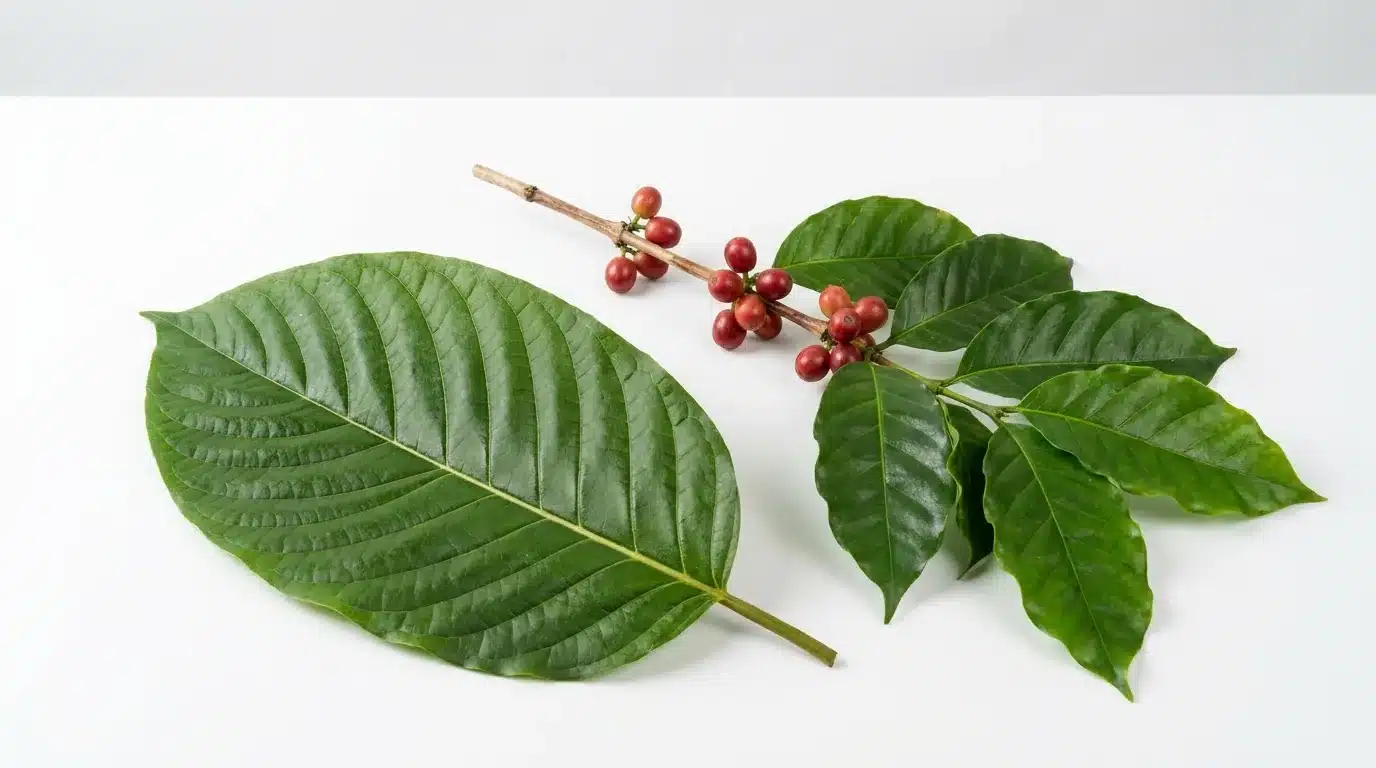
Both kratom (Mitragyna speciosa Korth.) and coffee (Coffea arabica L.) belong to the family Rubiaceae — one of the largest flowering plant families, with over 13,000 species. This makes them evolutionary cousins at the family level, though they diverged into different genera long ago. Brown et al. (2017) noted that the genus Mitragyna is one of several psychoactive genera within Rubiaceae, alongside Coffea and Uncaria (cat’s claw).[3]
The shared family classification explains some superficial similarities: both plants grow natively in tropical and subtropical regions, both produce large, glossy-veined leaves, and both concentrate their biologically active compounds in their leaf tissue. But their alkaloid chemistry diverges sharply at the genus level. Coffee’s primary active compound is caffeine, a methylxanthine. Kratom’s primary compound is mitragynine, a terpene indole alkaloid — a fundamentally different chemical class with a fundamentally different pharmacological mechanism.
In ten years of sourcing kratom directly from farmers in Indonesia and Borneo, I’ve heard the Rubiaceae connection come up more than almost any other botanical fact — customers who drink coffee daily are often surprised to learn they’re already enthusiasts of the kratom family. The connection is real, but it can be misleading: being in the same plant family doesn’t mean the compounds work the same way. Aspirin and digitalis both come from plants; that doesn’t make them interchangeable.
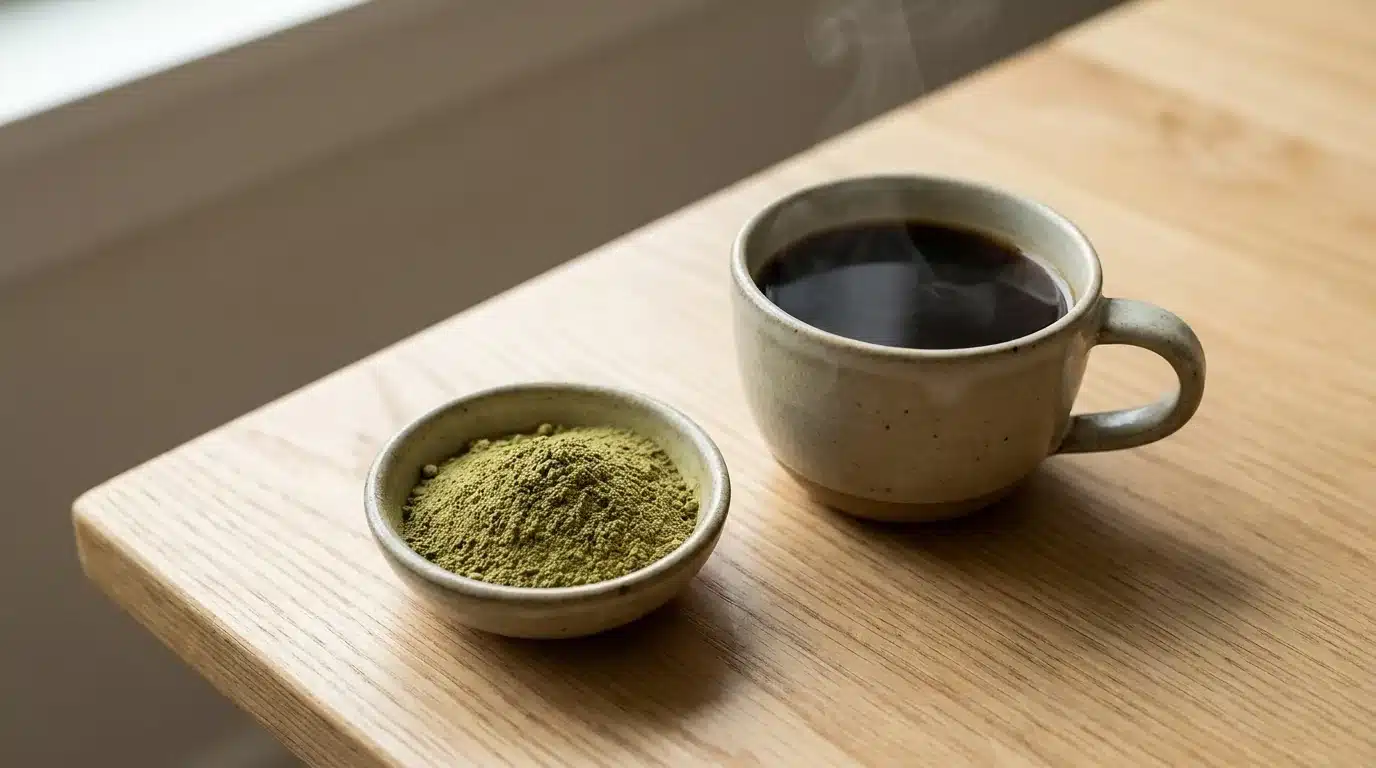
How Do Kratom and Coffee Work Differently?
Caffeine’s mechanism is well characterized: it is a non-selective competitive antagonist at adenosine A1 and A2A receptors. Adenosine is a neuromodulator that accumulates in the brain during waking hours and promotes sleepiness; when caffeine blocks its receptors, the result is reduced perceived fatigue, increased alertness, and heightened dopaminergic activity in reward circuits. Caffeine does not bind opioid receptors, adrenergic receptors, or serotonin receptors at pharmacologically relevant concentrations.
Mitragynine’s mechanism is more complex and dose-dependent. Kruegel & Grundmann (2018) characterized it as a partial agonist at mu-opioid receptors and an antagonist at kappa and delta receptors, with additional activity at adrenergic (alpha-2) and serotonergic (5-HT2A, 5-HT7) receptors.[8] At low doses, the adrenergic activity dominates — producing stimulant-like effects including increased energy, heightened focus, and mild euphoria. At higher doses, the opioid receptor activity becomes more prominent, producing sedation and analgesia.
The practical implication: caffeine and mitragynine do not compete for the same receptor targets. Their stimulant-like effects at low doses arrive via independent pathways, which means combining them produces additive stimulation rather than synergistic amplification at the receptor level. The total stimulant load increases, but neither compound alters the other’s pharmacology in a direct mechanistic sense.
How Do the Alkaloids in Coffee and Kratom Compare?
The table below compares the primary active compounds of each plant across the dimensions most relevant to users:
| Property | Caffeine (Coffee) | Mitragynine (Kratom) |
|---|---|---|
| Chemical class | Methylxanthine | Terpene indole alkaloid |
| Primary receptor targets | Adenosine A1, A2A (antagonist) | Mu-opioid (partial agonist), alpha-2 adrenergic, 5-HT2A |
| Onset (oral) | 15–45 minutes | 30–60 minutes |
| Peak plasma (oral) | ~1 hour | ~1.5 hours |
| Plasma half-life | 3–5 hours | ~9 hours |
| Dose-dependent effect shift | No — stimulant at all doses, anxiety at high doses | Yes — stimulant at low doses, sedating at high doses |
| Tolerance development | Common with daily use | Common with daily use |
| Legal status (US) | Unscheduled, GRAS | Legal federally, varies by state |
The half-life difference is practically significant. Caffeine clears the body in 3–5 hours; mitragynine has a plasma half-life of approximately 9 hours in human studies.[5] A 2022 clinical pharmacokinetic study by Tanna et al. confirmed that mitragynine reaches peak plasma concentration (Tmax) at approximately 1.5 hours post-ingestion and declines slowly across the rest of the day.[6] This means a morning kratom dose continues to have pharmacological presence well into the afternoon, long after the coffee from the same morning has fully cleared.
How Has Kratom Traditionally Been Combined with Caffeine?
The combination of kratom with caffeine is not a modern internet trend — it has roots in traditional Southeast Asian use patterns. In Thailand, where kratom has been chewed or brewed by agricultural workers for centuries, the plant was commonly consumed alongside other stimulants to sustain physical labor through long workdays in the heat.[2]
More directly relevant is the documented existence of a Thai beverage called the “4×100” cocktail — a drink combining kratom leaf tea with caffeine-containing soft drinks or energy beverages. Wahbeh et al. (2012) quantitatively analyzed a kratom cocktail sample and found measurable concentrations of both mitragynine and caffeine, along with codeine, chlorpheniramine, and phenylephrine, confirming that multi-substance kratom preparations are used in practice rather than being theoretical combinations.[1]
Singh et al. (2017) documented that in Malaysia and Thailand, kratom users frequently combined the plant with other substances to modify or intensify its effects, with caffeine-containing beverages being among the most common co-consumed items.[2] Traditional use in Southeast Asia supports the general safety of the kratom-caffeine combination at typical doses, though the cocktail preparations sometimes included additional pharmaceuticals that are not part of standard kratom use in the US market.
How Does Kratom’s Dose-Dependent Effect Change the Comparison?
One of the most important — and most misunderstood — aspects of kratom pharmacology is its biphasic dose response. Unlike caffeine, which produces stimulant effects at virtually all doses (with anxiety and cardiovascular effects at high doses), kratom shifts from stimulant to sedating as dose increases.
| Dose Range | Coffee / Caffeine Effects | Kratom Effects | When Combined |
|---|---|---|---|
| Low coffee + low kratom 1 cup / 1–3g kratom |
Mild alertness, reduced fatigue | Energy, focus, mild mood lift | Additive alertness; generally well-tolerated |
| Moderate coffee + moderate kratom 2–3 cups / 3–5g kratom |
Strong alertness, mild anxiety possible | Stimulant-sedative transition zone | Increased risk of nausea, anxiety, elevated heart rate |
| High coffee + high kratom 4+ cups / 5g+ kratom |
Anxiety, jitteriness, elevated BP/HR | Sedation, nausea, dizziness likely | Unpredictable interaction; avoid |
Smith et al. (2022) conducted a survey-based dose-effect analysis among regular US kratom users and found that at doses below 5 grams, stimulant-type effects (energy, focus, sociability) were the most commonly reported outcomes, while sedative and analgesic effects became more prominent at doses above 5 grams.[7] Grundmann (2017) similarly found that the majority of US kratom users consumed it for energy and focus at low to moderate doses.[4]
This matters for the coffee combination: if you are taking a low kratom dose for stimulant effects, adding coffee is doubling down on the same general goal — and the dose math of both substances matters. If kratom dose pushes into sedating territory while coffee is still providing stimulation, the result is a mixed, potentially uncomfortable experience rather than a clean compound effect.
What Happens When You Combine Kratom and Coffee?
Because caffeine and mitragynine work on independent receptor systems, combining them does not produce a direct pharmacological interaction at the receptor level — neither compound fundamentally alters the other’s binding kinetics. What happens instead is that the total stimulant burden increases, and the physiological effects of that increased burden compound.
The most commonly reported effects of combining kratom and coffee among regular users include:
- Enhanced alertness and focus — particularly pronounced when both are taken at low doses in the morning
- Increased heart rate — caffeine raises heart rate via adenosine blockade and indirect adrenergic effects; kratom’s adrenergic activity may add to this at low doses
- Nausea — more common when either compound is taken on an empty stomach; risk increases when both are present simultaneously
- Reduced appetite — both compounds suppress appetite through different mechanisms; the combined effect can be significant
- Anxiety or jitteriness — occurs at moderate-to-high doses of either compound and increases when combined, particularly in caffeine-sensitive individuals
In my experience with customers over a decade of retail operations, the kratom-coffee combination works best for people who already have low-to-moderate caffeine tolerance, who keep kratom doses in the 1–3 gram range, and who consume both with food. The combination becomes problematic most often when people try it after already having multiple cups of coffee, or when they use higher kratom doses thinking they need more to “feel it” on top of the caffeine stimulation.
How Should You Time Kratom and Coffee Together?
Given the different onset and half-life profiles of caffeine and mitragynine, timing significantly affects the subjective experience of combining them. The table below outlines practical timing strategies:
| Timing Approach | Method | Expected Experience | Best For |
|---|---|---|---|
| Simultaneous | Coffee and kratom at the same time | Coffee peaks first (~1hr), kratom catches up (~1.5hr) — slight stagger effect | Morning productivity window |
| Coffee first, kratom 30 min later | Coffee onset before kratom dose | Near-simultaneous peak of both compounds | Maximum alert window, manage carefully |
| Kratom first, coffee 1–2 hrs later | Kratom peaks, then coffee extends the window | Extended productivity, lower peak intensity | Extended work sessions |
| Alternating — not same day | Kratom on coffee-free days | Cleaner assessment of each compound | Beginners, tolerance management |
The key pharmacokinetic consideration: mitragynine’s ~9-hour half-life means an 8:00 AM kratom dose still has roughly half its peak plasma concentration at 5:00 PM.[5][6] Adding an afternoon coffee on top of active morning kratom is not a clean, isolated caffeine dose — it is caffeine on top of a still-active kratom burden. This matters especially for sleep: both compounds at high doses can disrupt sleep architecture, and the long kratom half-life means evening sleep quality can be affected by a mid-morning dose.
What Should You Consider Before Combining Kratom and Coffee?
If you’re considering combining kratom and coffee, several practical factors should inform your approach:
Caffeine sensitivity. People vary dramatically in how they metabolize caffeine based on CYP1A2 enzyme variation. Slow caffeine metabolizers are likely to experience more pronounced side effects (anxiety, elevated heart rate, sleep disruption) from any caffeine combination, including with kratom. If coffee alone at typical doses makes you anxious, adding kratom’s adrenergic activity at even a low dose will likely compound that response.
Empty stomach vs. with food. Both coffee and kratom taken on an empty stomach increase nausea risk. Either taken alone on an empty stomach can cause gastric irritation; taken together, the risk is amplified. A light meal before combining both significantly improves tolerability without meaningfully affecting the pharmacokinetics of either compound.
Cardiovascular considerations. Both caffeine (via adenosine blockade) and low-dose kratom (via adrenergic activity) can mildly elevate heart rate and blood pressure. For healthy individuals using normal doses, this is generally within a safe range. For individuals with pre-existing cardiovascular conditions or elevated baseline blood pressure, this combination warrants caution and medical consultation.
Hydration. Both coffee (mild diuretic via adenosine antagonism in kidneys) and kratom (potential for nausea-induced fluid reduction) can contribute to dehydration. Drinking a glass of water before taking either compound is a sensible baseline habit. Our COAs confirm the alkaloid content of each batch we source — but no lab test accounts for individual hydration status, so this remains a personal responsibility.
Tolerance cross-effects. Caffeine and mitragynine do not share receptor systems, so tolerance to one does not directly transfer to the other. However, both compounds produce tolerance through daily use at the neuroadaptation level, and both benefit from periodic breaks. For strategic recommendations on managing kratom tolerance specifically, see our guide on kratom tolerance.
Frequently Asked Questions
Are kratom and coffee from the same plant?
No — they are from the same plant family (Rubiaceae), but they are entirely different species. Coffee comes from the genus Coffea, primarily Coffea arabica. Kratom comes from Mitragyna speciosa, a large tropical tree native to Southeast Asia. They share an evolutionary lineage but diverged millions of years ago and produce alkaloids from completely different chemical classes. Being in the same family is roughly analogous to roses and apples being in the Rosaceae family — related, but very different plants.
Does kratom contain caffeine?
No. Kratom does not naturally contain caffeine. Caffeine is a methylxanthine produced by the genus Coffea, Camellia (tea), and a few other plants. Kratom’s active compounds are terpene indole alkaloids — primarily mitragynine and 7-hydroxymitragynine. The only scenario where kratom and caffeine appear together is when kratom is combined with caffeinated beverages, as documented in Southeast Asian “4×100” cocktail preparations. Any lab-tested kratom product with no additives will test negative for caffeine.
Can I make kratom coffee — brew them together?
Yes, and this is how some users prefer to take kratom — brewed as a tea mixed with or alongside coffee. Kratom brews well in hot (not boiling) water, especially with a small amount of acid like lemon juice, which improves mitragynine extraction. Adding coffee to kratom tea simply combines two beverages; it does not change the alkaloid chemistry of either. The main consideration is that brewing them together makes it harder to control dose independently. It is generally easier to brew kratom tea separately and combine it with brewed coffee to taste, so you can adjust each component independently.
Does coffee affect how kratom is absorbed?
There is no published clinical evidence that caffeine directly alters mitragynine absorption or bioavailability. However, coffee’s effect on gastric pH and gastric motility could theoretically modulate the rate of kratom absorption slightly. Tanna et al. (2022) found that food consumption slows kratom absorption and reduces peak plasma concentration (Cmax) while extending Tmax — a coffee-and-kratom combination taken with food would likely show this effect.[6] Both compounds are metabolized primarily via CYP3A4 and CYP2D6 hepatic enzymes; there is no evidence of meaningful competitive inhibition between caffeine and mitragynine at typical doses.
Is kratom more like coffee or more like opioids?
At low doses, kratom’s subjective effects resemble coffee more than opioids — users report energy, focus, and mood improvement that overlaps functionally with caffeine’s alertness profile. At high doses, kratom’s opioid receptor activity dominates and produces sedation and analgesia more characteristic of opioids. The mechanistic distinction matters: kratom is a partial mu-opioid agonist with atypical pharmacology, while caffeine has no opioid activity. Describing kratom as “like coffee” is accurate for low-dose effects but misleading as a complete characterization of the compound’s pharmacology.[8]
Will combining kratom and coffee cause anxiety?
It depends primarily on caffeine sensitivity and dose. Both caffeine (at moderate-high doses) and low-dose kratom (via adrenergic mechanisms) can elevate heart rate and contribute to anxiety symptoms. In caffeine-sensitive individuals, combining even small amounts of each may produce jitteriness or racing thoughts. For people with low caffeine sensitivity who keep both doses conservative, anxiety is less common. The practical recommendation: if coffee alone reliably makes you anxious or jittery, adding kratom will likely worsen that response, not neutralize it.
Can I use kratom as a coffee replacement?
Some users do substitute low-dose kratom for their morning coffee — particularly people who want stimulant-like effects without caffeine’s jitteriness or sleep disruption. Low-dose kratom (1–3 grams) commonly produces energy and focus that functionally overlaps with a cup of coffee. However, kratom’s significantly longer half-life (~9 hours vs. ~5 hours for caffeine) means the timing implications are different — a morning kratom dose has a longer tail into the evening, which may matter for sleep. Kratom is also not GRAS and carries different regulatory considerations than coffee. It is a substitute some find useful, not a direct equivalent.
Does kratom interact with caffeine in dangerous ways?
At typical consumer doses, there is no documented evidence of a dangerous pharmacological interaction between kratom and caffeine. They work on independent receptor systems and are not known to inhibit each other’s metabolism at normal doses. The primary risk from combining them is additive stimulant load — elevated heart rate, increased anxiety, nausea — particularly at high doses of either or both. Individuals with cardiovascular conditions, sensitivity to stimulants, or who are taking other adrenergic or cardiac medications should consult a healthcare provider before combining them.
Which kratom strains work best with coffee?
White vein and green vein strains are the most commonly reported kratom types used alongside coffee, as their alkaloid profiles skew toward stimulant rather than sedative effects at low doses. Red vein strains, which tend toward relaxation and sedation, are less frequently paired with coffee — the stimulant from coffee combined with the sedative character of a red strain can produce a muddled, uncomfortable experience rather than a productive one. For a full breakdown of strain differences, see our kratom strains guide.
How much kratom is safe to take with coffee?
There is no published clinical data establishing a specific safe dose ceiling for the kratom-coffee combination. The practical guidance from experienced users and available pharmacology literature: keep kratom in the 1–3 gram range when combining with coffee, limit coffee to 1–2 cups (100–200 mg caffeine), take both with food, and stay well-hydrated. These are conservative guidelines designed to keep the total stimulant burden within a manageable range for most adults. Individual sensitivity varies significantly — start lower than you think you need and assess response before increasing either compound.
Is kratom tea with coffee the same as a kratom coffee?
They are effectively the same concept: combining brewed kratom with coffee in some form. “Kratom coffee” sometimes refers to kratom powder mixed directly into brewed coffee (creating a suspension similar to toss-and-wash in liquid form), while “kratom tea with coffee” typically means brewing kratom separately as a proper tea and combining the two drinks. The alkaloid content and pharmacology are identical either way — the difference is preparation method and texture. Brewing kratom as a proper acid-extracted tea first generally improves palatability and may improve extraction efficiency compared to simply mixing powder into cold coffee.
References
- Wahbeh A et al. (2012). Quantitative Analysis of Mitragynine, Codeine, Caffeine, Chlorpheniramine and Phenylephrine in a Kratom (M. speciosa) Cocktail. Journal of Analytical Toxicology.
- Singh D, Narayanan S, Vicknasingam B. (2017). Changing trends in the use of kratom (Mitragyna speciosa) in Southeast Asia. Human Psychopharmacology. [PubMed]
- Brown PN, Lund JA, Murch SJ. (2017). A botanical, phytochemical and ethnomedicinal review of the genus Mitragyna korth: Implications for products sold as kratom. Journal of Ethnopharmacology. [PubMed]
- Grundmann O. (2017). Patterns of kratom use and health impact in the US — results from an online survey. Drug and Alcohol Dependence. [PubMed]
- Trakulsrichai S et al. (2015). Pharmacokinetics of mitragynine in man. Drug Design, Development and Therapy. [PubMed]
- Tanna RS, Nguyen JT, Hadi DL et al. (2022). Clinical pharmacokinetic assessment of kratom (Mitragyna speciosa), a botanical product with opioid-like effects, in healthy adult participants. Clinical Pharmacology & Therapeutics. [PubMed]
- Smith KE, Rogers JM, Dunn KE et al. (2022). Searching for a signal: self-reported kratom dose-effect relationships among a sample of US adults with regular kratom use histories. Drug and Alcohol Dependence. [PubMed]
- Kruegel AC, Grundmann O. (2018). The medicinal chemistry and neuropharmacology of kratom: a preliminary discussion of a promising medicinal plant and analysis of its potential for abuse. Neuropharmacology. [PubMed]
Disclaimer: This article is for educational purposes only and is not wellness advice. Kratom is not FDA-approved to diagnose, manage, resolve, or prevent any condition. Consult a qualified healthcare provider before starting, changing, or stopping any supplement regimen.
Prefer the loose-leaf route? Explore our kratom powder selection.

Shop Lab-Tested Kratom
Browse our full selection of AKA GMP-qualified kratom — powder, capsules, extracts, and more. Free shipping on orders $99+.
Shop All Kratom